NR-452 Week 6 usually turns the capstone toward the door: the catalog promises an eased transition into professional nursing, and the written work at this stage tends to be a concrete plan for it, covering licensure examination preparation, the first-job search, and the strategies that carry a new graduate through the hardest first year. The scoring difference is specificity: a plan with dates, methods and named supports outscores an essay about excitement and nerves. Your section may print this as NR 452 or NR452; it is the same course. Chamberlain publishes no syllabi outside Canvas. The placement here is our teaching judgment from the course's catalog arc; your section's rubric decides what your week actually asks.
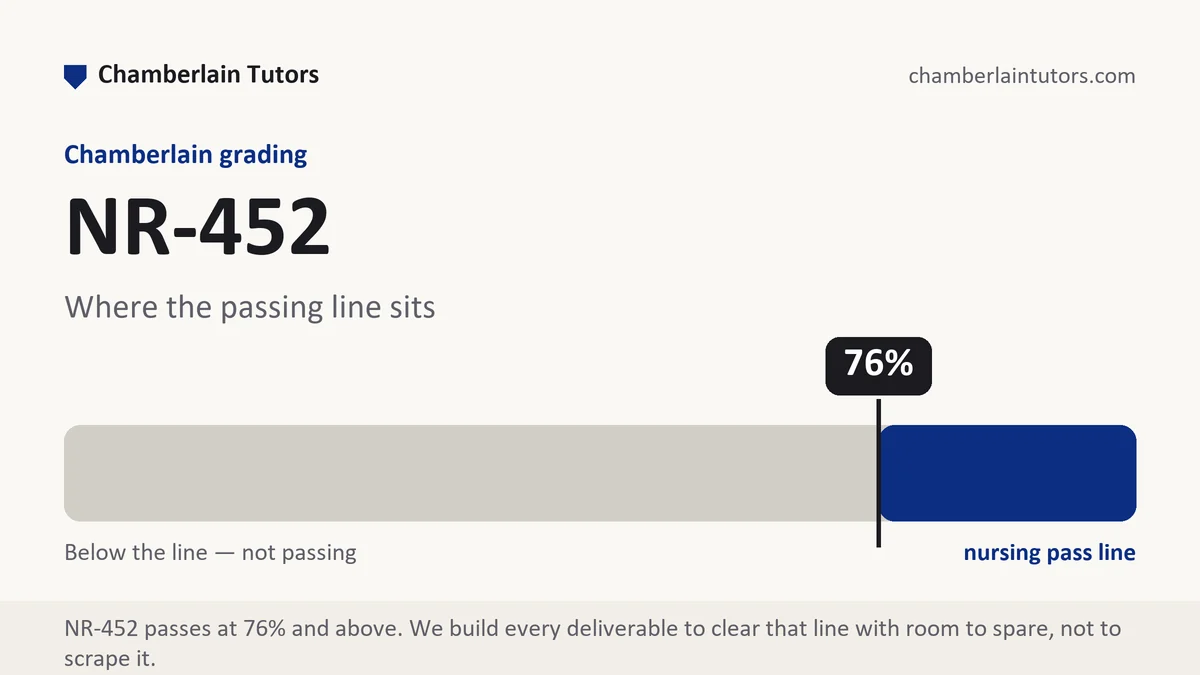
Know what NR-452 Week 6 asks for
There is a version of next spring in which you are four months into a pediatric clinic job, a parent is asking whether amoxicillin will interact with her daughter's reflux medication, and no instructor is standing behind you. Transition planning exists because the distance between student and that moment is real, studied and survivable with preparation. The literature on new-graduate transition describes a predictable arc of early confidence, a difficult middle, and eventual integration, and a written transition plan is your attempt to meet that arc with strategy instead of surprise. That is the spirit in which capstone sections typically assign this piece.
Expect the deliverable to be a structured plan or reflective-planning paper with several required territories: a licensure exam preparation strategy, since passing the national examination is the gate into practice; a job-search approach, often including where you intend to apply and how you will present your clinical experiences; and a self-care or resilience component, because the first year's attrition problem is well documented in nursing literature. Some sections fold in a professional development piece, such as which certifications or organizations you will pursue. Write toward whichever territories your rubric actually names, and resist importing ones it does not.
The register stays pre-licensure and practical. This is a plan you will execute, not a vision statement, so every commitment needs the shape of an executable task. Complete a set number of practice questions weekly using your review program, sit a full-length practice examination by a stated milestone, draft the resume before your practicum hours end so your preceptorship experience is fresh on the page. The practicum itself, its hours and its paperwork remain your own real work throughout; the plan simply schedules the written and preparatory life around it.
Work the Week 6 method, step by step
Six moves that turn anxiety about graduation into a plan a grader can score.
-
Read the rubric for required territories first
Transition plans are scored by coverage as much as quality. List the components your rubric names, exam preparation, employment, resilience, professional growth or others, and build one labeled section per component so nothing is lost to structure.
-
Diagnose your exam readiness before prescribing your plan
Base the preparation section on real signals: practice examination scores, content areas that consistently run weak, and your honest test-taking patterns. A plan that starts from diagnosis reads as judgment; a plan that starts from a generic schedule reads as filler.
-
Build the study plan in verifiable units
Questions per week, review blocks per content area, full-length practice tests at stated milestones, all placed on a calendar that respects your remaining coursework and practicum hours. Each element should be auditable by a stranger reading the plan.
-
Treat the job search as evidence-based too
Name the settings you will target and why, drawing on what your rotations taught you about fit. If pediatric or family-practice environments drew you, say what specifically confirmed it. Cite what the literature says about residency and mentorship programs for new graduates when you explain what you will look for in an employer.
-
Plan for the difficult middle, not just the start
The transition literature describes a predictable dip after the early weeks. Commit to two named supports before you need them: a mentor relationship, a peer cohort, a counseling resource, a scheduled debrief habit. Supports chosen in advance are the ones that get used.
-
Date everything and assign every action to a week
A transition plan without a timeline is a wish list. Anchor each commitment to a week relative to graduation and examination, and let the reader see the sequence: resume drafted, applications out, examination sat, first day survived.
Budget the words for a transition plan
The frame below fits a plan of roughly 900 to 1,200 words with the territories most rubrics name. It is our teaching outline, not a university document; your section's requirements override it wherever they differ.
| Section | What belongs in it | Word target |
|---|---|---|
| Where I stand | A short readiness diagnosis: practice scores, strong and weak content areas, and what the practicum is confirming about fit. | 120 to 150 |
| Examination preparation | The study system in verifiable units, on a dated calendar, with the weak areas given extra weight. | 220 to 270 |
| Employment strategy | Target settings with reasons, application timeline, and what you will seek in orientation and residency support, sourced where you make claims. | 200 to 250 |
| The difficult middle | Two named supports committed in advance, plus the warning signs you will watch for in yourself. | 150 to 190 |
| Professional growth | The organization you will join or the certification path you will start, with a realistic first-year milestone. | 100 to 130 |
| Timeline close | The whole plan compressed into a week-by-week sequence a reader could pin to a wall. | 80 to 110 |
Handle the evidence like a transition planner
Source your claims about transition, not your feelings about it. Statements about new-graduate turnover, the value of residency programs or the shape of the first year belong to published literature, cited with years. Your feelings need no citation; your generalizations always do.
Use your own data honestly. Practice examination results and content-area reports are legitimate evidence in this paper, reported plainly: which areas run strong, which run weak, without inflating or excusing. A plan built on honest numbers is the version graders trust.
Name programs and organizations precisely. If you commit to a professional organization, a certification pathway or a review resource, use its real name once and describe it accurately. Vague references to some certification eventually read as padding.
Keep employer research factual. Claims about what specific employers offer new graduates change and vary; frame them as what you will look for and verify, rather than asserting what any named institution provides. The plan is about your criteria and process, and that framing also keeps it honest.
Avoid the five mistakes that cost points here
- Writing a feelings essay where a plan was assigned. Excitement and nervousness may open the paper; they cannot be its content. Every section needs commitments with dates.
- A study plan with no diagnosis. Three hours a day, unattached to any identified weakness, is a schedule, not a strategy, and rubrics can tell.
- Skipping the resilience component. Sections that require it weight it, and the first-year literature is unambiguous that support planning is not optional sentiment.
- Unverifiable commitments. Stay positive and work hard cannot be audited. Every commitment needs the form of a checkable task on a stated week.
- Ignoring what the practicum is teaching you. Your 48 hours are live evidence about the settings and populations that fit you; a plan that never mentions what they confirmed wastes its best material.
Check these before you submit
- Every territory the rubric names has its own labeled section
- The study plan is built from a stated diagnosis of your weak areas
- All commitments are verifiable tasks anchored to weeks
- Claims about transition and residency programs carry cited sources
- Two supports for the difficult middle are named in advance
- The close compresses the plan into one visible sequence
Planning your transition in NR-452?
Send the prompt and the rubric out of Canvas. A premium original plan comes back in 24 to 48 hours with the territories covered and every commitment dated, and revisions run until the grade lands.