NR-453 is the four credit capstone: two theory credits, two clinical credits, 96 clinical hours. The catalog gives it three jobs. Pull general education and nursing coursework together, engage with trends and issues, and refine practice skills before the move to RN. That third job makes the writing different from anything else in the program, because a refinement claim is a claim about change in yourself, and change needs a before, an after and evidence for both. This page is the manual for producing that evidence rather than asserting it.
What NR-453 actually grades
Ninety six hours is roughly twelve twelve hour shifts, and that length is deliberate. A short placement can only show you a snapshot. A placement this long is expected to show movement: patient loads that grow, tasks you first watched and later did unassisted, an assignment you eventually sequenced yourself. So the graded writing asks a harder question than what happened. It asks what changed, how you know, and against what standard you are judging it.
That is where most drafts thin out. Students write twelve shifts as a diary, one paragraph per week, ending on growing confidence. A diary has no comparison in it, and without a comparison the refinement material has nothing to score. The fix is structural: pick one narrow skill early, gather dated evidence across the placement, and write the account as a before and after with the middle explained.
How we help in this course
We build the written layer around evidence you collected: the reflective account, the issue analysis, the development plan, and the scholarly apparatus holding them together. Send the rough material, including the shifts that went badly, and the draft is constructed from it rather than around it.
The placement itself stays entirely yours. We do not complete clinical hours, contact a site or a preceptor, sign or submit paperwork, fill in an hour log, or sit an assessment, and nothing we draft will report performance you did not deliver. Where your notes are thin, the draft asks you for the missing detail rather than inventing it.
How to write this course's deliverables
Chamberlain keeps section materials inside Canvas and publishes no syllabi, so a week by week grid here would be fabrication. What follows works against whatever your guide asks: a method for turning criterion rows into a plan, the parts a refinement account carries, and how to make a claim about your own improvement that survives a skeptical reader.
In NR-453 right now?
Send the week and the rubric from Canvas. First premium sample free, floor-checked, back in 24 to 48 hours.
What twelve shifts buy the writing
The extra clinical credit is worth about six additional shifts against the three credit version of this capstone, and the value lands in the writing rather than on the hour log. Twelve shifts with one preceptor usually means a growing assignment, so you can write about carrying four patients rather than describing one. It means repetition, so you can count how often you did something unassisted. It means the same colleagues over weeks, so handoff and delegation become things you did instead of things you read about. All of that is evidence, and none of it exists unless you write it down at the time.
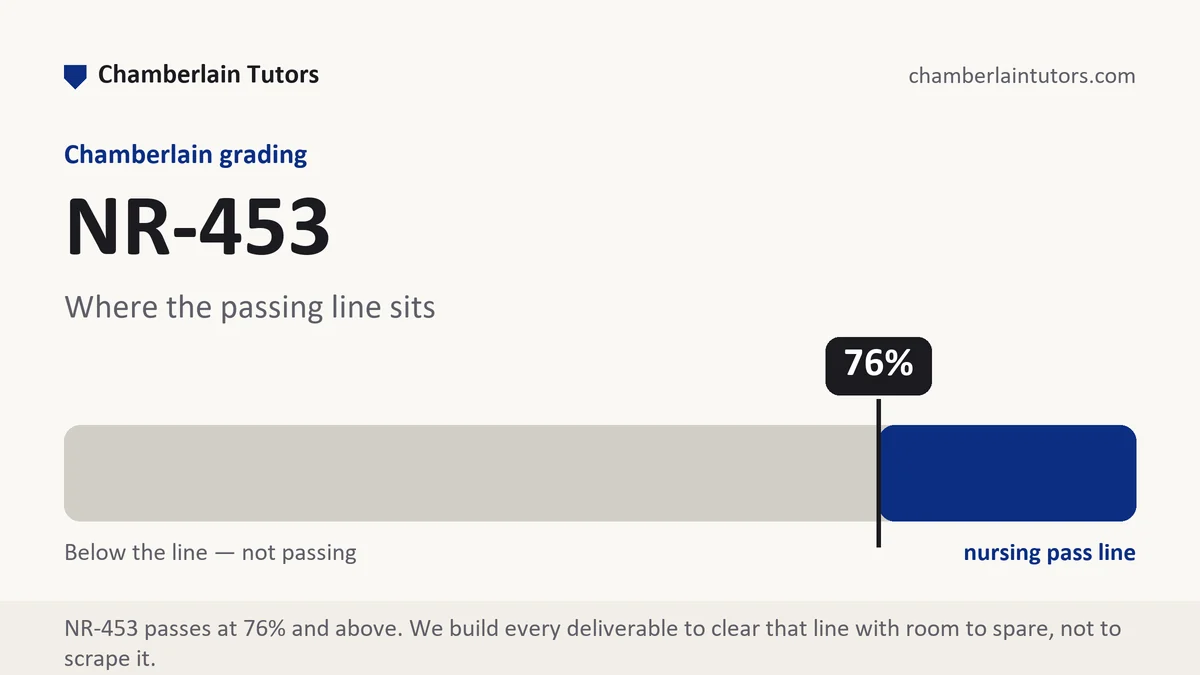
Keep a running log with three columns: the date, what you carried or performed, and one line of what you needed help with. Ten minutes a week produces the entire evidence base for the heaviest section of the paper. Do it inside an eight week session, since a sixteen week semester splits into two of them with up to six starts a year, and written deliverables land weekly while you are also on the unit. The 76 percent floor applies in core nursing courses and supplementary work cannot rescue a weak weighted average, so the last course before licensure is a poor place to plan a recovery. Discussion posts cannot be edited once submitted, which is worth remembering when a board asks you to describe an event from your placement.
Read the rubric first, then count the demands inside each row
Criterion rows are rarely single instructions. They are usually two or three demands wearing one sentence, and a row that scores badly is often a row where you answered the first demand and skipped the rest. So before drafting, underline every verb in every row and count them.
Here is the method on a worked example. Say your section caps a reflective account at 1,600 words across four rows. Row one, worth 25 percent, asks you to describe your starting point and analyze it, so two demands. Row two, worth 35 percent, asks you to compare early and later performance, evidence the comparison, and measure it against a standard, so three. Row three, worth 25 percent, asks you to identify a professional issue and connect it to your setting, so two. Row four, worth 15 percent, asks for goals with indicators that can be checked, so two. Nine demands in total, and 1,600 divided by nine is about 178 words each.
Now cross-check the demand count against the weights, because the two should roughly agree. Row one gets 356 words by demand count against 400 by weight, close enough. Row two gets 534 against 560. Row three gets 356 against 400. Row four gets 356 by demand count but only 240 by weight, so it is over by more than a hundred words. Where the two disagree, weight wins, and the disagreement is telling you something useful: that row wants both demands answered, but briefly. Trim row four to 240 and hand the difference to row two, which the guide has already called the largest thing on the page.
The parts of a practice refinement account
Whatever your section calls the deliverable, these are the parts that carry weight, with the version graders see too often beside each.
| Part | What it has to prove | The weak version |
|---|---|---|
| The skill, named narrowly | One action you can repeat and count, such as running a four patient morning or performing a specific procedure unassisted | Time management, which is too broad for any evidence to move |
| The starting point | What actually happened the first time, including what you needed help with and who gave it | I was nervous at the beginning of my placement |
| Dated evidence about yourself | Counts and dates: patients carried, unassisted repetitions, feedback received and when | A general impression that things got easier |
| The middle, where it turned | The shift where something changed and what caused it, whether a correction, a pattern you finally saw, or a patient who forced it | Steady improvement with no identifiable turning point |
| Prioritization across an assignment | How you sequenced a real morning, what you deferred, and the reason you were willing to defer it | A statement that prioritization is an important skill |
| Delegation, with the task named | Which task went to which role, why it suited that role, and what you kept because it could not be handed over | Delegation described as a principle, with no instance behind it |
| The standard you judge against | A scope statement, policy or guideline that says what safe performance looks like, cited by version | Best practice, unattributed and unquoted |
| The issue behind the pattern | The staffing, workload or handoff issue your difficulty was one instance of, tied back to a named shift | A researched issue section with no connection to the placement |
| The end state, checkable | What you can now do unassisted and what still needs support, written so an orientation preceptor could use it | I feel far more confident and ready to practice |
Making a claim about your own improvement
A refinement account is an argument about a sample of one, written by the interested party. Four habits keep it credible.
Artifacts, not impressions. Anchor every claim about yourself to something dated. Three IV starts unassisted in week six after two supervised attempts in week two is evidence. Becoming more skilled with IV starts is a feeling. Feedback counts as an artifact when you record what was said and when, so log it the same day rather than summarizing it at the end.
A denominator and a window, even for yourself. Most of the time is not a finding. On nine of my last eleven shifts is a finding, and it carries its own limitation honestly. The same rule governs your published sources: any rate needs a base and a period attached before it means anything, and a transition to practice statistic without a year is describing a workforce that may no longer exist.
Design and sample before the finding. When the issue section cites evidence, say what produced the number first. In a longitudinal survey of 3,200 newly licensed nurses across 15 states costs eleven words and turns an assertion into support. Keep sources inside a five year window unless your guide says otherwise or the source is the standard the field still uses, and cite guidelines by their current version.
Verbs sized to what you actually have. Your placement is a single account with no comparison group, so it supports description and not causation. Write that after the fourth week you completed the assignment without prompting, rather than that the preceptorship improved your clinical judgment. Applied to published work the same discipline holds: a study that only observed can report that something occurred more often among one group, while reduced or prevented belong to research that intervened and measured what followed.
Passing account, strong account, in this course
A passing NR-453 account covers the placement, mentions growth, cites some sources and ends on a confident note. It clears the floor and gives a reader no way to tell whether anything actually changed.
A strong one is recognizable in three moves. It is narrow, committing to one or two skills instead of surveying everything you did in twelve shifts. It is dated, so the before and after are anchored to weeks rather than to feelings. And it is honest about the ceiling, naming what still needs support in language an orientation preceptor could act on, which reads as readiness rather than as weakness. Narrow, dated, honest about the ceiling.
Six mistakes that cost points here
- A skill too broad to move. Communication and confidence cannot be counted, so nothing you write about them can be evidenced.
- Twelve shifts written as a diary. A week by week narrative has no comparison in it, and the refinement material scores on comparison.
- Improvement asserted without a date attached. Progress that never names when it happened is indistinguishable from hindsight.
- Delegation written as a principle. The row wants an instance: this task, this role, this reason, this shift.
- An issue section that floats free. Research on nurse workload earns nothing until it lands on the morning you could not finish.
- An ending made of confidence. Saying you are ready is the least persuasive sentence available. Saying what you can do unassisted and what you cannot yet is far stronger.
Questions students ask in this course
A classmate is doing the three credit version of this capstone. Does the writing standard differ?
I did not really improve at the skill I chose. What do I write?
How do I write about a near miss without it becoming a disciplinary document?
Where NR-453 sits in Chamberlain's programs
Open the exact program map for sequence, credit, and option context. The current student schedule and syllabus remain authoritative after transfer evaluation, electives, state rules, and approved plan changes.
The weeks, one by one
Week 1
NR-453 Week 1 opens a capstone built around a 96-hour clinical practicum, and the size of that number is the week's real subject: a dozen or more shifts is enough time to refine actual practice skills through repetition, which means the opening written work, usually a baseline self-assessment with. Read the full Week 1 manual.
Week 2
NR-453 Week 2 usually takes the trends-and-issues strand of the capstone and points it at the setting your 96 hours are unfolding in: pick a professional issue that is visibly alive on the kind of unit you are placed in, and write a brief that analyzes it with published sources while your own. Read the full Week 2 manual.
Week 3
NR-453 Week 3 works the catalog's promise of synthesizing general education with nursing coursework, and the live version of that promise is happening on your unit every shift: the writing at this stage usually asks you to demonstrate, through concrete moments, how learning from outside the nursing. Read the full Week 3 manual.
Week 4
NR-453 Week 4 usually lands near the midpoint of the 96-hour practicum, and its written work, journal entries or a structured midpoint reflection, has a job that shorter placements never assign: comparing your current performance against the baseline you wrote in Week 1 and adjusting your goals for. Read the full Week 4 manual.
Week 5
NR-453 Week 5 typically asks you to do in writing what the course is preparing you to do in practice: notice a care practice in your placement, ask what the published evidence supports, and argue a recommendation sized to a nurse entering the profession. Read the full Week 5 manual.
Week 6
NR-453 Week 6 tends to ask for the piece of writing this course is uniquely positioned to produce: a narrative that traces one practice skill from its first shaky attempt through its current refined form across the span of your 96 hours, analyzed with the vocabulary of professional growth rather than told as anecdote. Read the full Week 6 manual.
Week 7
NR-453 Week 7 typically carries the course's heaviest deliverable: a synthesis paper arguing that general education, nursing coursework and 96 hours of supervised practice have converged into a nurse ready for the registered nurse role, with the immersion's longitudinal evidence, skills measured at. Read the full Week 7 manual.
Week 8
NR-453 Week 8 finishes the course on two tracks at once: a final written piece, typically a closing audit of your Week 1 baseline joined to a concrete transition plan for entering the registered nurse role, and the course's closing logistics, the completed 96-hour record and its signatures, which only you can finish. Read the full Week 8 manual.