NR-439, RN Evidence-Based Practice, is a three credit lecture course in the RN to BSN with no clinical hours attached. It grades one skill split into three moves: turning something you noticed at work into an answerable question, running and documenting a search that another nurse could repeat, and reporting what the evidence supports without inflating it. This page is the manual for those three moves.
What NR-439 actually grades
The catalog describes the research process, framing research questions, searching for best evidence, and reading published findings so that evidence can ground professional practice. In graded terms that means your scoring guides are almost never asking whether you know the answer. They are asking whether your question was answerable, whether your search was disciplined enough to be trusted, and whether the claim at the end of your paper is the size the studies can actually carry. Working nurses find the first part easy and the third part hard, because the ward voice reaches conclusions faster than the evidence does.
How we help in this course
Send the practice problem you have in mind, or the one you were assigned, plus the scoring guide from Canvas. The draft comes back with the question built to your section's required format, a search you can reproduce, and every claim written at the strength its source supports. If the search we run turns up thin ground under your question, we say so before drafting rather than padding around it.
Orders go through the full pipeline: guide decoded row by row, core work tagged separately from supplemental, a writer matched to evidence-based practice work, a rubric pass and then an independent APA and originality pass, the scale check against your section's floor, delivery inside 24 to 48 hours.
How to write this course's deliverables
Your section's materials sit behind a Canvas login and Chamberlain issues no syllabi beyond that, which rules out any week-by-week grid worth trusting. What does hold across sections and sessions is method, so the rest of this page is method: reading a scoring guide as a spending plan, the load-bearing parts of an evidence paper, and the sourcing habits that decide the evidence rows.
In NR-439 right now?
Send the week and the rubric from Canvas. First premium sample free, floor-checked, back in 24 to 48 hours.
Why the theory-only course is not the easy one
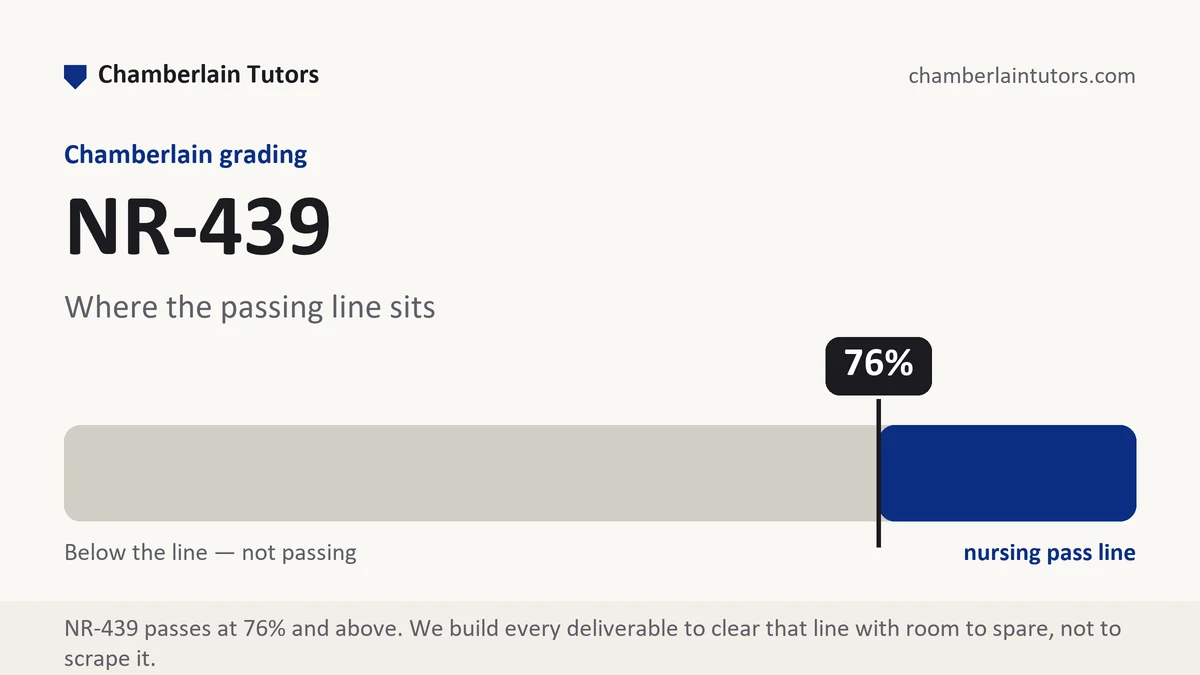
NR-439 has no clinical hours, which students read as breathing room and the gradebook does not. With no hours to absorb effort, the entire grade sits on written work, and the 76 percent core floor applies exactly as it does in any nursing course: the core assignments carry a separate average, and if that average finishes under 76 the supplemental points sitting behind it never come into play. Extra work does not repair a weighted average that has already gone soft. In an eight week session with weekly deliverables, two soft submissions in a three credit course are hard to out-earn, and discussion boards do not reopen once posted, so the first version you paste is the graded one.
Read the rubric first, then buy your words with points
Open the scoring guide before you reread the prompt. The prompt names the topic; the guide names the payments. Paste each criterion row into a blank document as a heading in the guide's own order, then write underneath. A grader working down the guide should meet your sections in the sequence the rows appear, and papers that answer everything in a different order lose points nobody can quite explain afterwards.
Then treat words as a currency you spend against points. Suppose your section caps the paper at 1,200 words and the guide reads: practice problem and question, 30 points; search strategy and sources, 30; synthesis of findings, 25; APA and scholarly writing, 15. Writing quality is judged across everything you submit rather than in a section of its own, so pull that row out first. Reserve 120 words for an opening and a close that carry no scored content, leaving 1,080 words to cover 85 points. That is a shade under 13 words per point: 380 words for the problem and question, 380 for the search, 320 for the synthesis. Write those figures in brackets beside each heading and delete a bracket only when the section reaches it.
Run your own guide's numbers rather than borrowing these, and notice what the arithmetic exposes. The search section has earned as much room as the problem section, and almost nobody gives it that. Most NR-439 papers spend eleven sentences on why the problem matters and one line on which database was used, then lose the search row and wonder why a well-written paper scored in the low eighties.
The parts of an evidence paper
Whatever your section calls the deliverable, an evidence-based practice paper has the same load-bearing parts. Each proves one thing, and the weak version of each is what graders see most.
| Part | What it has to prove | The weak version |
|---|---|---|
| The practice problem | Something observable is happening, to a specific group, often enough to matter, and you can say how you know | A topic of general interest, introduced as important with nothing observed behind it |
| The question | It has moving parts: who, what is being considered, what it is being weighed against, what outcome, over what period | A question about a subject rather than about a choice, so no study could answer it |
| Where you searched | Named databases chosen for a reason, not a general web search that happened to work | Research was conducted online, which tells a grader nothing they can check |
| How you searched | Terms, how they were combined, limiters applied and the date you ran it, written so another nurse gets your results | Keywords listed with no combination, no limits and no run date |
| What you kept and dropped | Stated inclusion and exclusion reasoning, so the reader knows the set was selected rather than collected | Five articles appearing with no account of the hundred that did not |
| The synthesis | Findings grouped by what they say, with agreement and disagreement both visible across studies | An annotated bibliography in paragraph form, one study per paragraph, in no order |
| What it means for practice | A recommendation sized to the evidence, naming who would do what differently | A change to national practice proposed on the strength of two small studies |
| What would change your mind | The gap or weakness in the evidence, named plainly | More research is needed, a sentence that appears in every paper and earns points in none |
Source craft, where the evidence rows are won
Four habits decide most of the evidence scoring in this course, and none of them are difficult once they are conscious.
Know which shelf each source came from. A peer-reviewed study reports original work. A review or a guideline digests other people's. A professional magazine article, a hospital web page and a course textbook are none of the above. All can appear in a paper, but only if you say which is which, because the evidence row is scoring your judgment about sources at least as much as your access to them.
Cite the study for the number, not the summary that mentioned it. When you quote a figure, follow it back to the paper that produced it and cite that. Reviews are for framing an argument. Primary studies are for values. Numbers passed along secondhand drift, and a grader who checks one and finds it different is now checking all of them.
Say what produced a number before you report it. Name the kind of study, in whom, and how many, then give the result. In a prospective study of 240 medical patients over six months costs you eight words and turns a claim into evidence. Then match the verb to that design: observational work supports was associated with, occurred more often among, predicted. Only a design where something was deliberately changed and measured supports caused, reduced or prevented.
Attach a denominator and a window to every rate. A figure with no base and no period is decoration. Write 14 of the 190 patients admitted during the twelve month period rather than 7 percent of patients, and say whether the count came from the study you are citing or from your own workplace. Local unpublished numbers are legitimate illustration and are not evidence, so label them that way rather than letting them sit in a sentence dressed as research.
What separates a strong evidence paper
A passing NR-439 paper states a problem, asks a reasonable question, finds articles that exist, and reports what they said. It clears the floor and it is indistinguishable from thirty others in the section.
A strong one shows its work in three places. It shows the search working rather than announcing it, including the first attempt that returned four thousand results and the change that fixed it, because a documented search is the only part of the paper a reader can genuinely verify. It synthesizes across studies instead of walking through them, so a paragraph opens with a finding and then names which studies support it and which one disagrees. And it sizes the recommendation to the evidence, which usually means proposing something a unit could pilot rather than something a profession should adopt. Searched visibly, grouped by finding, recommended at the right scale.
Six mistakes that cost points here
- A question with nothing to compare. If the question names only a topic and no alternative course of action, no study design can answer it and the question row cannot score well.
- A search nobody could repeat. Terms without combinations, limiters or a run date fail the row even when the articles found are excellent.
- Annotated bibliography instead of synthesis. One study per paragraph, in the order you found them, is a collection. The row is paying for grouping.
- A number taken from a review. Track the figure to the study that generated it, or do not use the figure.
- Causal verbs over correlational evidence. Reduced and prevented belong to designs that changed something. Everything else gets associated with.
- Discussion posts written in the reply box. Boards are permanent on submission, so draft outside Canvas, read it once cold, then paste.
What NR-439 students ask most
Does my question have to be one I could actually implement at work?
How many articles does an evidence paper actually need?
My search returns almost nothing. Do I change the question?
Where NR-439 sits in Chamberlain's programs
Open the exact program map for sequence, credit, and option context. The current student schedule and syllabus remain authoritative after transfer evaluation, electives, state rules, and approved plan changes.
The weeks, one by one
Week 1
NR-439 Week 1 usually opens the RN-to-BSN evidence course by asking where nursing knowledge actually comes from: which of your unit's daily practices rest on research, which rest on tradition and authority, and what evidence-based practice means beyond the slogan. Read the full Week 1 manual.
Week 2
NR-439 Week 2 usually moves from why evidence matters to the skill everything else depends on: converting a vague clinical concern into a focused, searchable question with its parts named, typically the population, the intervention or issue, a comparison where one exists, and the outcome that would settle it. Read the full Week 2 manual.
Week 3
NR-439 Week 3 usually teaches the search: translating your clinical question into database terms, running it through nursing and medical literature databases with deliberate limits, and, critically, documenting the strategy so another person could repeat it and get the same results. Read the full Week 3 manual.
Week 4
NR-439 Week 4 usually puts a quantitative research article in your hands and asks you to read it the way a nurse reads a chart: locate the design, the sample, the measures, and the findings, then restate what the numbers mean in plain clinical language. Read the full Week 4 manual.
Week 5
NR-439 Week 5 usually turns to the other half of the evidence: qualitative research, where the data are words and experiences rather than counts, and the findings arrive as themes rather than rates. Read the full Week 5 manual.
Week 6
NR-439 Week 6 usually assembles what the reading weeks built: ranking your collected studies on the evidence hierarchy, laying them side by side in an evidence table, and writing a synthesis that says what the body of evidence shows as a whole, where it agrees, where it conflicts, and how strong the overall case is. Read the full Week 6 manual.
Week 7
NR-439 Week 7 usually asks for the payoff: a written recommendation that translates your synthesized evidence into a specific, feasible practice change for a real setting, with the stakeholders named, the barriers anticipated, and the measure that would show whether the change worked. Read the full Week 7 manual.
Week 8
NR-439 Week 8 usually closes the course by looking past it: how findings get shared beyond one paper, how practice changes are kept alive after the launch energy fades, and how a working RN stays current with evidence for a career rather than a session. Read the full Week 8 manual.