NR-439 Week 5 usually turns to the other half of the evidence: qualitative research, where the data are words and experiences rather than counts, and the findings arrive as themes rather than rates. The written work asks you to identify a qualitative study's tradition, follow how its participants were chosen and its themes were built, and say what the findings mean for nursing care, in the same accurate-reading register as the quantitative week. Your section may print this as NR 439 or NR439; it is the same course. Chamberlain publishes no syllabi outside Canvas. The placement here is our teaching judgment from the course's catalog arc; your section's rubric decides what your week actually asks.
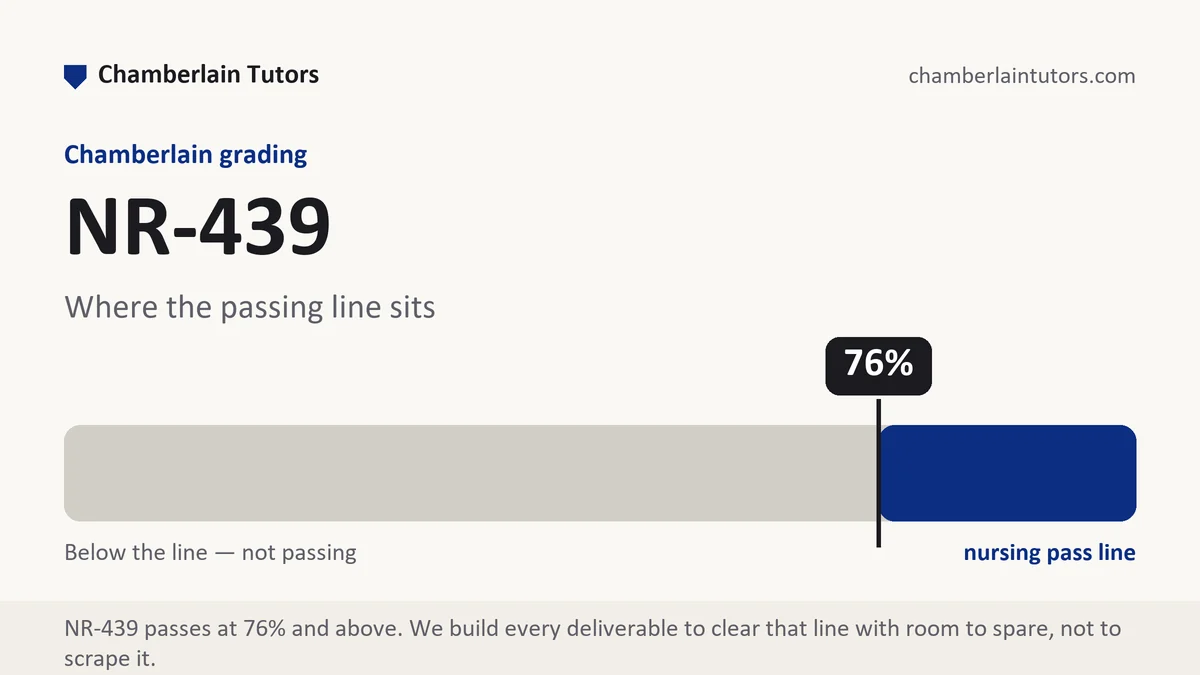
What NR-439 Week 5 asks for
A patient experience coordinator working through a quarter of survey returns sets the score columns aside and prints the free-text comments: two hundred remarks in patients' own words. Reading them once, she flags recurring language; reading them again, she sorts the flags; by the third pass, three stacks sit on her desk, nobody told me what was happening, everyone seemed too busy to ask, and the night noise stories. No percentage produced those stacks. They emerged from disciplined, repeated reading, and each stack can be traced back to the exact comments inside it. That is qualitative analysis in miniature, and this week's writing asks you to recognize the same discipline operating, at full scale and with formal rigor, inside a published study.
The deliverable at this stage is usually a structured summary or worksheet for a qualitative article, sometimes paired with the quantitative summary from the previous week for contrast: identify the purpose and the qualitative approach, describe how participants were selected and how many took part, explain how the data were gathered and analyzed, report the themes with the evidence behind them, and connect the findings to practice. The reading stations are parallel to the quantitative week's, but the vocabulary changes, and using the quantitative words in the qualitative house, calling twelve participants a small sample as if the study aimed at statistics, is the misstep graders watch for most.
The design vocabulary this level needs is short. Phenomenology studies the lived experience of something: what it is like to receive a diagnosis, to wait, to recover. Grounded theory builds an explanation of a social process from the data upward. Ethnography studies a culture or setting from inside it. Beyond those named traditions, many nursing studies describe themselves as general qualitative descriptive work, which is a legitimate label, not a failure to choose. Your summary needs the study's stated approach, one sentence on what that approach studies, and no more.
Understand why numbers behave differently here, because the difference is graded. Qualitative studies choose participants on purpose, selecting the people who have lived the experience in question, and they stop recruiting when new interviews stop yielding new ideas, a point the literature calls saturation. Small, deliberately chosen groups are therefore the method working as designed, not a weakness to apologize for. The credibility questions worth asking are different ones: whose voices were gathered, how systematically the analysis moved from transcripts to themes, and whether the authors show enough participant quotation that you can see the themes standing on real data.
The NR-439 Week 5 method, step by step
Six moves for reading a study whose data are words.
-
Match the question type to the method before judging either
Ask what the study wanted to know. Questions about how often and how much belong to quantitative designs; questions about what it is like and how people make sense of things belong here. One sentence establishing that fit shows the grader you know why this study is qualitative rather than merely noticing it is.
-
Name the approach and what it studies
Phenomenology, grounded theory, ethnography, or qualitative description, taken from the study's own methods section, with a plain sentence on what that tradition examines. Resist writing a paragraph of philosophy; the summary needs the label and its meaning, not its history.
-
Follow the selection logic, not just the count
Report how participants were chosen and why those people in particular, along with how many and in what setting. Purposeful selection is the design's engine, and describing it accurately is this week's version of the sample paragraph.
-
Trace the path from raw words to themes
Say how data were collected, interviews, focus groups, observation, and summarize the analysis the authors describe: transcription, coding, grouping codes into themes. You are not evaluating the coding; you are demonstrating you found and understood the path.
-
Report each theme with its supporting voice
Name every major theme and attach a fragment of the evidence beneath it, a participant quotation or a close paraphrase, cited to the study. A theme listed without its data is a headline without a story, and the pairing is what the findings section grades.
-
Write the practice meaning in nursing verbs
Close by saying what a nurse who believes these findings would do differently: what she would ask, watch for, explain, or change in her routine. Qualitative findings convert to practice through awareness and communication, and naming that conversion is the week's applied skill.
A layout and word budget for the qualitative summary
Our frame for a single-article qualitative summary of roughly 850 to 1,050 words. It is our own outline rather than anything the university issues, and your week's rubric outranks it wherever the two disagree.
| Section | What belongs in it | Word target |
|---|---|---|
| Citation, purpose, and fit | The full reference, the study's aim, and why this question needed a qualitative answer. | 110 to 140 |
| Approach, named plainly | The stated tradition and one sentence on what it studies. | 90 to 120 |
| Participants and selection | How and why these people were chosen, how many, and where, described in the design's own logic. | 140 to 170 |
| From words to themes | Data collection and the described analysis path, reported without evaluation. | 150 to 180 |
| Themes with their voices | Each major theme paired with a quotation or close paraphrase from the study. | 220 to 260 |
| Practice meaning | What these findings change for a nurse at the bedside, written in concrete verbs. | 120 to 150 |
Evidence craft for findings made of words
Quote participants through the study, with the page. When you reproduce a participant's words, you are quoting the article, so the quotation carries the authors' citation and page number. Keep the excerpts short; one vivid line per theme does the work, and your summary should remain summary rather than anthology.
Report themes as the authors built them. Use the study's own theme names, in its order, rather than renaming or reorganizing findings to suit your paper. Faithful reporting is the graded skill, and a grader with the article open will check your themes against its findings section first.
Keep the credibility vocabulary in its own register. Qualitative rigor has its own terms, credibility, transferability, the audit trail of analytic decisions, and your summary earns points by using them where the authors do, instead of importing validity language built for measurement.
Resist generalization; write transfer instead. Twelve participants in one region do not establish what all patients experience, and the study never claimed they did. The honest applied sentence is conditional: if patients like these are on your unit, these findings tell you what some of them may be living, and what is worth asking about.
Five mistakes that cost points in this week's territory
- Grading the study by quantitative rules. Faulting a phenomenological study for a small sample or missing control group announces that the week's core distinction did not land.
- The approach left unnamed. A summary that never states whether the study is phenomenology, grounded theory, ethnography, or descriptive work skips a station the rubric names.
- Themes without data. Listing theme titles with no participant voice beneath them reports the headlines and discards the evidence.
- Findings inflated into facts about everyone. Writing that patients feel a certain way, full stop, converts one setting's voices into a universal claim the study cannot carry.
- No practice translation. Ending at the themes, without one concrete sentence about nursing action, leaves the applied row, the reason nurses read this literature, unearned.
Before you submit
- The fit between question type and qualitative method is stated in one sentence
- The approach is named from the methods section with its plain meaning
- Selection logic and setting are described in the design's own terms
- The path from data collection to themes is traced without evaluation
- Every reported theme carries a cited participant voice
- The closing converts findings into concrete nursing verbs, conditionally stated
Qualitative summary due in NR-439?
Send the rubric and the article out of Canvas. A premium original draft comes back in 24 to 48 hours with the approach named, the themes paired with their voices, and the practice meaning written in nursing verbs, and revisions run until the grade lands.