The closing stage of a first practicum usually asks for something cumulative: a synthesis, a portfolio narrative or a summative piece arguing what 125 hours produced and what has to happen in the practicum that follows. It is an argument built from the documents you already wrote, not a summary of the rotation, and the strongest versions are precise about their own limits. Your section may print this as NR 574 or NR574; it is the same course. Chamberlain publishes no syllabi outside Canvas. The placement here is our teaching judgment from the course's catalog arc; your section's rubric decides what your week actually asks.
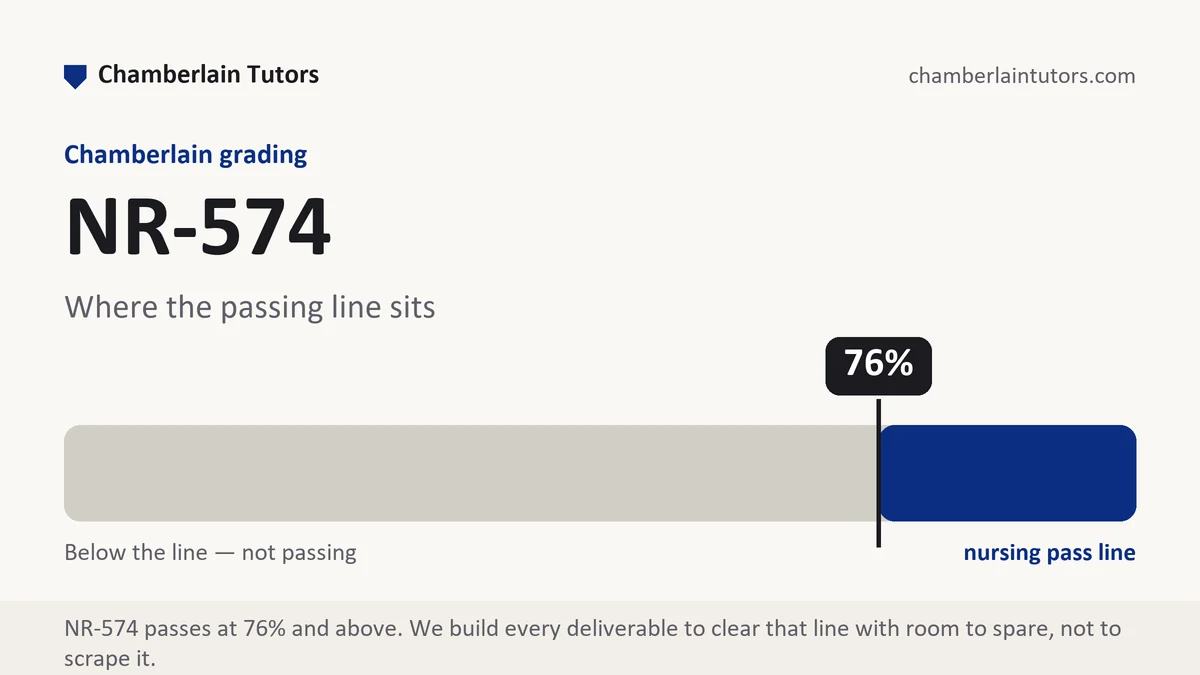
What NR-574 Week 8 asks for
Compare the reasoning trail you wrote in the second stage with the one you would write tonight and the shape of the change is usually visible in a single feature: the early one listed conditions and the later one listed questions. A practitioner who arrived from family practice thinking in diagnoses now thinks in discriminators, and that is a specific, evidenced claim about eight weeks of work. It is also exactly the kind of claim a closing synthesis exists to make, as opposed to the vaguer one about having grown as a clinician that most closing documents settle for.
A synthesis has three obligations. It has to argue one central claim about what changed, supported by artifacts a reader can see. It has to be honest about what 125 precepted hours can and cannot establish, which in a first practicum is beginning competence under supervision in a defined range of presentations rather than readiness to practise. And it has to carry something forward, because this course is the first of two closing practicums and the objectives that leave here should arrive there sharpened rather than reset.
The honesty requirement is worth taking seriously rather than treating as false modesty. Faculty who grade summative practicum work read for calibration, and an inflated claim damages a document more than a modest one ever does. The stronger version names the presentation classes you saw repeatedly, the ones you saw once, and the ones your setting never produced, then states what would be required to close each gap. Precision about a limit is a demonstration of judgment, and judgment is the thing the whole session has been assessing.
Timing deserves a word, because closing documents in an eight-week session arrive in the same days as everything else that has to finish. A synthesis is the assignment most damaged by being written last, since it depends on rereading work you produced weeks earlier and that rereading is the part that gets cut when time runs out. The practical fix is to pull your three artifacts and write the central claim in the previous stage, while the clinical work is still running, then draft the rest once the hours are complete. A document assembled that way is noticeably better argued than one written in a single evening from memory.
The boundary applies through the final submission and applies without exception. Your clinical hours, hour logs, encounter counts, census entries, preceptor evaluations, signatures, placement paperwork and every attestation your site or the school verifies are your own record, produced by you and verified through the school's process. They are never drafted, reconstructed or estimated with outside help, and nobody contacts your preceptor, faculty or site on your behalf. The clinical experience cannot be shortcut and nothing here pretends otherwise. Everything you cite from those hours is de-identified before it is written down, and the value on offer is a clearer written account of reasoning you genuinely did.
The NR-574 Week 8 method, step by step
Six moves for turning a practicum into an argued closing document.
-
Write the central claim before opening any file
One sentence naming the specific change in your clinical reasoning or practice. Everything in the document either supports that sentence or gets cut, which is what makes it a synthesis.
-
Select three artifacts from your own written work
An early piece, a middle piece and a late piece addressing comparable tasks. Three points establish a direction where two only establish a difference.
-
Name the change in content terms, not in adjectives
Not stronger analysis, but discriminators replacing descriptions, decisions committed to before asking, plans linked to problems rather than transcribed.
-
Map exposure honestly across three tiers
Presentations you worked repeatedly, presentations you met once, and presentations the setting never produced. That map is more useful to a reader than any general statement about case mix.
-
State the ceiling of a first practicum
What 125 precepted hours establish and what they do not, written as a fact about the structure of the course rather than as a confession about you.
-
Carry two sharpened objectives into the next practicum
Take the objectives that stalled or partially moved, rewrite them against what you now know about your gaps, and attach conditions. Forward linkage is graded content in a closing piece.
Budget a closing practicum synthesis
Our layout for a summative piece, sized for roughly 1,200 to 1,500 words. It is our own outline rather than anything the university issues, and your week's scoring guide outranks it wherever the two disagree.
| Section | What belongs in it | Word target |
|---|---|---|
| The claim being argued | The one specific change in your reasoning the document will argue, stated before any account of the rotation. | 100 to 130 |
| Three-artifact evidence | Early, middle and late pieces of your own writing, quoted briefly, with the direction of change named. | 300 to 360 |
| Exposure map | Presentations worked repeatedly, met once, and never encountered, with what each tier means for readiness. | 200 to 250 |
| Objectives outcome | Each opening objective judged as met, partially met or stalled, with the evidence and the reason. | 250 to 300 |
| The ceiling of this stage | What a first precepted practicum establishes and what would be required to extend it. | 160 to 200 |
| Goals for the second practicum | Two sharpened goals for the next practicum, each with an action, a condition and a rationale from your gaps. | 150 to 190 |
Argue a summative claim from checkable material
Quote your own artifacts rather than describing them. Three short excerpts with dates prove a direction of change; three paragraphs characterizing your earlier work prove only that you remember it favourably.
Position against a named competency framework with conditions attached. Acute care advanced practice competencies are published with issuing bodies and years, and every level you claim should arrive with the supervision under which it holds.
Cite the literature on practicum learning once, precisely. Published work on how clinical reasoning develops across supervised practice supports the ceiling section and keeps it from reading as either modesty or complaint. One source is enough at this length.
Keep every claim inside the population you actually practised in. A student whose earlier career was in family practice or another specialty can slide into claiming a general acute readiness the rotation never tested. Name the setting and the population your evidence comes from and say where transfer needs separate preparation.
Five mistakes that cost points in this week's territory
- A rotation diary in summative clothing. Recounting the session week by week answers a question the closing rows did not ask.
- Change asserted without artifacts. A claim about development with nothing quoted behind it leaves the whole document unsupported.
- An exposure map that hides the gaps. Listing only what you saw, and never what your setting could not provide, reads as an incomplete self-assessment.
- Readiness claimed beyond a first practicum. Writing that you are prepared for independent practice overstates what 125 precepted hours establish and invites a correction.
- Objectives reset rather than sharpened. Carrying forward the same broad goals you wrote in the opening stage wastes everything the session taught you about your own gaps.
Before you submit
- A single central claim appears in the opening paragraph
- Three dated artifacts from your own writing are quoted as evidence
- The change is described in content terms rather than in adjectives
- The exposure map includes what your setting never produced
- Every objective is judged with evidence and a reason
- Two forward objectives carry actions, conditions and a rationale drawn from your gaps
Finishing NR-574 this week?
Send the closing instructions and the scoring guide out of Canvas along with your earlier submissions. A premium original synthesis comes back in 24 to 48 hours argued from three artifacts with an honest ceiling and sharpened forward objectives, and revisions run until the grade lands.