A practicum built around growing independence usually opens with objective setting, and objectives are the most consequential short document you will write in this course, because every later reflection is scored against them. The written task is to convert broad course outcomes into two or three personal objectives that name an action, a condition that would count as met, and a window inside 125 clinical hours. Your section may print this as NR 574 or NR574; it is the same course. Chamberlain publishes no syllabi outside Canvas. The placement here is our teaching judgment from the course's catalog arc; your section's rubric decides what your week actually asks.
What NR-574 Week 1 asks for
A nurse practitioner student who has spent four years in a family practice clinic starts an acute care practicum knowing how to run a fifteen-minute visit and not yet knowing how to hold a patient whose physiology is moving. The objectives she writes in the opening week decide whether the next eight weeks produce evidence of that transition or a folder of pleasant reflections. Objective writing is the hinge of a practicum, and it is treated as a formality by most students precisely because it arrives before anything has happened.
The distinguishing feature of this course is stated in its own description: a focus on growing independence. That phrase should appear inside your objectives as a mechanism rather than as an aspiration. An objective that says you will develop confidence in managing complex patients cannot be assessed by anyone. An objective that says you will formulate an assessment and plan independently before presenting, for a defined class of presentation, and will document the difference between your plan and the one adopted, can be assessed by you every week and by a reader at the end. The second version also generates the raw material every later written assignment in the course needs.
Objectives also have to be honest about scope. Eight weeks and 125 hours is a specific amount of exposure, and an objective set that promises mastery across an entire specialty reads as unfamiliarity with what a practicum is. Two or three objectives, each narrow enough to be pursued in the hours you actually have, produce a better document and a better session than five broad ones.
The boundary around this course is absolute and belongs in front of everything else. Your clinical hours, your hour logs, your encounter counts, your preceptor evaluations, any signature, any site documentation and every attestation the school or your site verifies are your own record. They are never drafted, reconstructed or estimated with help of any kind, and nobody contacts a preceptor, a faculty member or a site on your behalf. The clinical experience itself cannot be shortcut and is not being offered here. What is on offer is the written layer that surrounds it: the objectives, the reflections, the case write-ups, the reasoning trails and the analytic pieces, written about work you genuinely did. Every patient detail that reaches a page is de-identified before it gets there.
The NR-574 Week 1 method, step by step
Six moves for writing objectives the rest of the session can be scored against.
-
Reduce each course outcome to its verb
Copy the outcomes into a blank file and strip each to the action it demands: formulate, manage, evaluate, communicate, document. Those verbs are the raw material, and they tell you what kind of evidence will eventually be required.
-
Name your starting point in one accurate sentence
Where you are coming from, what you already do independently and what you have never done without someone standing beside you. Objectives written without a baseline cannot demonstrate movement, because there is nothing to move from.
-
Choose a narrow presentation class to work in
A defined category of patient you expect to encounter repeatedly in your setting. Repetition is what produces visible progression, and an objective aimed at everything produces evidence about nothing.
-
Write the independence mechanism explicitly
State what you will decide before asking, when you will ask, and what you will record about the difference. That mechanism is the engine of every reflection you will write for seven more stages.
-
Attach a condition that counts as met
Not more comfortable, but something observable: presenting an assessment and plan without prompting, or working up a defined presentation independently on repeated occasions across the session.
-
Set a mid-session review point in writing
Name the week at which you will assess progress and what you will do if the objective is not moving. Objectives with a built-in review are the ones that survive contact with a busy rotation.
Budget a practicum objectives document
Our frame for an opening objectives piece, sized for roughly 700 to 900 words. It is our own outline rather than anything the university issues, and your week's scoring guide outranks it wherever the two disagree.
| Section | What belongs in it | Word target |
|---|---|---|
| Setting and baseline | The clinical environment in general terms and what you currently do with and without supervision. | 110 to 140 |
| Objective one, with mechanism | A narrow clinical reasoning goal, the independence mechanism, and the condition that would count as met. | 170 to 210 |
| Objective two, with mechanism | A second goal in a different domain, usually procedural exposure or communication, built the same way. | 170 to 210 |
| Evidence you will keep | The written artifacts you will generate as you go, and how each one supports an objective. | 110 to 140 |
| Review point and contingency | The week you will reassess and what changes if an objective has not moved by then. | 90 to 120 |
| Alignment to course outcomes | Each objective mapped to the outcome verb it serves, stated in one sentence per objective. | 80 to 110 |
Anchor objectives to published competency language
Map each objective to a named competency document. Advanced practice competencies for acute care are published by professional bodies, and writing your objectives in their vocabulary lets a grader see the alignment rather than infer it. Give the issuing organization and the year inside the sentence.
Cite the evidence base for the presentation class you chose. If your objective is built around a category of patient, one current source describing the reasoning or management standard for that category shows the objective was chosen deliberately rather than because it was convenient.
Do not import an ambulatory scope into an acute care objective. A student arriving from family practice frequently writes objectives sized for a clinic visit rather than for an unstable inpatient, and the mismatch is visible to any faculty reader. Name the acute care standard explicitly where you are converting a habit formed elsewhere.
Keep every number a real number. Where an objective involves repetition, write how many encounters, across what part of the session, in what setting. Vague frequency language is the most common reason an otherwise sound objective cannot be assessed at the end.
Five mistakes that cost points in this week's territory
- Objectives phrased as feelings. Becoming more confident is not observable and cannot appear as evidence in any later reflection.
- Restating course outcomes verbatim. Copying the outcome back is not writing an objective; the graded work is the conversion into something personal and narrow.
- Scope inflation. An objective that promises competence across a specialty in 125 hours signals that the writer has not thought about the arithmetic.
- No independence mechanism. In a course whose focus is growing independence, an objective that never says what you will decide before asking has missed the theme entirely.
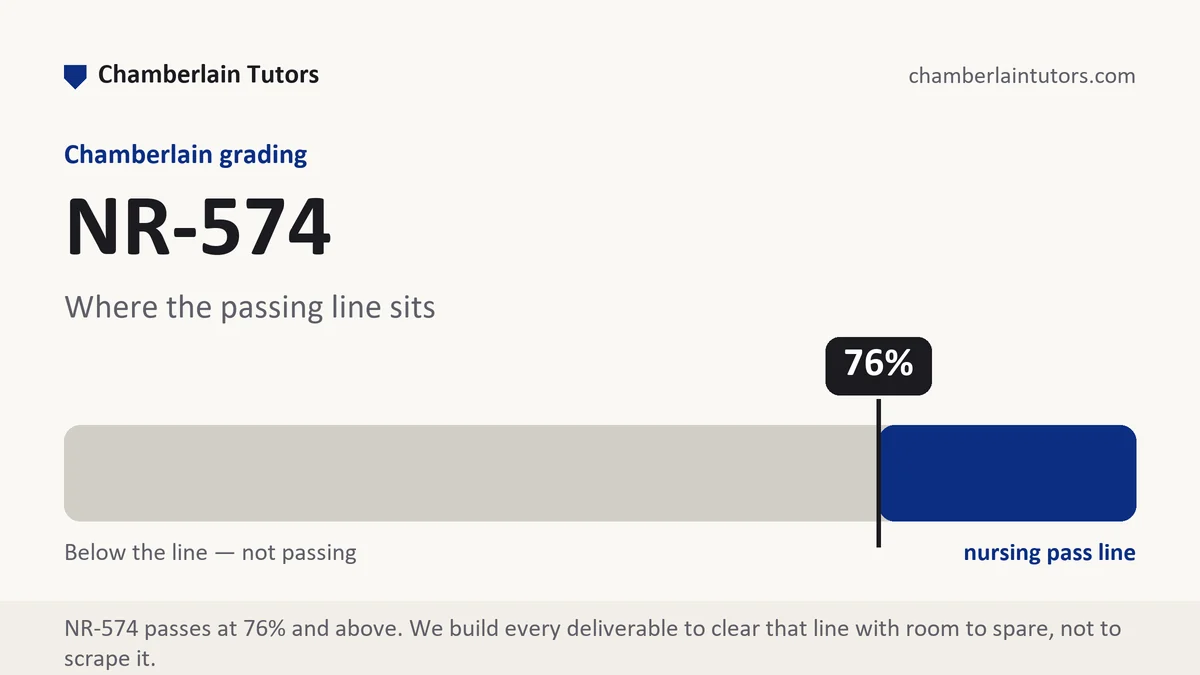
- Treating the opening document as low stakes. On a specialty scale with no C, the piece that shapes every later reflection is a poor place to spend forty minutes.
Before you submit
- Your baseline states what you currently do without supervision
- Each objective names a narrow presentation class rather than a specialty
- Each objective contains a stated independence mechanism
- Each objective carries a condition a reader could verify
- A named review week and a contingency both appear
- Every objective is mapped to a course outcome verb and a published competency
Starting NR-574 this week?
Send the objective instructions and the scoring guide out of Canvas. A premium original objectives document comes back in 24 to 48 hours with mechanisms and verifiable conditions built in, and revisions run until the grade lands.