NR-574 is the first of the two closing acute care practicums, 125 precepted clinical hours in complex acute practice with a stated focus on growing independence. That focus changes the writing. The graded documents in this course are less about whether the plan was right and more about whose plan it was: what you decided before asking, what your preceptor changed, and what you did with the difference.
What NR-574 actually grades
Progression made visible. A practicum that grades independence needs evidence of independence on the page, and the evidence is specific: the point in an encounter where a decision was required, the decision you reached on your own, the reasoning behind it, and then what happened when you tested it against your preceptor. Students who write a smooth narrative in which everything went well produce no evidence at all, because a document with no decision point in it has nothing to grade.
The second thread is the loop from gap to plan. A reflection that identifies a weakness and stops is half an assignment. The scoring guide almost always wants what you did about it, which means a specific objective for the coming weeks with something measurable attached: how many of a particular presentation you will work up first, which resource you will read and by when, which skill you will ask to lead.
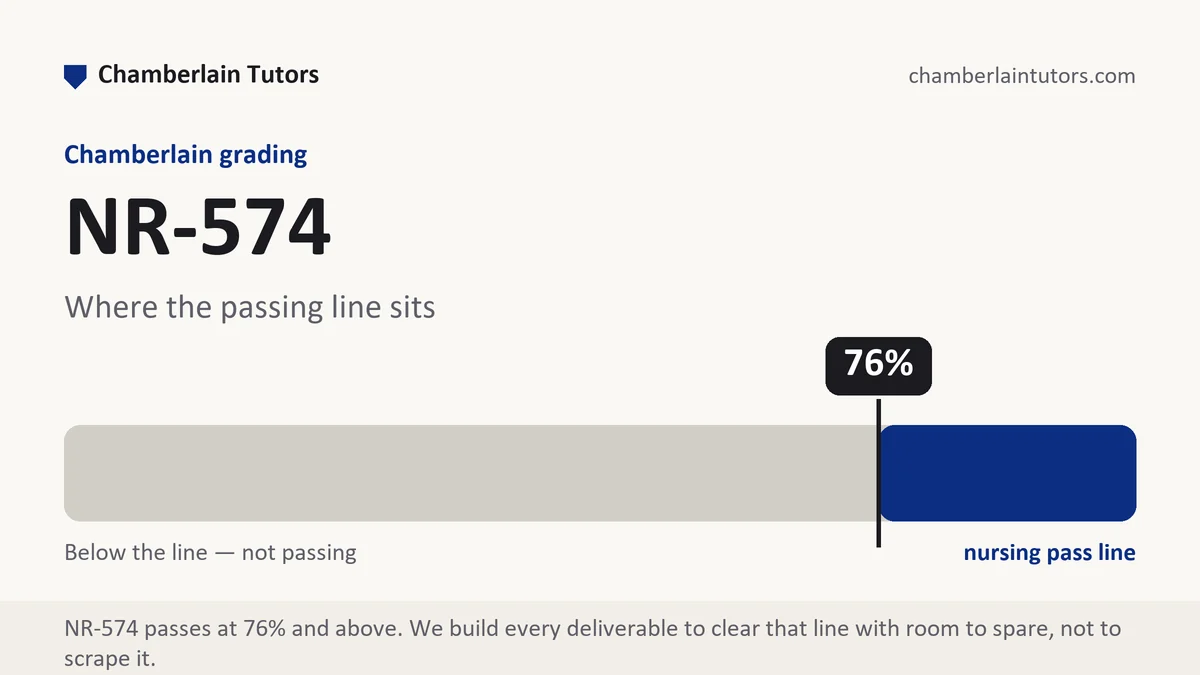
The specialty scale has no C, so the pass line is 84, and no supplementary work rescues a weighted average that has slipped. Reflective assignments feel low-stakes, which is precisely why they are where averages leak in practicum courses.
How we help in this course
We draft the reflective assignments, clinical reasoning journals, encounter analyses, objective statements, self-evaluation narratives, discussion posts and any case papers your section requires. The pattern our drafts hold to is that every reflection contains a decision, a comparison and a plan, which is the shape scoring guides in this course reward and the shape a tired writer at the end of a clinical day almost never produces unaided.
Your clinical record is yours. We do not work hours, contact preceptors, faculty or sites, complete or sign evaluations, hour logs or placement paperwork, or sit any assessment. Those 125 hours belong to the 625 clinical hours the MSN NP tracks require and they are attestations about your own practice. Our contribution is the written half, drafted from what you tell us happened.
In NR-574 right now?
Send the week and the rubric from Canvas. First premium sample free, floor-checked, back in 24 to 48 hours.
Convert the guide into a reflection plan
Reflective rubrics are the most misread scoring guides in a nursing program, because the word reflection suggests free writing and the rows say otherwise. Copy them out and reduce each to its verb: describe, analyze, connect, evaluate, plan. Those verbs are your sections, and they are not interchangeable. Describe wants the encounter. Analyze wants why you decided as you did. Connect wants evidence or theory. Evaluate wants a judgment about your own performance. Plan wants the next objective.
Then budget them, because reflective assignments are short and unbudgeted words disappear into the description. Take an 800 word reflection with rows weighted 35, 30, 20 and 15 percent: about 280 words for analysis of your reasoning, 240 for the evidence connection, 160 for self-evaluation, and 120 for the plan. That leaves the description of what happened as the smallest piece of the document, which is the opposite of how these are usually written. Most submissions arrive as 500 words of story and 300 words of everything else, and they score exactly where you would expect.
Keep the budget beside each heading. If the analysis section will not fill 280 words, the encounter you chose had no decision in it, and the fix is to choose a different encounter rather than to write more about this one.
The shape of a practicum reflection
Whatever your section calls the assignment, this is usually the object being scored.
| Section | What it has to contain | The version that reads as a diary |
|---|---|---|
| Encounter, chosen for a reason | A de-identified clinical situation selected because it contained a decision you had to make. | The most interesting patient of the week, described at length. |
| The decision point | The exact moment where two reasonable options existed, and what you were weighing. | A smooth account in which the right answer was obvious. |
| Your independent reasoning | What you concluded before consulting anyone, stated plainly even if it was wrong. | The plan the team followed, with no statement of what you thought first. |
| Preceptor input, compared | What your preceptor added or changed, and the reasoning behind the difference. | My preceptor agreed, offered as the whole comparison. |
| Evidence checked afterwards | What the literature or guideline says about the decision, looked up after the shift. | A citation attached to a sentence that did not need one. |
| Honest self-evaluation | What you did well, and the specific thing you were slow or uncertain about. | A confidence statement with nothing behind it. |
| Objective for the next weeks | One target with a number, a method and a date attached. | Continue to build confidence and improve. |
Evidence and citation craft in reflective writing
Reflections are still graduate documents, and the evidence rows in their rubrics are scored the same way as anywhere else.
Check the evidence after the encounter, and say so. The most useful citation in a reflection is the one you looked up because the shift raised a question. Where your guide sets no rule, hold recommendations to a five year horizon and justify anything older in the sentence. This habit is also the one that makes the connection row easy to fill, because you are writing about something you actually wondered.
Design and sample before the finding, even here. One sentence of provenance keeps a reflection from sliding into opinion: naming that a recommendation came from a trial in a defined population reminds the reader, and you, that the guidance had a source and a boundary.
Verbs the design can pay for. Reflective writing tempts overstatement because the writer is trying to sound decisive about their own growth. Keep associative verbs for observational evidence and causal verbs for controlled comparisons, and apply the same discipline to claims about yourself: say what you did faster or noticed earlier, not that you became better.
Numbers with a base and a period. If you quote a rate from a source, carry its denominator and window. If you quote your own experience, do the same: nine of the fourteen admissions I worked up this month were respiratory presentations is a fact about your practicum, and it is far stronger evidence of progression than a sentence saying you saw many respiratory patients.
What separates a passing reflection from a strong one
A passing reflection describes a good day at a good placement. It is honest, well written, and unfalsifiable, and it would fit any student in any acute setting in any week. That is why it sits in the band it sits in.
Strong reflections risk something. They state the conclusion the writer reached before asking, including the ones that turned out to be wrong, because a wrong conclusion analyzed carefully is worth more to a grader than a right one arrived at by following. They name the alternative not taken and what would have made it correct. And they end in an objective that could fail: a number of encounters to lead, a resource to finish by a date, a skill to ask for next week. Independent conclusion, alternative examined, objective that can be checked.
Mistakes that cost points here
- Writing a diary. Chronology is not analysis. Open at the decision point and leave out everything that did not bear on it.
- Hiding the wrong answer. The row rewarding analysis needs your reasoning, and a reflection where the student was right about everything has removed its own evidence.
- Objectives with no measure. Improve time management scores nothing. Name the count, the method and the date.
- Criticising the site or preceptor. Even where a complaint is fair, a reflection that evaluates others instead of the writer misses the row entirely and travels further than you expect.
- Identifiers of any kind. No names, dates, room numbers, facility names or details that would identify a colleague or a patient. Describe by age band and setting only.
- Posting a reflection unread. Discussion posts at Chamberlain do not reopen after submission, so draft the entry in a document, strip identifying detail, then paste.
Questions NR-574 students ask
How do I write about independence when my preceptor makes the final decisions?
My week was quiet and nothing notable happened. What do I write about?
How many encounters should a reflective assignment cover?
Where NR-574 sits in Chamberlain's programs
Open the exact program map for sequence, credit, and option context. The current student schedule and syllabus remain authoritative after transfer evaluation, electives, state rules, and approved plan changes.
The weeks, one by one
Week 1
A practicum built around growing independence usually opens with objective setting, and objectives are the most consequential short document you will write in this course, because every later reflection is scored against them. Read the full Week 1 manual.
Week 2
Early in a practicum the written work usually turns preparatory: reading toward the presentations you expect, and building the reasoning structures that will be available to you in the moment rather than reconstructed afterwards. Read the full Week 2 manual.
Week 3
Once a practicum is running, sections commonly ask for a written case: an encounter you personally participated in, de-identified and rebuilt as a structured note with an assessment and plan that shows your reasoning rather than the team's conclusion. Read the full Week 3 manual.
Week 4
Around the midpoint of a practicum the reflective assignments start carrying real weight, and the single change that moves a reflection from an average score to a strong one is structural: description shrinks to the smallest section and analysis of your own decision becomes the largest. Read the full Week 4 manual.
Week 5
Past the midpoint, practicum writing usually stops being satisfied with your reasoning alone and starts asking you to put a clinical decision against the published evidence. Read the full Week 5 manual.
Week 6
Later stages of a practicum tend to widen from the encounter to the handover, because acute care work is transferred constantly and most of what goes wrong goes wrong at the seams. Read the full Week 6 manual.
Week 7
Late in a practicum whose stated focus is growing independence, sections commonly ask for a self-evaluation narrative: a written account of where you now sit against the objectives you set, argued from evidence you generated rather than from how the rotation felt. Read the full Week 7 manual.
Week 8
The closing stage of a first practicum usually asks for something cumulative: a synthesis, a portfolio narrative or a summative piece arguing what 125 hours produced and what has to happen in the practicum that follows. Read the full Week 8 manual.