NR-573 is the half-credit faculty-supervised lab where advanced assessment and procedural skills for acutely and critically ill adults are practised in person. The hands belong to you and always will. What we can help with is everything written around the lab: the preparation that makes a first attempt look competent, and the documentation that has to describe a procedure precisely enough for somebody who was not in the room.
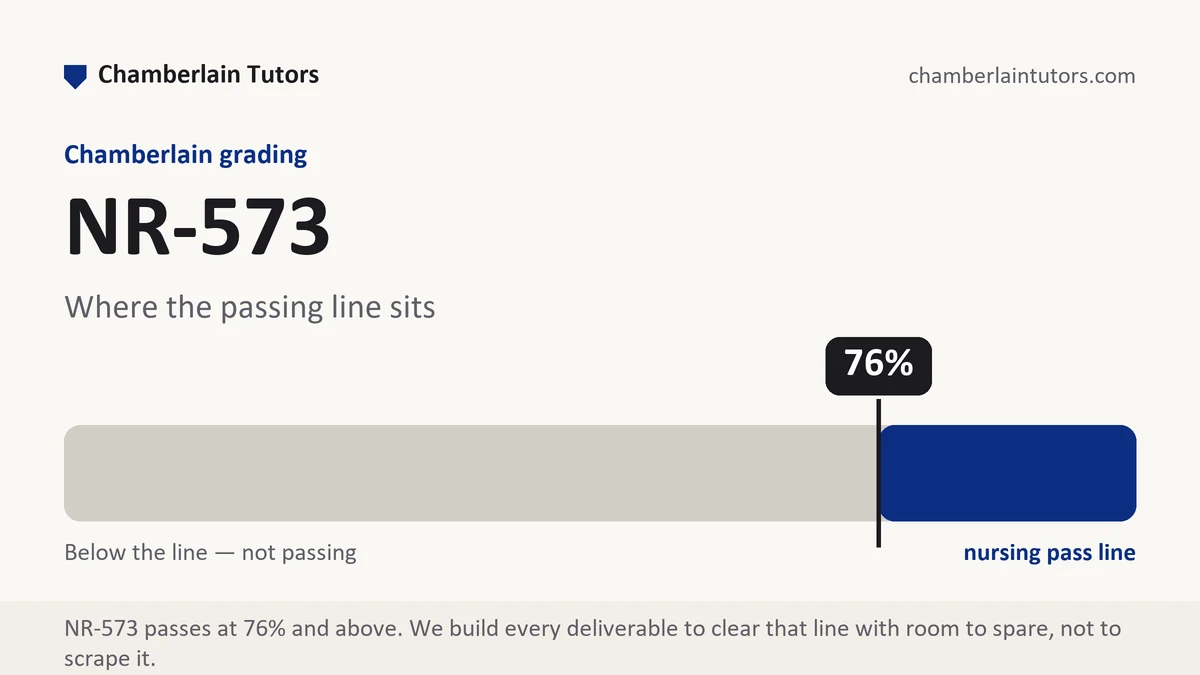
What NR-573 actually grades
Performance in front of faculty, plus whatever written work your section attaches to it. The performance part is not something any service can stand in for, and Chamberlain has been explicit about that pattern elsewhere in the NP curriculum: NR-509 pairs written work with a video-recorded physical examination check-off, and failing that demonstration reverts the entire course grade to F. Skills demonstrations are the student's own, and a lab course is built on the same principle.
The written layer is where preparation shows. Where your section asks for pre-lab preparation, procedure documentation or a post-lab self-assessment, those pieces are graded on precision rather than enthusiasm: whether you can state an indication and its contraindications, whether your description of a technique would let another clinician reproduce it, and whether your reflection produces a specific next attempt rather than a general intention to improve.
Because this sits inside an NP specialty track, the scale has no C and 84 is the last passing number. A half-credit lab looks small in a transcript and behaves like anything else in a weighted average, which is worth remembering when it is the assignment easiest to leave until the night before.
How we help in this course
We build the written scaffolding: pre-lab preparation notes that put indication, anatomy, equipment and complications in front of you before the session, procedure documentation drafted to a standard note structure, post-lab reflections written to a scoring guide, and any paper or discussion post attached to the lab.
What we do not do is attend, perform or demonstrate anything. No lab session, no check-off, no simulation, no recorded assessment, and no signing or completion of any form about your participation. We also never work clinical hours or contact your faculty or site. The value here is preparation before the session and clean documentation after it, which is exactly the part most students under-prepare.
In NR-573 right now?
Send the week and the rubric from Canvas. First premium sample free, floor-checked, back in 24 to 48 hours.
Read the checklist as a rubric
Skills courses hand out checklists, and a checklist is a rubric with the weights removed. Rewrite it as one. Copy the steps into a document, group them into the four or five things they are really testing, preparation, technique, safety, recognition of complications, documentation, and treat each group as a section to prepare rather than a line to tick.
Where a written piece accompanies the lab, price it the same way any assignment gets priced. Take a 900 word procedure write-up with rows weighted 40, 30, 20 and 10 percent: about 360 words for technique and rationale, 270 for indication and preparation, 180 for complications and their management, and 90 for the documentation and communication row. Students usually reverse the first two, writing a long build-up about why the procedure was indicated and then describing the technique itself in five lines, which is the opposite of what the heaviest row wants. The arithmetic takes a minute and it changes where the effort goes.
Keep the group headings in front of you during practice as well as during writing. Prepared students look different in a lab because they are running a structure rather than remembering a sequence.
The shape of a procedure note
Where your lab asks you to document a procedure, this is the object being graded, and every line of it is checkable.
| Element | What it has to record | What loses the point |
|---|---|---|
| Indication and alternatives | Why this procedure now, and what was considered instead. | The procedure named with no reason attached. |
| Contraindications checked | The specific ones ruled out, including coagulation, anatomy and site condition. | No contraindications noted, which reads as none looked for. |
| Consent and pause | Who consented or why they could not, and the pre-procedure verification performed. | Consent obtained, with no mention of what was explained. |
| Preparation | Positioning, aseptic technique, equipment, medication used with dose, and who was present. | Sterile technique used, offered as the whole of preparation. |
| Technique, stepwise | The steps in order with landmarks, guidance method, depth or size, and number of attempts. | A narrative that reads as a story rather than a record. |
| Findings and confirmation | What was obtained or observed, and how correct placement or effect was confirmed. | Procedure successful, with no confirmation stated. |
| Complications and response | What happened or did not, over what observation period, and what was done. | No complications, with no window and no monitoring named. |
| Post-procedure plan | Monitoring, restrictions, follow-up imaging or checks, and who was informed. | Patient tolerated the procedure well. |
Evidence and citation craft in procedural writing
Procedural claims look factual and are frequently repeated from habit, which is why sourcing them carefully stands out.
Technique guidance ages. Where your guide sets no limit, five years is a sensible horizon for procedural recommendations, and older material needs its reason in the sentence. Anatomy does not change; site preference, guidance method and dressing practice do, and a technique described from an older source can be wrong in a way an anatomy diagram never is.
Complication rates belong to an operator and a setting. A rate measured among experienced proceduralists using imaging guidance is not the rate for a first attempt without it. State the setting and the guidance method before the number, because in procedural literature those two variables move the result more than anything else.
Verbs the design can support. Most procedural evidence is observational or from registries, so write was associated with fewer attempts rather than reduced attempts, and reserve the causal verb for randomized comparisons. Simulation research, which this course sits close to, is largely pre-post work in single cohorts, and it should be described that way.
Rates carry their base and their window. Eleven of the 480 procedures performed over two years resulted in the complication is a usable figure. A 2 percent complication rate is not, because neither the number of operators nor the observation period is visible, and both decide whether the number means anything for a learner.
What separates a passing lab write-up from a strong one
A passing procedure note records that the steps happened. It is accurate, sequential and interchangeable, and it could have been written by anyone who watched a video of the procedure.
The strong version records decisions. It says why this site rather than that one, what the ultrasound or landmark showed before the needle moved, what made the first attempt fail and what changed for the second, and what specifically was watched afterwards and for how long. Reflection follows the same rule: a strong one names a single mechanical thing to change next time and the observation that will tell you it worked, rather than expressing a general intention to build confidence. Decisions, deviations, and one measurable next attempt.
Mistakes that cost points here
- Narrating instead of documenting. A procedure note is a record, not a story. Cut the chronology of the room and keep the sequence of the technique.
- No indication line. A note that begins with preparation has skipped the first thing a reviewer looks for.
- No complications, unqualified. Say what was watched, for how long, and what would have counted as a complication.
- Attempts left uncounted. Number of attempts and what changed between them is graded content in procedural documentation, and omitting it reads as concealment.
- Reflection without a target. Improving my technique is not an objective. Name the step, the change and the measure.
- Any identifier in a lab document. Even in simulation, use age band and clinical picture, and keep faculty, peer and facility names out of the write-up.
Questions NR-573 students ask
Can you sit or record the skills check-off for me?
How do I prepare for a lab session efficiently when I am working full time?
The lab has a written component. What is it actually testing?
Where NR-573 sits in Chamberlain's programs
Open the exact program map for sequence, credit, and option context. The current student schedule and syllabus remain authoritative after transfer evaluation, electives, state rules, and approved plan changes.
The weeks, one by one
Week 1
NR-573 opens with the written work that sits in front of a skills lab rather than inside it. Read the full Week 1 manual.
Week 2
Once the opening preparation stage is behind you, a lab session typically moves to advanced assessment, and the written object that accompanies it is a findings write-up: an exam performed on a manikin, a standardized participant or a lab partner, then documented in language precise enough that a. Read the full Week 2 manual.
Week 3
Airway and oxygenation work is the part of an acute care lab where preparation writing has the shortest half-life, because the sequence has to be in your head before the session and legible on paper afterwards. Read the full Week 3 manual.
Week 4
Mid-session in an acute care skills lab, the procedural work usually turns to invasive access, and the written object becomes a full procedure note: consent and pause, site selection with a reason, sterile technique described as a sequence rather than a claim, the attempt count, the confirmation. Read the full Week 4 manual.
Week 5
By the midpoint of an acute care lab the emphasis usually widens from performing a procedure to interpreting what comes back from one: rhythm strips, blood gases, imaging reports, hemodynamic numbers and laboratory panels. Read the full Week 5 manual.
Week 6
Late-middle stages of a skills lab typically stop rewarding clean performance and start rewarding recovery, which means the written object becomes a complication and rescue analysis: what went wrong, when it became recognizable, what was done, who was called, and what in the system rather than the person allowed it. Read the full Week 6 manual.
Week 7
Toward the end of a skills lab, sections commonly attach a self-assessment: a written piece in which you evaluate your own performance against the competencies the lab has been building. Read the full Week 7 manual.
Week 8
Closing stages of a lab course usually ask for something cumulative: a synthesis, a portfolio narrative or a final written piece that argues what the session built and what it did not. Read the full Week 8 manual.