NR-510 Week 8 closes the course by turning seven weeks of analysis into a document about you: where you intend to practice, what has to be true before that can happen, and what you will actually change in the first year after graduation. Your section may print this as NR 510 or NR510; it is the same course. Chamberlain publishes no syllabi outside Canvas. The placement here is our teaching judgment from the course's catalog arc; your section's rubric decides what your week actually asks.
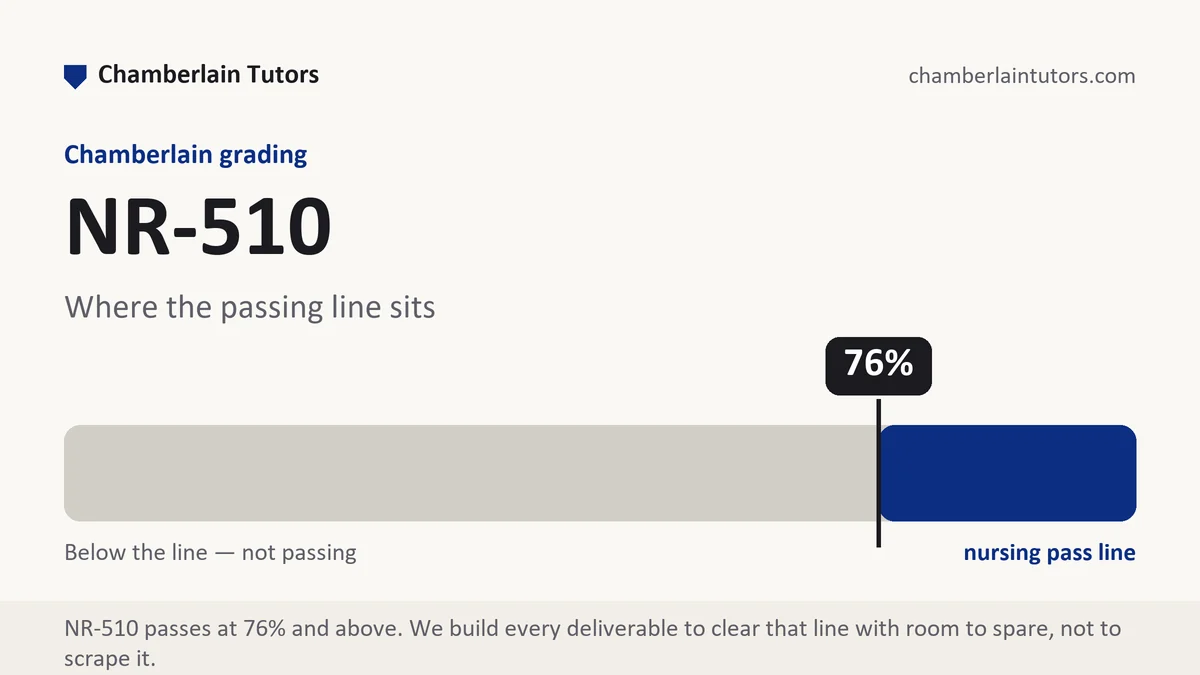
What NR-510 Week 8 asks for
A closing stage in a role course usually gathers everything into one plan. The pieces are recognizable: a statement of where you are going, an honest account of the distance between that and where you stand now, the steps and paperwork that close the distance, the people who will help, and a description of the leader you intend to be with a mechanism attached rather than a mood. The word vision does most of the damage in this week, because it invites writing that sounds finished and commits to nothing.
The deliverable is often the longest piece of the session and sometimes carries an appendix: a certification timeline, a licensure step list, a curriculum vitae, or a table of goals. Where an appendix is invited, use it, because moving reference material out of the body buys words for the reasoning sections. If your section runs a discussion this week, it will usually ask what changed in your thinking across the session, and a specific answer naming one abandoned assumption reads better than a summary of the course.
The standard that separates the bands is testability. Every element of the plan should be something an outside reader could check: a date, a document, a number, a named person or body. A goal to become a confident leader cannot be checked. A goal to complete certification within ninety days of graduation, submit a license application in a named state, and lead one practice change with a stated measure by the end of the first year can be, and it is the same ambition written so it can be graded.
The NR-510 Week 8 method, step by step
Six moves that convert a closing reflection into a plan somebody could hold you to.
-
Write the destination as a job posting
Describe the position you are aiming at the way an employer would advertise it: setting, patient population, hours, scope, the arrangement with other clinicians. Job posting language forces specificity that vision language lets you avoid.
-
Run the gap against law and money
Use what you built earlier in the session. Compare your destination with the authority rules of the state you named and with the economics of the setting you chose. Gaps found this way are real; gaps invented at the end of a course tend to be personality traits.
-
Put a date on every gap
Each item gets a target month and a first action. Certification examination, license application, controlled substance registration if your role requires it, a specific clinical skill, a professional relationship you need to build. Undated plans are lists.
-
Give the vision a mechanism
State what you want to change, at what level of the organization, using which of the influence routes you studied, and who would have to agree. Vision graded in this course means a change with a path attached, not an aspiration with adjectives.
-
Attach one measure per goal
Choose a single number for each objective and say where the number would come from. One measurable indicator per goal is worth more than a paragraph of intentions, and it stops the plan from being unfalsifiable.
-
Build the appendix the reader can verify
Where the assignment allows, close with the checkable material: the certification eligibility requirements you are working from, the licensure steps in your state with their sources, and a plain curriculum vitae. It demonstrates the plan is grounded in documents rather than in memory.
A layout and word budget for a professional development plan
The frame below is what our writers use for a closing plan running roughly 1,300 to 1,500 words, which is often longer than earlier weeks in a session. It is our own working outline, and your assignment's required sections replace any of ours that conflict.
| Section | What belongs in it | Word target |
|---|---|---|
| The destination | The role, setting, population and practice arrangement you are aiming at, written as a posting rather than as a hope. | 100 to 130 |
| Where you stand now | An honest inventory of what you already hold: license, experience, hours completed, relationships, and what is missing. | 150 to 180 |
| The gaps, dated | Each gap with a target month, a first action, and the document or body that governs it. | 220 to 260 |
| Vision with a mechanism | The change you intend to lead, the level it sits at, the route you would use and who must agree. | 200 to 230 |
| Measures | One indicator per goal, with the source of the number and the point at which you would judge it. | 150 to 180 |
| The first year | The plan divided into quarters, so the reader can see what happens in month three rather than in year five. | 150 to 180 |
Evidence and citation craft in a plan about yourself
A plan cites the requirements it is built on. Certification eligibility rules and state license application steps are published by the bodies that run them. Citing those documents turns a personal timeline into a sourced one, and it catches the requirement you assumed rather than checked.
Give a timeline estimate a provenance. Processing times for applications and registrations vary by state and by season. Where you predict how long a step takes, say where the estimate came from and treat it as a range rather than a promise.
Use leadership sources for mechanism, not for uplift. The value of a leadership model in this paper is that it names how influence moves through an organization. Quoting one for inspirational effect adds nothing a rubric can score. Quote it where you are explaining a step you intend to take.
Do not assert a salary you cannot source. Where compensation appears in a plan, tie it to a named survey with its year and geography, or leave it out. An unsourced figure in a document otherwise built on citations damages the reader's trust in the rest.
Your own experience is context, not proof. Personal history explains why you chose a goal. It does not establish that the goal is achievable or that the approach works, and where a claim needs support, the support has to come from outside your own account.
Five mistakes that cost points in this week's territory
- A vision with no actor in it. Improving access for underserved patients names an outcome and no path. Say who changes what, at which level, and who has to agree before it happens.
- Goals with no measure attached. Grow as a leader and become a strong clinician cannot be assessed by anybody, including you. One number per goal fixes the whole section.
- The plan begins after everything settles. Timelines that start once school is over and life calms down are the ones that never start. Put the first action inside the next ninety days.
- Requirements assumed instead of checked. Certification and licensure rules differ by body and by state and they change. A plan built on what a classmate said is a plan built on rumor.
- The paper written as a farewell letter. Thanking the course, describing personal growth and closing on gratitude spends the word budget on the one section no criterion row is paying for.
Before you submit
- The destination is written with setting, population and practice arrangement
- Every gap carries a target month and a named first action
- Certification and licensure requirements are cited to the bodies that publish them
- The vision names a level, a route and the person who would have to agree
- Each goal has exactly one measure with a stated source
- The first ninety days contain at least one action already scheduled
Closing out NR-510 this week?
Send the final assignment and the scoring guide out of Canvas. Our writers return a premium original draft in 24 to 48 hours with dated gaps, sourced requirements and a measure on every goal, and revisions run until the grade posts.