NR-510 is the three theory hour course on advanced practice role development, scope of practice, ethical and legal decision making, and visionary leadership inside organizations. Nothing in it is clinical. Everything is written, and it grades whether you can argue about authority: who may do what, under which law, and how a nurse practitioner decides when law, employer and patient pull in different directions.
What NR-510 actually grades
Students expect a soft course and meet a legal one. The subject matter is your own future scope: what an advanced practice nurse may prescribe, sign, order and bill for, and how that answer changes at a state line. Graders want one specific move. Take a rule that exists in writing somewhere, a practice act, a board regulation, an employer policy, a payer requirement, and reason from it to a decision about a case.
That is why generalized enthusiasm about the role scores badly. A paragraph explaining that advanced practice nurses improve access is true and unscored. A paragraph naming the specific authority that lets a nurse practitioner in a named state sign a home health certification, or explaining that the authority is absent and what the workaround is, sits in the top band. Role development here means the shift from a nurse who follows policy to a clinician who can read the source that policy came from.
The leadership half is graded the same way. Visionary leadership on paper means naming a change, naming the level of the organization that has to move, and naming what you would do at your own level of authority. Vision without a mechanism reads as a mission statement.
How we help in this course
NR-510 carries no clinical hours, so nothing here touches placement, preceptors, site paperwork or hour logs. The whole course is graded writing, and that is the layer our team covers.
Send the week's prompt and its rubric out of Canvas and you get a premium original draft in 24 to 48 hours, built against the actual criterion rows, with the regulatory reasoning sourced to documents you can open yourself rather than to a summary. Every draft clears both quality passes and the floor check, and revisions are free until the piece lands.
Writing this course's deliverables from the rubric
The method below is the one our writers use here, and it works whether or not you send anything to us. Read the scoring guide first, build the plan from it, then go looking for the regulation. The reverse order produces a paper full of interesting law that answers a question the rubric never asked.
In NR-510 right now?
Send the week and the rubric from Canvas. First premium sample free, floor-checked, back in 24 to 48 hours.
The scale that has no C
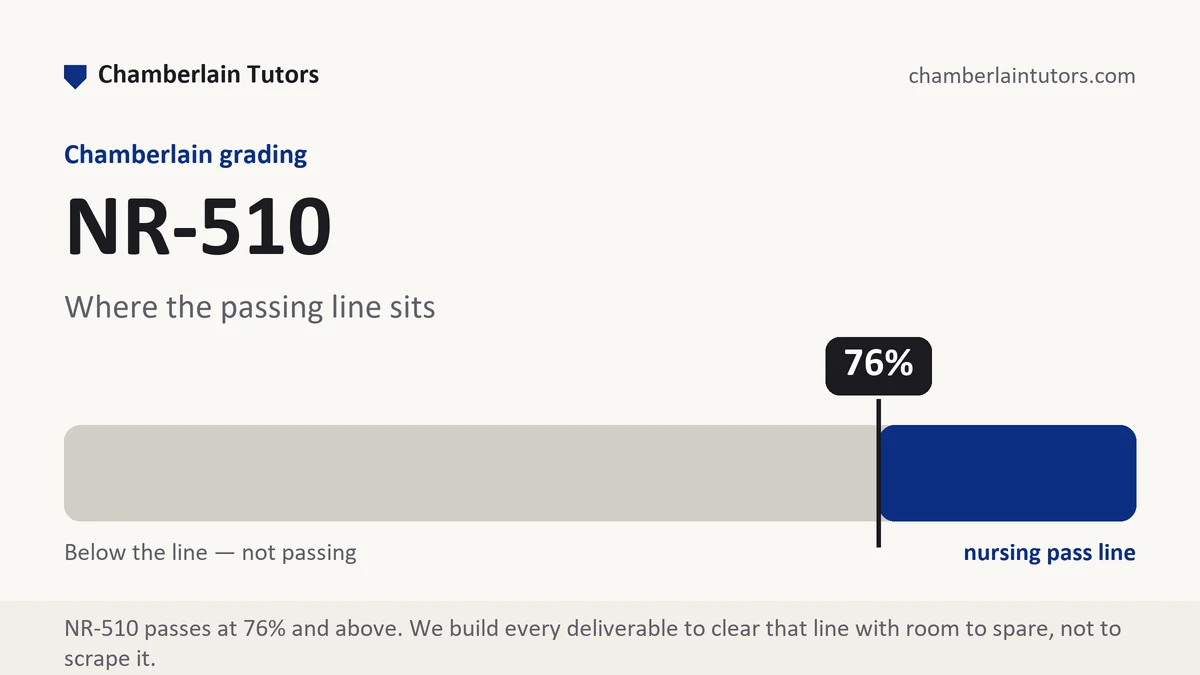
Core nursing courses at Chamberlain pass at 76 percent. The nurse practitioner specialty scale is stricter: there is no C band on it at all, so anything below 84 is a failure rather than a weak pass. NR-510 usually arrives early in the track, which means the average you build here is the cushion you spend later, in courses where the writing is harder and the reading is heavier.
Two structural facts make that cushion matter. Supplementary work cannot repair a weak weighted average, so no late rescue exists in week seven. And the calendar is compressed: sixteen week semesters split into two eight week sessions, up to six starts a year, deliverables due weekly. A week written the night before does not average out. It sits in the record and pulls the number toward a line with nothing underneath it.
Turn the criterion rows into a section plan
The prompt tells you the topic. The rubric tells you what earns marks, and only one of those two documents is open while your grade is decided. Copy the criterion rows into a blank file, one per line, in the guide's own order. Under each, write the verb that row is built on: analyze, compare, justify, apply, evaluate. Those verbs are your headings, and keeping the order means a grader scrolling for row four finds section four waiting.
Then convert weight into words, because a percentage in a scoring guide is a depth instruction in disguise. Suppose your week caps the paper at 1,400 words across four rows weighted 35, 30, 20 and 15 percent. The arithmetic gives roughly 490 words to the first row, 420 to the second, 280 to the third and 210 to the last. In a role and scope paper the heaviest row is almost always the one asking you to apply regulation to a situation, and 490 words is far more than the two sentences most drafts give it. The row students overwrite is background, where the history of the advanced practice role is easy to write and worth 210 words at most.
Write the target in brackets beside each heading while drafting and delete it once the section is full. If your guide excludes the title page and reference list from the count, note that too, since padding toward a limit that never included your references writes four hundred words nobody reads.
The shape of a scope of practice paper
Most graded writing in NR-510 is a scope and role analysis in one costume or another: a paper, a case response, a board post about an ethical conflict. Six parts, and a grader is hunting for every one of them.
| Part | What it has to establish | How the thin version reads |
|---|---|---|
| The situation, stated flat | Who is asking to do what, in which setting and which state, in two or three sentences with no windup. | An opening about the growing importance of advanced practice. |
| The governing authority | The named source that decides the question: a practice act, a board rule, an accrediting standard, a payer policy. | A claim about what nurse practitioners can do, with no source behind it. |
| What the authority actually says | The provision quoted or closely paraphrased, including its limits and any supervision or collaboration requirement. | A paraphrase so general it would fit any state. |
| Application to the case | The reasoning step: because the rule says this, the clinician in this situation may or may not proceed, and here is the qualifier. | A restatement of the rule with no decision attached. |
| The ethical layer | Where the legal answer and the right answer diverge, named honestly, with the principle you are weighing. | A sentence declaring the writer would always advocate for the patient. |
| The leadership move | What you would change and at which level, plus how you would know it worked. | A recommendation aimed at legislators the writer will never meet. |
Evidence and citation craft when your source is a rule
This course is unusual because much of your best evidence is not a study. It is a statute, a rule, a position statement or a national report, and each has its own handling rules.
- Cite the current version and say so. Practice acts are amended. A paper describing authority that a legislature changed two years ago is describing a world that no longer exists, and this is the single easiest error for a grader to catch. Where you cite a rule, name the year of the version you read.
- Go to the regulation, not to the article about the regulation. Advocacy pages and news coverage summarize, and summaries drop the qualifier that decides your case. Open the board of nursing text itself. Where you genuinely cannot reach the primary document, say plainly that you are working from a secondary account.
- Describe a study before you use its number. Set it up first: a retrospective analysis of 1.1 million primary care visits across four states examined whether outcomes differed by provider type, and then the finding. A statistic arriving alone with a year after it carries no argumentative weight.
- Keep the verb inside what the design supports. Nearly all workforce and access evidence here is observational. States with less restrictive authority had more clinicians practicing in rural counties is defensible. Removing restrictions increases rural supply is not, and overstatement in a course about legal reasoning is a self-inflicted wound.
- Give every rate a denominator and a window. Write that 4,180 of the 22,600 licensed clinicians surveyed in a single year held prescriptive authority, rather than that 18 percent did. A percentage without a base and a date proves nothing.
The gap between a passing paper and a strong one
A passing NR-510 paper is organized, positive about the role, and cites real sources. It explains what advanced practice nurses do, notes that scope varies by state, and recommends advocacy. On a scale with no C, that paper sits closer to the edge than it feels, because it never decided anything.
Strong papers do three things instead. They commit to one jurisdiction and one situation, so the analysis has something to be true about. They name the constraint rather than working around it, because a paper admitting that a rule blocks the clinician has an argument while a paper claiming full authority everywhere has only a mood. And they end inside the writer's reach: changing an employer's credentialing checklist is a plan, changing federal reimbursement is a wish.
Six mistakes that cost points here
- Writing about scope in general. There is no national scope of practice. A paper that never names a state has skipped the analysis the heaviest rubric row is paying for.
- Confusing licensure, certification and privileging. These are three separate gates operated by three separate bodies, and swapping them is the error that most reliably marks a draft as underprepared.
- Turning the ethics section into a values statement. Naming a principle and then asserting a conclusion is not analysis. Show the two obligations in tension and say which one you subordinate and why.
- Citing an advocacy organization as neutral. Position statements are legitimate evidence for what a profession argues, not for what the law requires. Label them as what they are.
- Submitting a board post from the text box. Chamberlain discussion posts do not reopen once submitted. Compose in a document, check the citation, then paste once.
- Recommending at a level you have no access to. Vision is graded on mechanism. A change with no named actor and no way to measure it reads as filler however sincerely it is written.
Questions NR-510 students ask
Which state should I write about if I plan to move after graduation?
How much of the paper should be history of the role?
The prompt asks for personal reflection but the rubric does not mention it. What do I do?
The weeks, one by one
Week 1
NR-510 Week 1 opens the advanced practice role course where the role actually begins, which is a change in who is accountable for a decision rather than a change in what you know. Read the full Week 1 manual.
Week 2
NR-510 Week 2 is where the course stops being about identity and starts being about law: what an advanced practice nurse in one named state may do, under which written authority, and what changes the moment you cross a state line. Read the full Week 2 manual.
Week 3
NR-510 Week 3 narrows from what an advanced practice nurse may do in general to the authority students ask about most and understand least: writing a prescription, and the separate federal permission needed before a controlled drug can appear on one. Read the full Week 3 manual.
Week 4
NR-510 Week 4 puts law and ethics inside the same case on purpose, because the problems that actually reach an advanced practice clinician are the ones where the lawful answer and the right answer point in different directions. Read the full Week 4 manual.
Week 5
NR-510 Week 5 moves the course inside a building. Read the full Week 5 manual.
Week 6
NR-510 Week 6 answers the question that decides whether an advanced practice role exists at all: who pays for the visit, what a practice has to complete before a payer will pay for it, and what the clinician has to produce to cover the cost of the seat. Read the full Week 6 manual.
Week 7
NR-510 Week 7 lifts the authority question out of the clinic and into the rooms where the rules get written, which means picking a lever, finding the person who controls it, and writing something short enough to be read. Read the full Week 7 manual.
Week 8
NR-510 Week 8 closes the course by turning seven weeks of analysis into a document about you: where you intend to practice, what has to be true before that can happen, and what you will actually change in the first year after graduation. Read the full Week 8 manual.