NR-510 Week 7 lifts the authority question out of the clinic and into the rooms where the rules get written, which means picking a lever, finding the person who controls it, and writing something short enough to be read. Your section may print this as NR 510 or NR510; it is the same course. Chamberlain publishes no syllabi outside Canvas. The placement here is our teaching judgment from the course's catalog arc; your section's rubric decides what your week actually asks.
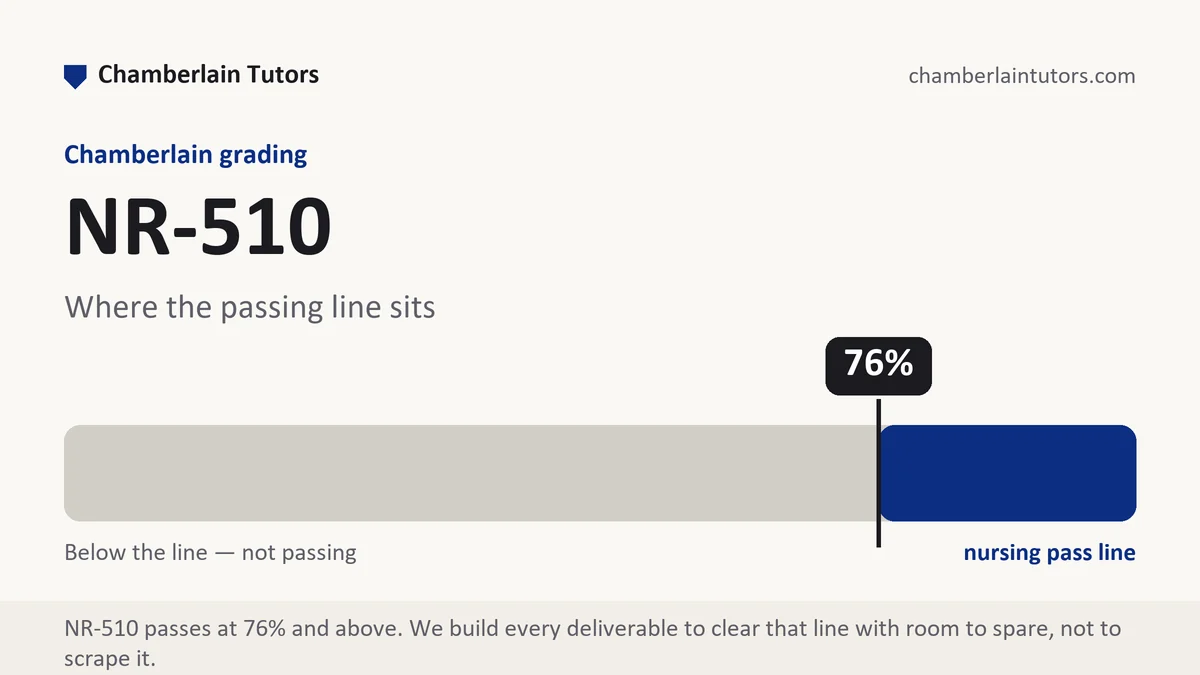
What NR-510 Week 7 asks for
The material here separates two machines that students routinely merge. Legislatures pass statutes, which are broad, slow and public. Agencies and boards write rules under those statutes, which are narrower, faster, and open to comment for a stated window before they take effect. A third machine sits beside both: payers write coverage policy that changes practice as effectively as any law. Knowing which machine controls your issue is most of the work, because an argument aimed at the wrong one cannot succeed however well it is written.
Deliverables at this stage are usually an issue brief, a policy analysis, or a drafted letter to a named official. Length is often short on purpose, since the form is built for a reader with limited time. If your section runs a discussion this week, expect a prompt asking you to defend a position on a live proposal, and remember that a posted position in Canvas cannot be revised after submission, so check the status of anything you cite before you paste.
The habit that lifts these papers is choosing the smallest lever that would solve the problem. Student policy writing reaches for federal legislation by reflex, and most of the barriers that matter to an advanced practice clinician sit in a state rule, a board policy or a payer manual, where a comment letter from a nurse is genuinely read. Aiming smaller is not modesty. It is accuracy about where the change is available.
The NR-510 Week 7 method, step by step
Six moves for building a brief that a busy office would act on rather than file.
-
State the problem as a number and a person
Open with a countable fact and one concrete situation it produces. A rural county with no prescriber accepting new patients and a named type of patient waiting eleven weeks is a problem. Access disparity is a category.
-
Identify the lever that controls it
Ask what document would have to change: a statute, an administrative rule, a board policy, a payer coverage manual, or an employer practice. Write the answer in one sentence, because everything about your audience and your ask follows from it.
-
Find the owner and the window
Levers have custodians and calendars. A rule has a comment period with dates. A bill sits with a committee. A payer policy has an annual update cycle. Name the owner and the next opening in the calendar, and your brief acquires urgency it did not have to manufacture.
-
Write the ask as one sentence
The reader has to be able to repeat what you want to somebody else. Support the bill as written, amend the rule to strike the chart review requirement, add the service to the covered list. Where a proposal already exists, cite it by its number and current status.
-
Answer the strongest objection
Find the best argument against your position, state it fairly in its own paragraph, and answer it with evidence rather than with adjectives. A brief that never names an opponent reads as though the writer has not met one.
-
Build for ninety seconds of attention
Front load the ask, keep paragraphs short, use one number the reader will remember rather than five they will not, and put detail in an appendix if your assignment allows. Persuasion here is a formatting problem as much as a writing one.
A layout and word budget for a policy issue brief
Below is the brief structure our writers work to when a week asks for policy material, sized for about 1,000 to 1,200 words. It is our shape, not an official form, and any structure your assignment prescribes replaces it outright.
| Section | What belongs in it | Word target |
|---|---|---|
| The problem, quantified | One countable fact and one concrete situation, with the source of the number in the sentence. | 90 to 120 |
| The lever and its owner | The document that would have to change, the body that controls it, and the next date on its calendar. | 150 to 180 |
| Where things stand now | The current rule or proposal, its status, and what happens if nothing changes. | 150 to 180 |
| The ask | One sentence a reader could repeat, followed by the specific wording or action you are requesting. | 120 to 150 |
| The case for it | Evidence organized around the reader's concerns rather than yours: access, cost, safety, workforce. | 220 to 260 |
| Objection and answer | The strongest counterargument stated fairly, answered with evidence, then the closing request. | 150 to 180 |
Evidence and citation craft in a policy brief
Public data outranks everything else here. Figures from a health department, a licensing board, a census product or a federal agency carry weight with policy readers precisely because nobody can accuse them of being produced for the argument. Reach for those first and cite the dataset and year, not a news article about them.
Say who paid for the report. Research funded by an association, an insurer or a professional body may be perfectly sound and still needs its sponsor named in the sentence. Disclosing it protects your argument; letting a reader discover it themselves ends your argument.
A bill is a document with a number and a status. If you write about proposed legislation, give its identifier, its chamber, its most recent action and the date. A brief describing a proposal without saying where it currently sits tells the reader the writer has not checked this month.
Cost estimates are models with assumptions inside. Where you cite a projected saving, name who produced it and one assumption it rests on, such as an assumed uptake rate. Projections cited as facts are the easiest claim in a brief to knock over.
One number, repeated, beats five mentioned once. Briefs are read quickly and remembered badly. Choose the single figure that carries your case, put it in the opening, and return to it in the close instead of scattering statistics through every paragraph.
Five mistakes that cost points in this week's territory
- The argument aimed at the wrong machine. Asking a legislature to change something a board controls, or a board to change something a payer decides, produces a brief that cannot succeed on its own terms.
- The brief written for clinicians. Policy readers are not nurses. Clinical shorthand, unexplained acronyms and professional grievance language all reduce a document that was supposed to persuade an outsider.
- A problem with no number in it. Every issue in health policy competes with other issues for attention. A brief that cannot say how many people, how often or how much has not entered the competition.
- Position statements used as proof of effect. An organization declaring that a change would improve access is evidence of advocacy. Evidence of effect comes from data, and conflating the two is the error most likely to be circled in this week.
- No ask anywhere in the document. A brief that ends with a call for more attention to an issue has wasted the only sentence in it that mattered.
Before you submit
- The opening carries one sourced number and one concrete situation
- The controlling document is named, along with the body that owns it
- Any proposal cited includes its identifier, its status and the date checked
- The ask appears as a single repeatable sentence
- The strongest objection is stated fairly and answered with evidence
- Sponsorship is named for every source produced by an interested party
Drafting the policy piece this week?
Send the brief instructions and the criterion rows out of Canvas. A premium original draft returns in 24 to 48 hours with a real lever identified, a repeatable ask, and every figure sourced to a public dataset, revisions free.