NR-510 Week 3 narrows from what an advanced practice nurse may do in general to the authority students ask about most and understand least: writing a prescription, and the separate federal permission needed before a controlled drug can appear on one. Your section may print this as NR 510 or NR510; it is the same course. Chamberlain publishes no syllabi outside Canvas. The placement here is our teaching judgment from the course's catalog arc; your section's rubric decides what your week actually asks.
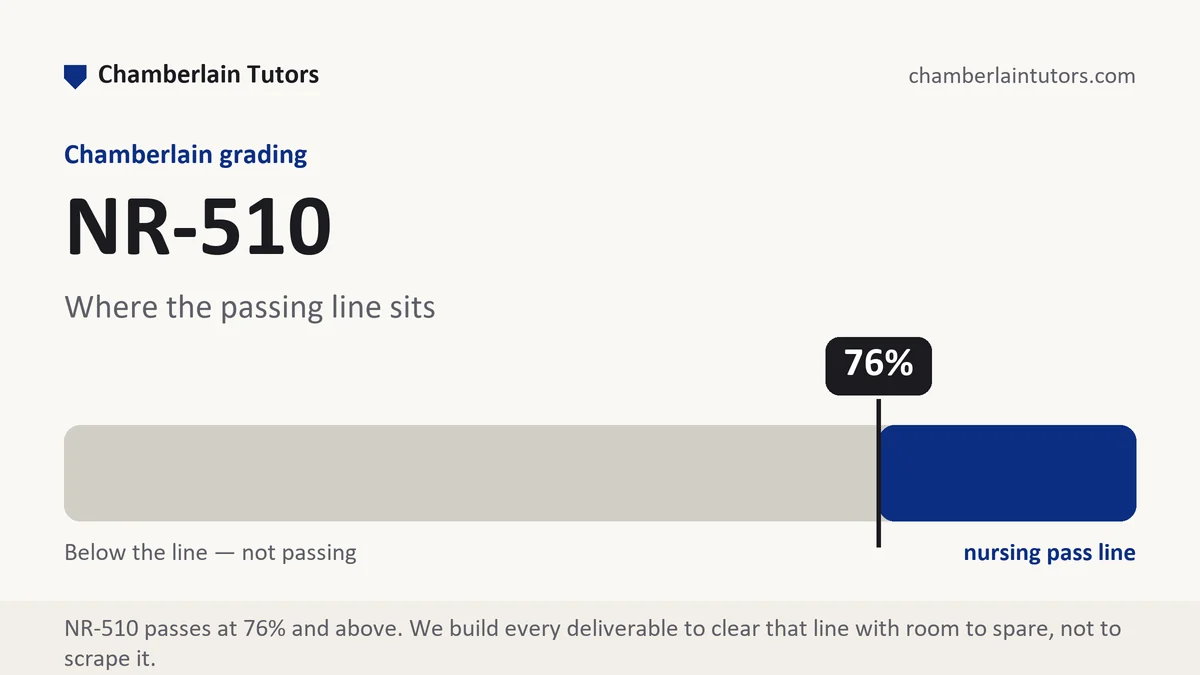
What NR-510 Week 3 asks for
This stage is built on a two layer permission structure. A state decides whether an advanced practice nurse may prescribe at all, what may be on the list, and under what arrangement with another clinician. A federal registration, held personally by the prescriber, decides whether controlled substances may be ordered and at which schedules. Both layers must be satisfied, they are issued by different authorities, and a clinician can hold one while lacking the other. Around that core sit the working duties: monitoring program queries, quantity and duration limits for certain drugs, electronic prescribing requirements, and record keeping.
Deliverables at this point usually take the form of a case. A clinician wants to write something for a patient, and you are asked whether that is permitted, under what conditions, and what to do if it is not. Some sections run this as a paper and some as a posted case response. If your section runs a discussion this week, write it in a document first, because the citation to a rule is the part that cannot be fixed after a post is submitted in Canvas.
What earns the top band is a conditional answer. Prescribing questions are almost never yes or no; they are yes provided the arrangement is on file, or no at this schedule but yes at that one, or yes only after the monitoring database has been queried. A draft that produces a flat verdict has usually skipped the conditions, and the conditions are where the reasoning marks live.
The NR-510 Week 3 method, step by step
Six moves for turning a prescribing question into an answer a licensing board would recognize.
-
Split the question before answering it
Write two headings on your page: may this clinician prescribe at all in this state, and is this particular drug a controlled substance. The answer to the case is the intersection of those two, and separating them stops the paper from collapsing into a single vague paragraph.
-
Find the formulary language
Some states grant prescribing authority and then carve pieces out of it, by schedule or by drug class or by setting. Locate the provision that describes what may be prescribed, quote its limits, and note whether the limits sit in the statute or in the board rules.
-
List the conditions on the grant
Written arrangements with a collaborating physician, a period of supervised practice after certification, protocols filed with the board, chart review obligations. Write them as a checklist before you write prose, and mark which ones your scenario satisfies and which it does not.
-
Check the monitoring duty and its trigger
Many states require a query of the prescription monitoring database before certain prescriptions, and the requirement is written with a trigger: a schedule, a day supply, a new patient. State the trigger, then say whether your case meets it.
-
Write the answer as a conditional
Build the decision sentence explicitly. This clinician may write this prescription if the arrangement is current and the database has been queried; the same clinician may not write it at this schedule in this state. That sentence is what the application row is buying.
-
Say what happens when the answer is no
A refusal is not the end of the case. Name the alternative: a non controlled option, a consultation, a referral, or a documented handoff to a prescriber who does hold the authority. Ending on the block without the next step reads as an unfinished analysis.
A layout and word budget for a prescribing case analysis
This is the shape our team drafts to for a prescribing scenario running about 1,100 to 1,300 words. Treat it as a working outline rather than a standard, and let the criterion rows in your own scoring guide reorder it whenever they disagree.
| Section | What belongs in it | Word target |
|---|---|---|
| The request, stated flat | Who wants to prescribe what, for which patient situation, in which state and setting, with no preamble. | 70 to 90 |
| State authority to prescribe | The provision granting prescriptive authority, its formulary limits, and where those limits are written. | 170 to 200 |
| The federal layer | Whether the drug is controlled, at which schedule, and what personal registration the prescriber would need. | 170 to 200 |
| Conditions and duties | Arrangements, filings, supervised periods, database queries, quantity limits, with your case checked against each. | 200 to 240 |
| The decision, conditional | The verdict written with its qualifiers attached, so a reader can see exactly what it depends on. | 170 to 200 |
| What the patient gets | The next clinical step whichever way the decision fell, including referral or an alternative agent. | 100 to 130 |
Evidence and citation craft across two levels of government
Never cite one government for the other. A federal registration rule says nothing about whether your state allows prescribing, and a state board rule cannot alter a federal schedule. Keep the two source sets visibly separate in your reference list so the reader can see you know which is which.
Schedules move. Drugs are rescheduled, and states occasionally add restrictions above the federal baseline. Name the year of the listing you read, and where your state is stricter than the federal rule, say so plainly, because the stricter rule governs the clinician.
A clinical drug reference is not a legal source. Point of care applications and formulary tools are excellent for dosing and terrible for authority. When the sentence is about permission, the citation belongs to a statute, a rule or an agency document.
Give prescribing statistics a base and a period. Write that 12,400 of the 96,000 prescriptions reviewed over one year were written for a schedule two agent, rather than reporting a percentage alone. Prescribing rates without a denominator and a window cannot be compared with anything.
Keep implementation claims observational. Evidence about monitoring programs and prescribing limits is nearly all before and after work with confounders running through it. States adding a query requirement reported fewer overlapping prescriptions is defensible; the requirement reduced overdose deaths is a claim the design cannot pay for.
Five mistakes that cost points in this week's territory
- A federal registration treated as permission to prescribe. Registration lets a clinician handle controlled substances once a state has already granted prescribing authority. It never creates that authority, and swapping the two is the single most common error in this territory.
- The formulary exclusion missed entirely. Papers that establish general prescribing authority and stop there miss the carve out that decides the case, which is usually written in the board rules rather than in the act.
- A flat yes or no. An answer with no condition attached tells the grader that the arrangement, the filing and the query requirement were never examined.
- Dispensing confused with prescribing. Handing a patient a package is governed by different rules from writing an order for one, including rules about samples and labeling, and the distinction is worth a sentence in every case where product changes hands.
- A workaround recommended that the rule forbids. Suggesting that a colleague sign instead, or that a standing protocol can substitute for a missing arrangement, converts an analysis problem into a professional conduct answer, and graders mark it hard.
Before you submit
- State authority and the federal controlled substance layer are answered in separate sections
- The formulary limit is quoted from the document that actually contains it
- Every condition on prescribing is checked against the facts of the scenario
- The monitoring database requirement is stated with the trigger that activates it
- The verdict is written as a conditional rather than as a flat yes or no
- A clinical next step exists for the patient whichever way the decision fell
Working a prescribing case this week?
Send the scenario and the criterion rows out of Canvas. A premium original draft returns in 24 to 48 hours with the state layer and the federal layer sourced separately and the decision written with its conditions, revisions included.