NR-505 Week 3 is the stage students underestimate most and the one graders check most literally. The search is not something you did before writing; it is part of the written work, and it is assessed on whether someone else could repeat it and get your results. That means databases named, terms and combinations shown, limits stated, counts reported and selection decisions explained. Your section may print this as NR 505 or NR505; it is the same course. Chamberlain publishes no syllabi outside Canvas. The placement here is our teaching judgment from the course's catalog arc; your section's rubric decides what your week actually asks.
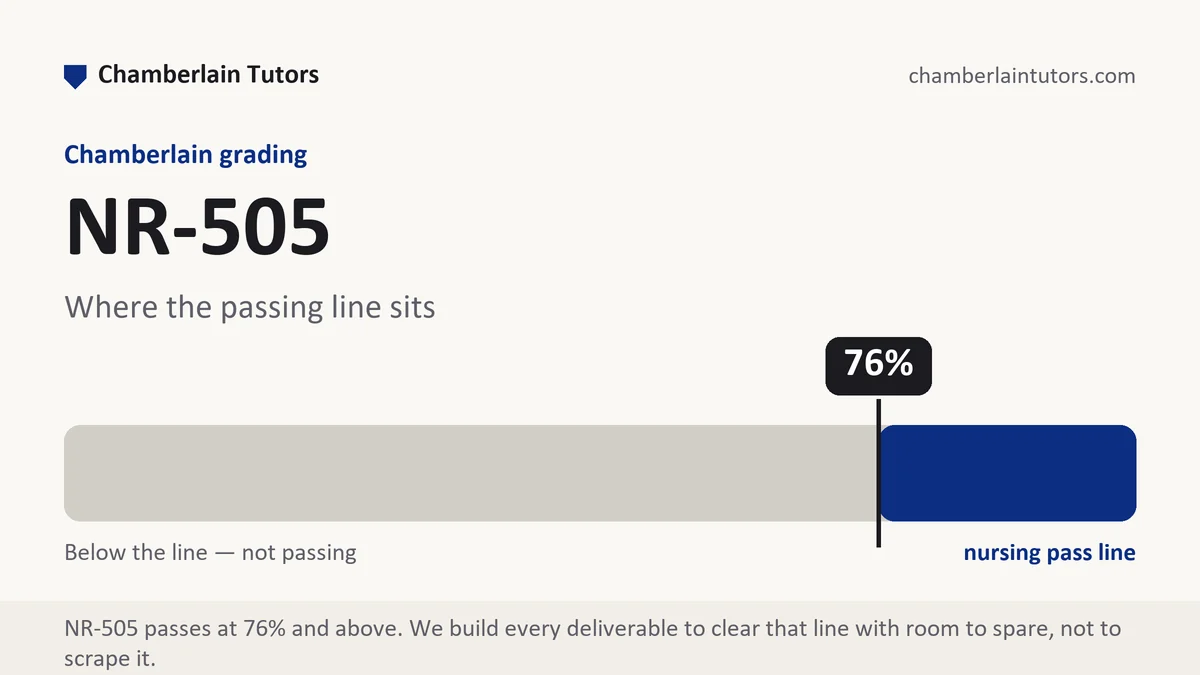
What NR-505 Week 3 asks for
The graded object here is reproducibility. A sentence saying that a search of several databases was conducted using relevant keywords is the standard low scoring version, and it is low scoring because it contains no information. The version that scores states which databases, which controlled vocabulary headings and free text terms, how they were combined with the Boolean operators, which limits were applied for date, language, age group and publication type, how many results each combination returned, and what happened to them.
Selection is the second half. Screening by title, then by abstract, then by full text is the normal sequence, and the numbers that survive each stage tell the reader as much as the terms did. Inclusion and exclusion criteria have to be written before you screen rather than reconstructed afterwards, since criteria invented to justify a set of papers you already liked show up as inconsistencies between the criteria and the final list.
Deliverables around this point tend to include a written search strategy, sometimes with a table or a flow of counts, and sometimes an early evidence table. If your section runs a discussion this week, it will often ask what terms worked, which is genuinely useful to read; posts do not reopen after submission in Canvas, so include the actual strings rather than describing them.
The NR-505 Week 3 method, step by step
Six moves for a search someone else could run.
-
Build a concept grid before opening a database
One column per concept from your question, one row per synonym, including spelling variants and the terms clinicians used a decade ago. Searching from a grid produces coverage. Searching from memory produces whatever you thought of first.
-
Search each concept separately, then combine
Run the population set, the intervention set and the outcome set as separate searches, joining synonyms within a concept and then joining the concepts together. Combining at the end lets you see which concept is destroying your yield, which is information you cannot get from one long string.
-
Use controlled vocabulary and free text together
Subject headings catch indexed articles reliably and miss recent ones; free text catches recent work and picks up noise. Doing both, and saying you did both, is what separates a graduate search from a search box.
-
Apply limits deliberately and record them
Date range, language, peer review status, age group, publication type. Each limit is a decision that excludes real evidence, so state it and justify the ones that could change your findings, particularly the date range.
-
Record counts at every stage as you go
Results returned, records screened by title, abstracts read, full texts retrieved, studies included, with reasons for the exclusions at full text. Reconstructing these later is painful and inaccurate, and graders can tell when the numbers do not add up.
-
Chase the reference lists of your best papers
Hand searching the references of a strong review usually finds two or three studies your terms missed. Say that you did it and what it produced, because it demonstrates that you understand where database searching is weakest.
A layout and word budget for a search strategy write-up
Our frame for a search stage deliverable, sized for roughly 1,000 to 1,300 words of narrative plus whatever table your guide asks for. It is our own outline, not a university document, and your week's rubric outranks it wherever the two disagree.
| Section | What belongs in it | Word target |
|---|---|---|
| Purpose and question restated | One sentence of question and one of what the search had to find, without re-arguing the problem. | 60 to 90 |
| Databases and why | Each database named with a sentence on what it covers and why it suits this question rather than being a default. | 150 to 190 |
| Terms and combinations | The concept grid in prose or table form, with the actual strings and operators shown rather than described. | 250 to 320 |
| Limits and criteria | Every limit applied, with inclusion and exclusion criteria written as rules a second person could follow. | 200 to 250 |
| Yield and screening | Counts at each stage, reasons for exclusion at full text, and the number that reached the synthesis. | 200 to 240 |
| Limitations of the search | What the strategy probably missed and what you did about it, including hand searching. | 140 to 180 |
Evidence craft for search documentation
Name databases as products, not as places. Say which database and, where relevant, which platform you searched it through, because the same database returns different results through different interfaces and a reader trying to reproduce your work needs both. Give the date you ran the search too, since databases grow.
Distinguish peer reviewed research from everything else. Guidelines, position statements, quality improvement reports and organizational white papers all have a place in a proposal and none of them is a primary study. Label each source type when you introduce it, and check whether your guide sets a minimum number of primary research reports.
Treat date limits as an argument. A five year limit is conventional and defensible for clinical evidence, and it will exclude the landmark study in some fields. Where you apply it, say so; where you make an exception for an older key paper, say that too and give the reason in the sentence.
Be careful with sources that are not what they appear. Some journals accept anything for a fee, and some articles that look like research are commentary. Check that a cited study reports a method and results, not just conclusions, and prefer sources indexed in the databases your program provides over anything a general web search surfaced.
Five mistakes that cost points in this week's territory
- Describing the search instead of showing it. Relevant keywords were used is the single most common sentence in a low scoring search section.
- One long string with no structure. Without concept blocks you cannot tell which term collapsed your yield, and neither can your reader.
- Criteria written after screening. Retrofitted rules contradict the final list, and the contradiction is visible to anyone reading both.
- No counts anywhere. A search with no numbers cannot be reproduced or believed, and it removes the easiest points in the section.
- Stopping at the first page of results. Relevance ranking is not evidence selection, and a set of studies that all happen to agree is usually a set chosen by convenience.
Before you submit
- Every database is named with a reason for including it
- The actual search strings appear, with operators visible
- Controlled vocabulary and free text terms are both present
- Inclusion and exclusion criteria are written as rules, not preferences
- Counts appear at each screening stage and the arithmetic is consistent
- The date the search was run is stated
Writing up the NR-505 search?
Send the rubric and your question out of Canvas. A premium original draft comes back in 24 to 48 hours with the strategy documented to reproducible detail and the screening counts laid out, and revisions run until the grade lands.