NR-505 covers research methodology and literature critique, and it points them at a practical target: an evidence based project addressing quality improvement or safety. The work builds across the session rather than sitting in separate weeks, so the problem you choose early determines how hard every later piece will be. This page is the manual for choosing well and writing each stage so it survives the next one.
What NR-505 actually grades
The scoring rows track a chain, and the chain is what gets marked rather than any single link. A practice problem stated with evidence that it exists. A question built so it can actually be searched. A search you documented well enough that someone could repeat it. A body of evidence synthesized rather than listed. A proposed change that follows from that evidence rather than from your preference. And a measure that would tell you whether the change worked.
Where papers break is between synthesis and proposal. Students find good literature, describe it accurately, then recommend something the literature did not support, usually because the recommendation was decided before the search began. Graders read the two sections side by side, and a proposal with no visible line back to the evidence loses points in both rows at once.
How we help in this course
Send the prompt, the scoring guide from Canvas, and the practice problem you are working with, along with anything already submitted in this course, because the pieces are meant to fit together and a stage written in isolation shows. The draft comes back with the question narrowed until it is searchable, the search documented in the form your guide asks for, evidence grouped by what it shows rather than by article, and a proposed change traceable line by line to the studies behind it.
Orders run the full pipeline: guide decoded row by row, core deliverables separated from supplemental, a writer matched to research methods and quality improvement work, a rubric pass then an independent APA and originality pass, the scale check against your section's floor, delivery inside 24 to 48 hours. Note one boundary: we help you write a proposal. We do not carry out a project in a clinical setting, and no part of this service involves your workplace or any clinical record.
How to write this course's deliverables
Chamberlain publishes no syllabi outside Canvas, so what follows is craft rather than a week grid. It covers converting your scoring guide into a word budget at a per point rate, the parts an evidence based practice proposal has to contain, and the appraisal habits that keep the evidence section defensible.
In NR-505 right now?
Send the week and the rubric from Canvas. First premium sample free, floor-checked, back in 24 to 48 hours.
Why an early wrong turn is expensive here
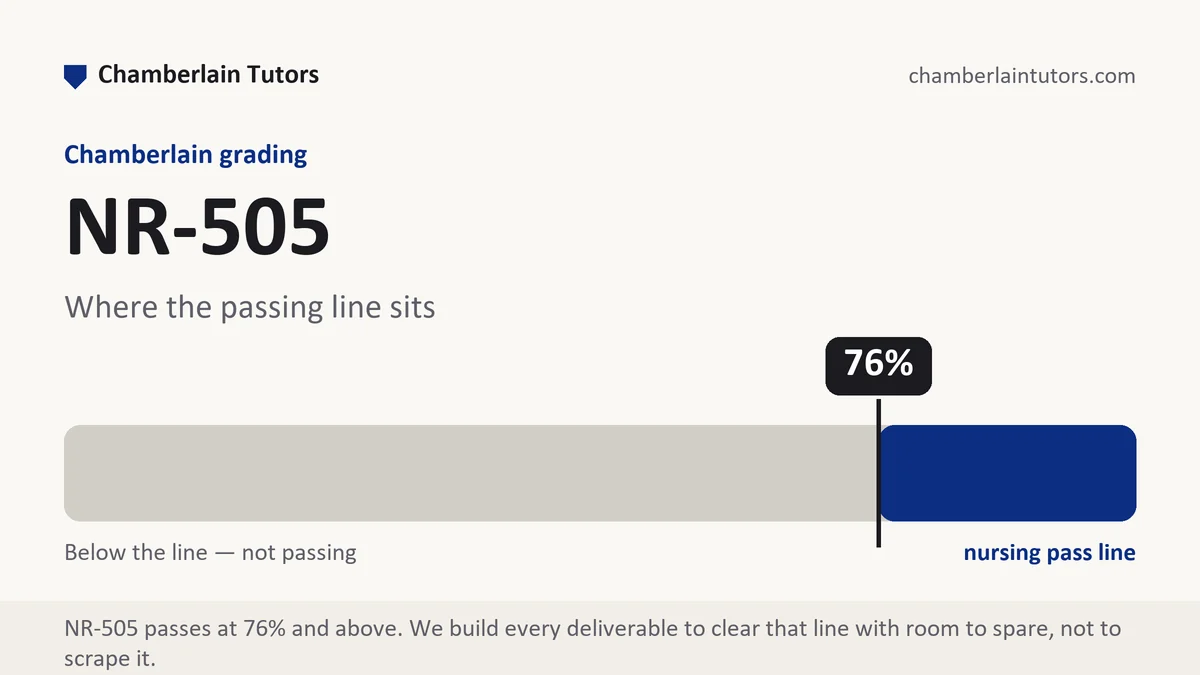
Most core nursing courses let a weak week stay a weak week. This one compounds, because later deliverables are built on earlier ones, so a problem chosen badly in the first fortnight costs points repeatedly for the rest of the session. The 76 percent floor applies as everywhere in core nursing coursework, core assignments are averaged apart from supplemental ones, and supplementary work cannot rescue a weighted average that has already gone soft.
The compression makes it sharper. Sessions run eight weeks inside a sixteen week semester with deliverables due weekly, which leaves no gap in which to change direction quietly. If the problem you picked turns out to have almost no literature behind it, raise it with your instructor in the first two weeks rather than the sixth, when the synthesis section makes the shortage impossible to hide.
A per point word rate, and where to spend it
Read the scoring guide before you open a database. Search behaviour changes completely depending on whether the evidence row is worth a tenth of the grade or a quarter, and students who search first tend to gather whatever appears and then bend the paper around it. Copy the rows into a blank document as headings in the guide's order, then convert points into words.
Work an example. Say the paper is capped at 1,600 words with six rows: problem and significance at 15 points, the question at 15, search strategy at 15, evidence synthesis at 25, proposed change with implementation at 20, and APA with scholarly writing at 10. Lift the APA row out, since it is earned across the document. Reserve 150 words for the opening and closing. That leaves 1,450 words against 90 points, about 16 words per point. The problem, question and search sections take roughly 240 words each, synthesis takes around 400, and the proposed change about 320.
Two things fall out of that arithmetic. Two hundred and forty words is a tight budget for a search strategy, which means it has to be written as specification rather than narrative: databases, terms, limits, and what came back. And 400 words of synthesis is not four 100 word article summaries, because summaries at that length say nothing. It is two or three paragraphs organized by finding, each one carrying several studies. If your own guide weights synthesis more heavily, the case for grouping by finding rather than by article gets stronger, not weaker.
The parts of an evidence based practice proposal
However your section stages the work, the proposal has to cover this ground, and each part has a familiar weak version.
| Part | What it has to establish | The version that loses points |
|---|---|---|
| The practice problem | A specific problem in a specific setting, with a figure showing it exists there or in comparable settings | A national issue described in general terms with no local anchor |
| Why it matters here | The consequence of leaving it alone, stated in outcomes rather than adjectives | An assertion that the problem is significant, repeated in three sentences |
| The question | Population, the change being considered, the comparison, the outcome, and a time frame, written so it could be searched | A topic phrased as a question, which returns thousands of irrelevant results |
| The search, documented | Databases named, search terms and combinations, limits applied, and how many results were kept | A sentence saying a literature search was conducted using several databases |
| Evidence synthesized | Findings grouped by what they show, with agreement and disagreement between studies both visible | One paragraph per article, in the order they were found |
| The proposed change | What would be done, by whom, to whom, how often, and which studies support each element | A recommendation to educate staff, with no mechanism and no source |
| Evaluation | The measure, the baseline, the comparison period, and who would collect it | Outcomes would be monitored for improvement |
Handling the evidence so the proposal holds
The evidence section is where this course is won, and four habits carry most of it.
Rank before you write. Not all support is equal, and a scoring guide at this level expects you to notice. Say what kind of study each central piece of evidence is, because a systematic review of trials and a single site pre and post project support very different strengths of claim, and treating them as equivalent is the error that flattens an otherwise good synthesis.
Provenance before finding, always. No result should reach the reader ahead of its context. In a randomized trial of 486 adults across four clinics is nine words that convert a claim into evidence. And match verbs to design: observational work supports was associated with, occurred more often among and predicted, while reduced, prevented and improved belong only where an intervention was applied deliberately and the outcome measured.
Every rate arrives with what was counted and over how long. Baseline figures are where proposals leak credibility. Write that 21 of the 305 patients admitted over a six month period experienced the event, rather than that the rate was 6.9 percent, and if you use the percentage, keep the count and the window in the same sentence. A baseline with no denominator cannot be compared with anything afterwards, which quietly destroys the evaluation section too.
Keep the clock visible. Where your guide sets no recency rule, treat five years as the working boundary for evidence and justify anything older inside the sentence that uses it. Guidelines carry their own dates and get revised, so name the issuing body and the version year rather than citing a guideline as though it were timeless.
Passing proposal, strong proposal, in NR-505
A passing NR-505 proposal identifies a real problem, finds relevant literature, describes it accurately, and recommends a reasonable change. It clears the floor and reads as an assembled set of stages rather than one argument.
A strong proposal differs in three ways a grader can point at. Its question is narrow enough that the search terms are obvious from reading it, which is the clearest sign the writer understood the searching stage. Its synthesis reports disagreement, because a body of literature in which every study agrees usually means the search was too narrow or read too kindly, and saying where studies conflict is the strongest evidence of genuine reading. And its proposed change is sized to the evidence: a pilot where the support is thin, a fuller change where it is strong, and an honest sentence about which parts of the plan the literature does not cover.
Six mistakes that cost points here
- Deciding the intervention before searching. The proposal then has to be defended against the evidence rather than built from it, and graders see the seam.
- A question too broad to search. If the terms are not visible in the question, the search section will be vague and the synthesis unfocused.
- Synthesis written article by article. Grouping by source is a reading list. Grouping by finding is the graded skill.
- Baselines with no denominator or period. An unmeasurable starting point makes the evaluation section unmeasurable too.
- Evidence quoted from abstracts. The numbers you need sit in the methods and results sections, and abstracts report the friendliest version.
- An evaluation plan with no collector. Naming who gathers the measure, and how often, is what turns a plan into something that could happen.
Questions NR-505 students ask
Do I have to actually carry out the project I propose?
How many articles do I need, and can I use a systematic review?
What actually makes a synthesis different from a summary?
The weeks, one by one
Week 1
NR-505 Week 1 is the most consequential stage of the session, because everything built later is built on whatever you choose here. Read the full Week 1 manual.
Week 2
NR-505 Week 2 converts a problem into a question a database can answer. Read the full Week 2 manual.
Week 3
NR-505 Week 3 is the stage students underestimate most and the one graders check most literally. Read the full Week 3 manual.
Week 4
NR-505 Week 4 asks you to read a quantitative study the way a methodologist does rather than the way a reader does. Read the full Week 4 manual.
Week 5
NR-505 Week 5 turns to the evidence that explains why an intervention works or fails rather than whether it did. Read the full Week 5 manual.
Week 6
NR-505 Week 6 is where the appraised studies stop being a pile and start being an argument. Read the full Week 6 manual.
Week 7
NR-505 Week 7 asks the question the whole session has been building toward: given what the evidence shows, what exactly would you change, and how would that change reach the people who have to do it. Read the full Week 7 manual.
Week 8
NR-505 Week 8 closes the chain by answering two questions the earlier stages left open. Read the full Week 8 manual.