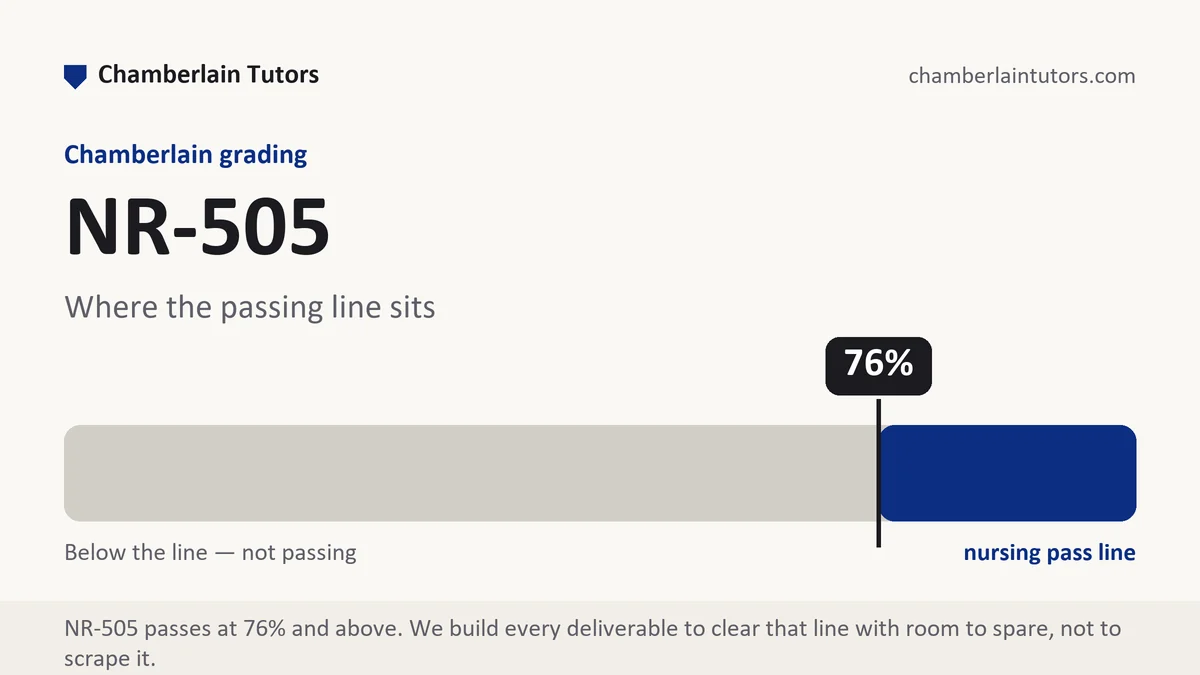
NR-505 Week 1 is the most consequential stage of the session, because everything built later is built on whatever you choose here. The opening territory is the practice problem: a specific gap between what happens on a unit and what the evidence says should happen, stated narrowly enough to be searched and documented well enough that a reader believes it exists. Choose loosely and every later stage costs more. Your section may print this as NR 505 or NR505; it is the same course. Chamberlain publishes no syllabi outside Canvas. The placement here is our teaching judgment from the course's catalog arc; your section's rubric decides what your week actually asks.
What NR-505 Week 1 asks for
A practice problem is not a topic, a population or an interest. It is a discrepancy, and the word that makes it graduate work is gap. Falls is a topic. Patients on the medical unit are not being reassessed for fall risk after a change in medication, although the protocol requires it, is a problem. The difference is that the second version implies a measurement, an intervention and a comparison, while the first implies a reading list.
The opening stage usually asks you to describe the problem, establish that it matters, and place it in a setting. Establishing that it matters is where marks are gained and lost, because most students argue significance by assertion. The graded version cites the size of the problem where it has been measured, names the consequence in outcome terms rather than in adjectives, and gives at least one indication that the setting you describe resembles the settings where it was studied.
There is a scoping judgment underneath all of this. The problem has to be small enough that a body of literature exists on precisely it, and large enough that the literature is not one paper. Opening deliverables here are often short, sometimes a page or two of written work or a posted response, but the size of the deliverable is a poor guide to its importance. If your section runs a discussion this week, draft it elsewhere first, since a post cannot be edited after submission in Canvas and this is the week classmates and faculty give the most useful early feedback.
The NR-505 Week 1 method, step by step
Six moves for choosing a problem you will not regret in week six.
-
Start from something that annoys you at work
Recurring frustration is a reliable detector of a real gap. Write down three things that go wrong often enough to be predictable on your unit. Interest sustains eight weeks of reading in a way that an assigned topic does not.
-
Write each one as a discrepancy
Two clauses: what happens now, and what should happen according to a standard, guideline or evidence base. If you cannot complete the second clause, that candidate is a topic rather than a problem and it will fail in the search stage.
-
Test each candidate against the literature for fifteen minutes
Run a rough search on each before committing. A candidate that returns almost nothing is a research question rather than an evidence based practice problem, and a candidate that returns thirty thousand results is still a topic. This fifteen minutes is the cheapest insurance in the course.
-
Size the problem with a number you can defend
Find one figure that shows the problem exists, either locally or in a comparable setting, and record its base and its window at the same time. A problem with no magnitude cannot have an evaluation stage later, because there is nothing to compare against.
-
Name the population precisely
Adults is not a population. Adults admitted to a medical surgical unit with two or more antihypertensive medications is. Precision here is what makes the searching stage tractable rather than exhausting.
-
Say what happens if nothing changes
Close with the consequence stated in outcome terms: readmissions, injuries, delays, unplanned transfers, avoidable costs. This paragraph is the significance row, and vague versions of it lose points more often than any other single sentence in an opening stage.
A layout and word budget for a practice problem paper
The frame our tutors use for an opening problem statement, sized for roughly 900 to 1,200 words. It is our own outline rather than anything the university issues, and your week's rubric outranks it wherever the two disagree.
| Section | What belongs in it | Word target |
|---|---|---|
| Problem statement | The discrepancy in two clauses, current state against expected state, with the standard named. | 120 to 150 |
| Setting and population | The kind of unit, the patient group defined by clinical characteristics rather than by convenience, and the staff involved. | 150 to 180 |
| Magnitude | At least one defended figure with its base and its period, plus a sentence on how comparable the source setting is to yours. | 200 to 250 |
| Consequence | What the gap costs in outcomes, sourced rather than assumed, and who carries the cost. | 200 to 240 |
| Why it is addressable | Evidence that something has been tried elsewhere, named in one sentence each, without becoming a literature review. | 150 to 200 |
| Scope note and close | What you are deliberately excluding, and the question the rest of the session will answer. | 100 to 130 |
Evidence craft for establishing a problem
Separate the three kinds of number. National prevalence, published rates from comparable settings and your own local figures do different work and carry different weight. Say which kind you are using in the sentence that uses it, because a national statistic tells the reader the problem exists somewhere and only a local or comparable figure tells them it exists where you are.
Local data has to be handled carefully. If you cite a figure from your own workplace, describe it generally, avoid anything that identifies the organization, and be accurate about where it came from and what period it covers. Do not report internal data you do not have permission to use, and do not present a recollection as a measurement.
Benchmarks come from bodies and have dates. A target rate or a threshold is issued by an organization, published in a year and revised. Name the body and the version in the sentence, since a benchmark quoted without its source is exactly as persuasive as an opinion.
Age matters more for magnitude than for mechanism. Where your guide sets no recency rule, treat five years as the working boundary for prevalence, cost and outcome figures. Descriptive work about how a process fails can stand older, provided you say why the older source still describes current practice.
Five mistakes that cost points in this week's territory
- A topic submitted as a problem. If the statement has no expected state in it, there is no gap and the rest of the session has nothing to close.
- Significance argued by adjective. Serious, alarming and widespread are not evidence. A rate with a denominator is.
- A problem chosen because the intervention was already decided. Starting from a solution guarantees a search that only looks for agreement.
- A population defined by setting alone. Patients on my unit gives the searching stage no clinical characteristics to work with.
- Scope left open. Without an explicit exclusion the search returns three adjacent problems and the synthesis later loses focus.
Before you submit
- The statement contains both a current state and an expected state
- The population is defined by clinical characteristics, not just by location
- At least one magnitude figure carries a base and a time period
- The consequence is stated as an outcome rather than as a description
- A rough search has confirmed that literature on this exact gap exists
- Nothing in the draft identifies an employer, a unit or a patient
Choosing your NR-505 problem this week?
Send the prompt and the rubric out of Canvas along with two or three candidate problems. A premium original draft comes back in 24 to 48 hours with the gap stated and the magnitude defended, and revisions run until the grade lands.