NR-503 Week 8 asks you to propose something and to say how anyone would know whether it worked. A closing paper in population health puts the pieces of the session together: the population you defined, the measures you reported, the determinants sorted by level, and now an intervention with an agent, a dose, a delivery route and an evaluation measure attached. The failure mode is generosity of spirit. Increase awareness and provide education is not a proposal, because nobody delivers it, nobody receives a stated amount of it, and nothing about it could be counted afterwards. Your section may print this as NR 503 or NR503; it is the same course. Chamberlain publishes no syllabi outside Canvas. The placement here is our teaching judgment from the course's catalog arc; your section's rubric decides what your week actually asks.
What NR-503 Week 8 asks for
Three things distinguish a proposal from a wish. The first is a level. Interventions aimed at individuals, at communities and at systems or policy behave differently and reach different numbers of people, and a proposal that never states its level usually drifts down to individual advice regardless of what the problem was. The second is specification: who delivers it, to whom, how often, for how long, through what channel, and what it costs in staff time or money. The third is evaluation, which needs a process measure for whether the thing actually happened and an outcome measure for whether anything changed, each with a population, a period and a source of data.
Determinants deserve their own attention here because they decide where the intervention should sit. Sorting contributors into individual, community and structural levels, and then aiming at a level where change is plausible, is what stops a paper from listing structural barriers in one section and proposing a pamphlet in the next.
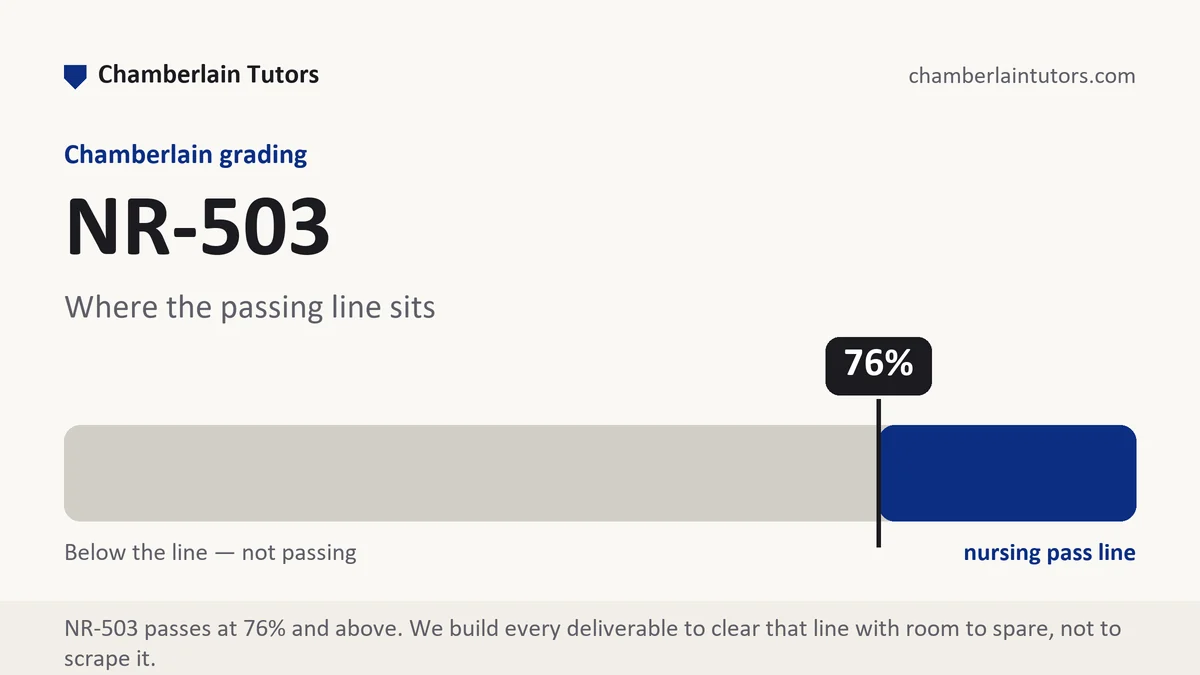
Final deliverables in an eight-week session are the heaviest of the set, commonly six to eight pages, and they arrive when time is shortest. Core nursing courses carry a 76 percent floor, core work averages separately from supplemental work, and supplementary points cannot lift a core average that has already sagged, which makes a rushed final paper an expensive way to end the session.
The NR-503 Week 8 method, step by step
Six moves that turn a health problem into a proposal somebody could carry out and evaluate.
-
Restate the problem in numbers you already gathered
Population, measure, comparison, source and years, in one compact paragraph. A closing paper that reintroduces its problem with adjectives instead of the figures established earlier has thrown away the work of the session.
-
Sort determinants by level and pick your target
Individual, community, structural. Then choose the level you are aiming at and say why, including what you are giving up by not aiming elsewhere. That sentence is the argument, and it is what makes the rest of the proposal coherent.
-
Choose an intervention with published evidence behind it
Something that has been tried and reported, cited with its design, its population and its effect size. Inventing an intervention is allowed in some sections and always harder to defend, since you then have to argue plausibility without any evidence of effect.
-
Specify it until someone else could run it
Agent, recipients, frequency, duration, channel, setting and resources. If a reader cannot picture a Tuesday on which this happens, the specification is not finished, and the row that pays for it will be marked as partially met.
-
Write the evaluation as two measures, not one
A process measure asking whether the intervention was delivered as planned, and an outcome measure asking whether the health indicator moved. Give each a population, a data source and a period, and say what result would count as success rather than leaving the word improvement to do that work.
-
Name what could stop it
Funding, staffing, reach into the group least likely to attend, competing priorities. Two or three barriers with a mitigation each is the section that separates a proposal from a plan, and it also protects you from a grader who thinks of the barrier you left out.
A layout and word budget for an intervention proposal
Sized for a closing paper of roughly 1,800 to 2,100 words. The frame is our own rather than a university template, and where your week's rubric disagrees with it, follow the rubric.
| Section | What belongs in it | Word target |
|---|---|---|
| Problem restated with data | Population, measure, comparison, source and years, in figures rather than in adjectives. | 250 to 300 |
| Determinants by level | Individual, community and structural contributors separated, with the level of each named explicitly. | 300 to 360 |
| Target level and rationale | The level you are aiming at, why change is plausible there, and what aiming elsewhere would have gained. | 200 to 250 |
| The intervention specified | Agent, recipients, frequency, duration, channel, setting and resources, with the supporting evidence cited. | 400 to 470 |
| Evaluation plan | A process measure and an outcome measure, each with population, data source, period and a stated success threshold. | 350 to 420 |
| Barriers and close | Two or three barriers with mitigations, then a close that returns to the population and the figure. | 250 to 300 |
Evidence craft for a proposal
Cite an effect size, not an endorsement. Saying an approach is recommended tells a reader nothing about how much it moved anything. Report the design, the population and the size of the change, so your projected benefit has a number behind it rather than an adjective.
Check that the evidence population resembles yours. An intervention that worked in an urban workplace programme may not transfer to a rural clinic panel. Say what differs and what that difference would do to the expected effect, since transferability argued openly is worth more than transferability assumed.
Give the evaluation measure a real data source. Name where the numbers would come from: an existing registry, chart review, a scheduled survey, or attendance records. A measure with no source cannot be collected, which makes the evaluation section decorative.
Keep projected results in conditional language. You are proposing, not reporting. Would be expected to and is projected to are honest; will reduce is a claim about something that has not happened, and it is the verb error that most often appears in a closing paragraph.
Five mistakes that cost points in this week's territory
- Education proposed as the whole intervention. Where the determinants section named structural barriers, an information programme aimed at individuals does not address the problem the paper diagnosed.
- No agent and no dose. An intervention nobody delivers, at no stated frequency, cannot be costed, run or evaluated, and the specification row will read as unmet.
- Outcome measures that cannot be observed. Improved health and better awareness are not measurable. A change in a named indicator, in a defined group, over a stated period, is.
- The evaluation missing its process half. Without a delivery measure, a null result cannot be told apart from an intervention that never actually reached anyone.
- Barriers listed with no mitigation. Naming an obstacle and leaving it there reads as an excuse written in advance rather than as planning.
Before you submit
- The problem is restated with figures that carry their base, source and years
- Determinants are sorted by level and at least one sits above the individual
- The intervention names an agent, recipients, frequency, duration and channel
- Supporting evidence includes a design, a population and an effect size
- Both a process measure and an outcome measure appear with data sources and periods
- Every projected result is written in conditional rather than declarative terms
Final proposal due this week?
Send the prompt, the rubric and the population you have worked with all session. A premium original proposal comes back in 24 to 48 hours with the intervention specified and the evaluation measurable, floor-checked before delivery.