NR-722 Role of the Educator in Facilitating Learning is a three-credit doctoral course on the nurse educator's role in facilitated learning, learner development and professional socialization, grounded in educational theory. The graded writing is design writing. You produce teaching plans, module designs and analyses in which every choice, what is taught, how it is taught, how it is assessed, is traceable to a learning theory and to something known about the learners in front of you. Content expertise is assumed here. Instructional reasoning is what is scored.
What NR-722 actually grades
The first row is alignment. Objectives, teaching strategy and assessment have to line up so tightly that a reader could predict any one from the other two. If the objective says the learner will demonstrate a technique, then the teaching strategy has to include practice and the assessment has to include observation. A plan that states a performance objective, teaches by lecture and assesses by multiple choice has broken alignment three ways, and it is the most reliable point loss in the course.
The second row is theory doing work. Facilitated learning is a specific stance: the educator arranges conditions rather than transmits content, which changes what the plan looks like minute by minute. When a paper names an adult learning or constructivist framework and then describes a lecture with questions at the end, the theory has been cited rather than applied. Graders look for the moment where a theoretical claim about how people learn produces a concrete instructional decision.
How we help in NR-722
Our doctoral writers build teaching plans backwards from the assessment, so alignment holds by construction rather than by luck. Every strategy in the plan arrives with the theory that justifies it and the evidence base behind it, which is what the analysis rows in this course are scanning for.
Deliverables run the standard promise: a premium original draft in 24 to 48 hours, targeted at the A band of your course's actual scale, through the eight-person pipeline with both QA passes and the floor check, revised free until it lands.
In NR-722 right now?
Send the week and the rubric from Canvas. First premium sample free, floor-checked, back in 24 to 48 hours.
Read the rubric before the prompt
Education rubrics often mix a designed artifact with an analytical narrative, and the two are scored on different qualities. Copy the rows into a blank file and mark which ones will be satisfied by a section of the plan itself and which need argument with citations. Losing marks because the plan lacked a labelled evaluation section, while the narrative discussed evaluation at length, is a common and entirely avoidable outcome.
Then price the narrative. A 2,000-word analysis with four rows at 36, 24, 24 and 16 percent leaves 720, 480, 480 and 320 words. In NR-722 the 720-word row is usually the alignment analysis and the 480 the theoretical justification, which leaves the description of the content itself at the 320 end. That surprises subject experts, who often want to spend the paper explaining the clinical material rather than explaining how it will be taught.
Write the assessment first, before the objectives are polished and long before the activities are chosen. If you can say exactly what the learner will do that shows the learning happened, the objective writes itself and the strategy becomes obvious. Plans built in the other order, activities first, tend to end with an assessment that measures attendance.
The shape of a teaching plan
Whether the week asks for a lesson plan, a module design or an instructional analysis, these parts carry the score. Each carries a design decision, and a reader can trace it back to the one before it.
| Part | What it has to prove | How a thin version looks |
|---|---|---|
| Learner analysis | Who these learners are, what they already know, and what in their situation shapes how they can learn. | An audience described only by program level. |
| Objectives as observable behavior | Verbs a reader could watch happen, at a stated level, with the conditions and standard attached. | Objectives beginning with understand or appreciate. |
| Theory that explains the method | A named framework whose claims about learning justify the strategy you chose over the alternatives. | A theory paragraph disconnected from the activities. |
| Instructional strategy in sequence | What happens in what order, with the learner's activity described rather than the educator's. | A list of topics to be covered. |
| Materials and realistic timing | Resources named and minutes assigned, adding up to the time actually available. | A session plan that would need twice the scheduled hour. |
| Assessment aligned to objectives | A method that measures the stated behavior at the stated level, with the criteria written out. | A quiz that tests recall for a performance objective. |
| Feedback and remediation | What the learner receives, how quickly, and what happens for those who do not meet the standard. | Feedback promised without form or timing. |
| Socialization into the role | What the design does for professional identity, not only for knowledge. | Professionalism mentioned as an aspiration. |
Evidence craft in education writing
Four habits carry the difference between a plan that reads as designed and one that reads as assembled.
Cite the learning theory from its own literature. Educational frameworks have primary sources, and secondary summaries in nursing education textbooks compress them until the claims lose their edges. Cite the origin for the concept and the nursing education literature for its application, and keep the two roles separate in your sentences.
Attach the population and setting to every education finding. Write that a study of 96 prelicensure students at one school found the difference, then report it. Evidence from prelicensure classrooms, graduate seminars and staff development sessions is not interchangeable, and treating it as such is one of the quiet ways an evidence row is lost.
Keep verbs inside the design. Much of the nursing education evidence base is quasi-experimental, single-site and short-term. That buys was associated with and performed better on. Reserve improved learning for evidence with a control and an outcome measured beyond the session itself. Where your guide sets no recency rule, education research older than five years needs its justification in the sentence, with foundational theory exempt as the origin.
Do not accept satisfaction as evidence of learning, and give every number a denominator. Learners frequently rate enjoyable sessions highly and learn less from them. Write that 24 of 31 participants met the criterion on the post-session check, then report the satisfaction score separately and label it as reaction rather than as outcome.
What separates a pass from a strong pass here
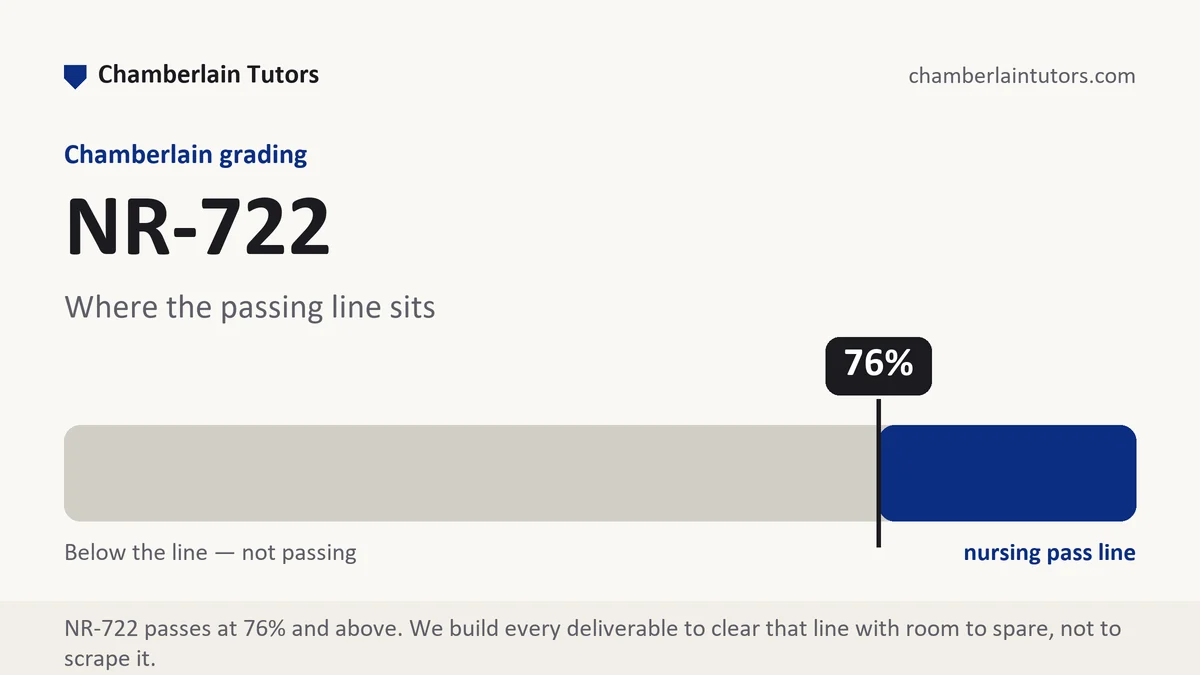
A passing NR-722 plan is complete and plausible. It has objectives, activities and an assessment, and it names a theory. Its usual weakness is that any of the three parts could be swapped for another without the plan noticing, which is what a grader means when alignment is marked down. Chamberlain requires 76 percent to pass a core nursing course, and later work will not repair an average that has settled low, so alignment marks lost every week add up quickly in a design-heavy course.
Strong plans are specific about learners and honest about time. They name what these learners get wrong, which turns a generic session into a targeted one, and they allocate minutes that add up, because an over-packed plan tells an experienced educator that it has never been taught. They also design for the learner who does not meet the standard, since remediation is where educational reasoning is tested hardest. And they say what would count as evidence the teaching worked, at what interval, which is what separates a plan from a hope.
Six mistakes that cost points in NR-722
- Objectives that cannot be observed. Understand, know and appreciate cannot be assessed, and every downstream section inherits the problem.
- Theory cited but not applied. If removing the theory paragraph would leave the plan unchanged, the theory row is unanswered.
- Assessment at the wrong level. Recall testing for an application objective breaks alignment even when the questions are well written.
- Timing that does not add up. A plan needing 90 minutes in a 50 minute session shows it was never rehearsed against the clock.
- Teaching content rather than learners. The learner analysis is a scored row, and skipping it makes every later choice arbitrary.
- Using satisfaction as the outcome. Reaction data belongs in the plan, labelled as reaction. It is not evidence that learning occurred.
Questions NR-722 students ask
Can I write my teaching plan for staff education rather than for students?
How many objectives should a single session have?
What does facilitated learning look like in practice if I am used to lecturing?
Where NR-722 sits in Chamberlain's programs
Open the exact program map for sequence, credit, and option context. The current student schedule and syllabus remain authoritative after transfer evaluation, electives, state rules, and approved plan changes.
The weeks, one by one
Week 1
NR-722 opens on the educator role itself, and the opening written work in a course of this shape usually asks you to define that role rather than to describe your teaching. Read the full Week 1 manual.
Week 2
The second stage of a course on facilitating learning usually turns to theory: behaviorist, cognitive, constructivist and humanistic traditions, adult learning principles, and the transformative strand that treats learning as a change in how a person interprets experience. Read the full Week 2 manual.
Week 3
The third stage of a facilitation course typically turns to the learner: how capability develops in stages, how a newcomer is socialized into a profession's norms, and what an educator does differently for someone at the beginning of that arc than for someone in the middle of it. Read the full Week 3 manual.
Week 4
Around the midpoint, a facilitation course usually turns to the conditions under which learning is possible at all: climate, psychological safety, civility, and the inclusive practices that determine whether every learner in a room can actually participate. Read the full Week 4 manual.
Week 5
The fifth stage of a facilitation course usually asks you to design something teachable: a session, a module, a unit of instruction, complete with outcomes, activities and a plan for knowing whether it worked. Read the full Week 5 manual.
Week 6
The sixth stage of a facilitation course usually widens from a single session to the settings a modern educator has to work in: online and asynchronous, simulated, and practice-based teaching that happens in the middle of real work. Read the full Week 6 manual.
Week 7
The seventh stage of a facilitation course usually turns to assessment: what formative and summative assessment are actually for, how an instrument earns validity evidence, how a scoring guide is built so two raters agree, and what makes feedback change performance rather than merely inform a learner they were wrong. Read the full Week 7 manual.
Week 8
The closing stage of a facilitation course usually asks two connected things: how you would evaluate your own teaching with evidence rather than with satisfaction scores, and how the resulting knowledge reaches other educators. Read the full Week 8 manual.