NR-721 Topics in Healthcare Systems Leadership II is a two-credit doctoral course on interprofessional collaboration and the organizational strategies that support advanced nursing leadership. Its graded writing tends to be structural rather than discursive: charters, role and decision documents, strategy briefs. What scores is specificity about who decides what, and what scores badly is a document that describes collaboration as a value instead of building the machinery that produces it.
What NR-721 actually grades
The first row is decision rights. Interprofessional groups fail most often not because people dislike each other but because nobody agreed in advance who decides when the group disagrees. A doctoral submission in this course is expected to answer that: which decisions the group makes by consensus, which the chair makes, which sit with a professional discipline because of licensure, and which escalate out of the group entirely.
The second row is structure over sentiment. Meeting cadence, membership by role rather than by name, quorum, how work is assigned between meetings, what is documented and where it goes are the parts a grader can score. Statements about mutual respect and shared goals are true and unscoreable. The strongest submissions in this course read almost like operating documents, with the evidence base supplied separately in the rationale.
How we help in NR-721
Our doctoral writers produce the artifact and the rationale as two connected pieces: a charter or strategy document precise enough to use, and a sourced argument for every structural choice in it. Two-credit deliverables come back compressed rather than padded, which is what this course's rubrics reward.
Deliverables run the standard promise: a premium original draft in 24 to 48 hours, targeted at the A band of your course's actual scale, through the eight-person pipeline with both QA passes and the floor check, revised free until it lands.
In NR-721 right now?
Send the week and the rubric from Canvas. First premium sample free, floor-checked, back in 24 to 48 hours.
Read the rubric before the prompt
When a rubric asks for a document rather than an essay, the scoring changes shape. Copy the rows out and split them in two: artifact rows, satisfied by a section existing and being specific, and rationale rows, which need evidence and argument. Artifact rows are easy marks that students lose by writing prose where a labelled section was expected.
Then budget. Suppose the week asks for a charter of about 1,000 words plus an 800-word rationale, with four rows at 50, 25, 15 and 10 percent across the combined 1,600. That leaves 800, 400, 240 and 160 words. The 800-word row usually covers the collaboration structure itself, a reminder that the charter is what gets scored and the rationale exists to defend it, not the other way round.
Before drafting, write the group's purpose in one sentence that names a decision it exists to make. Groups without a decision to make become reporting meetings, and a charter written for such a group cannot be made specific no matter how carefully it is worded. If you cannot finish that sentence, change the group rather than the wording.
It also helps to draft the membership list twice. The first pass names the disciplines you would like in the room; the second pass removes anyone who has no decision to contribute and adds anyone whose absence would let the group agree to something it cannot deliver. Pharmacy, informatics and revenue roles are the three most commonly left out of student charters, and each of them can stop an otherwise sound plan at the moment of implementation.
The shape of an interprofessional charter
Whether your week calls for a charter, a governance document or a collaboration strategy, these are the parts that carry the score. Each removes an ambiguity that would otherwise stall the group months later.
| Part | What it has to prove | How a thin version looks |
|---|---|---|
| Purpose and decision | Why the group exists, expressed as the decision or output it is accountable for. | A mission statement about improving patient care together. |
| Membership by role | Seats defined by discipline and function so that a person leaving does not empty the seat. | A list of individuals who currently attend. |
| Decision rights | What is decided by consensus, by the chair, by a discipline, and what escalates. | A statement that decisions are made collaboratively. |
| Cadence and quorum | How often it meets, what constitutes a quorum, and what happens when one is not reached. | Regular meetings scheduled as needed. |
| Work between meetings | How tasks are assigned, tracked and reported, and who holds the list. | Action items mentioned with no owner or due date. |
| Shared measures | Two or three measures the group is accountable for, each with an owner and a source. | A promise to monitor quality indicators. |
| Conflict and escalation path | The named route when the group cannot agree, including who receives it and in what timeframe. | Disagreements resolved through open communication. |
| Review or sunset date | When the charter is revisited and on what evidence it would be closed. | An open-ended commitment with no end. |
Evidence craft in collaboration writing
Four habits keep the rationale from reading as opinion with references attached.
Cite the interprofessional framework you are building on. The field has published collaborative practice frameworks and team models with defined domains. Cite the framework document itself with its edition, and use its terms rather than inventing parallel ones, so a reader can trace each structural choice back to a source. Where two frameworks cover the same ground, pick one and say why, because a document that borrows a domain name from each becomes impossible to audit against either.
Give team evidence the design it earned. Most published work on team structure, briefings and shared decision-making comes from before-and-after evaluations in single organizations, which buys was followed by and was associated with. Randomized team interventions exist but are rarer. Where your guide sets no recency rule, sources past five years old need their justification stated in the sentence.
Respect the regulatory differences between professions. Disciplines carry different licensure, different accountability and different documentation obligations, and a charter that gives a group authority over something a licensed discipline cannot delegate is unworkable. Cite the relevant scope or regulatory requirement when a decision right touches it.
Every measure carries a denominator, a window and an owner. Shared measures without owners belong to nobody. Write that the proportion of eligible patients with a documented plan, out of all admissions to the service in a calendar month, is reported by a named role at the second meeting of each month. That single sentence satisfies more rubric rows than a paragraph about accountability culture.
What separates a pass from a strong pass here
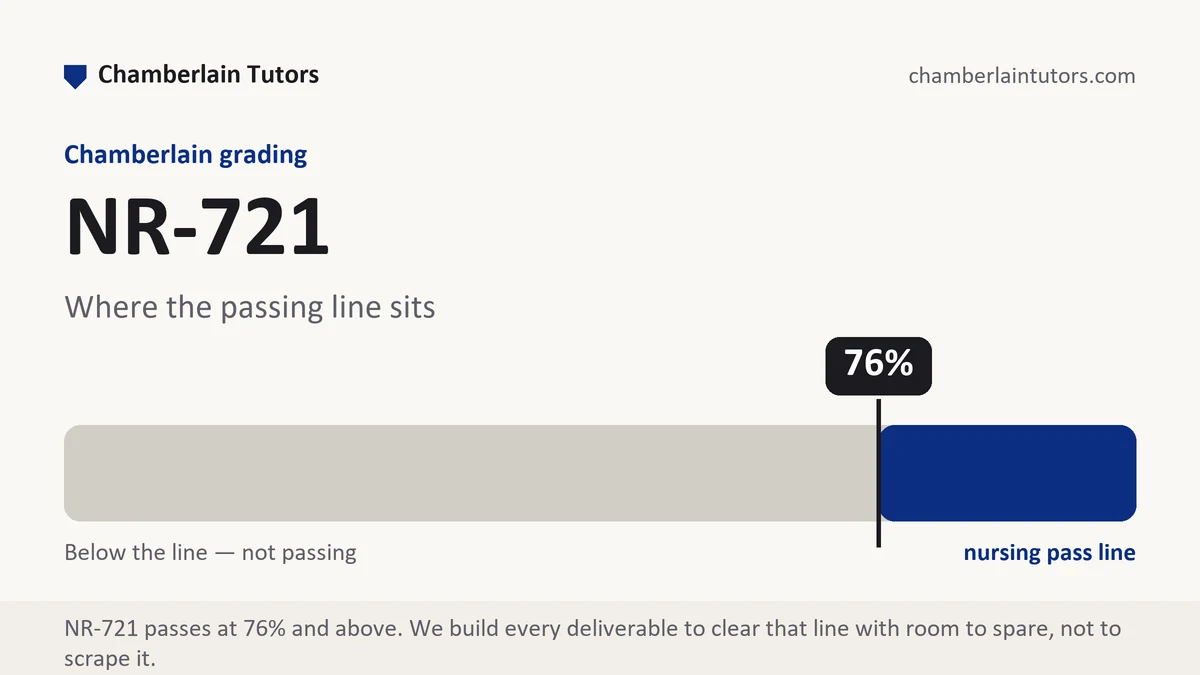
A passing NR-721 submission produces a complete document with sensible sections and a rationale citing the right literature. What it usually lacks is the willingness to make hard structural choices, so decision rights stay soft and the escalation path stays implied. No core nursing course at Chamberlain is passed under 76 percent and no supplementary work rescues an average that has weakened, soft documents in a short course are an expensive habit.
Strong submissions decide things. They name who breaks a tie, and they accept that this means someone occasionally loses an argument. They anticipate the predictable failure, usually that one discipline's members stop attending because the group has no authority over anything they care about, and they build against it by giving the group a real decision. And they include the unglamorous parts: quorum, documentation, review date. A charter that would still work if every current member left is the version that earns the top band.
Six mistakes that cost points in NR-721
- A charter with no decision rights. This is the single most common gap, and it is usually worth the largest single row.
- Membership listed by name. Seats defined by role survive turnover; seats defined by person do not.
- Shared measures nobody owns. A measure without an owner and a reporting date is an aspiration in a table.
- No escalation path. Groups deadlock. A document that has not planned for it has not been thought through.
- Ignoring what a profession cannot delegate. Some decisions sit with a licensed discipline regardless of group consensus, and a charter that overlooks this is unusable.
- Filling a short deliverable with theory. Two-credit work is graded on precision. Move the literature into the rationale and keep the document operational.
Questions NR-721 students ask
Can I write a charter for a group that does not exist yet?
How do I handle a discipline that will not participate?
How long should the charter itself be?
Where NR-721 sits in Chamberlain's programs
Open the exact program map for sequence, credit, and option context. The current student schedule and syllabus remain authoritative after transfer evaluation, electives, state rules, and approved plan changes.
The weeks, one by one
Week 1
NR-721 opens a second pass at systems leadership, and the opening written work in a course of this shape usually asks you to describe an organizational system rather than a role inside it. Read the full Week 1 manual.
Week 2
The second stage of a systems leadership course usually moves from the shape of the system to the behavior expected inside it: what collaborative practice competencies actually require, how team performance is described in published frameworks, and how a leader evaluates a team against something. Read the full Week 2 manual.
Week 3
Midway into the first third of a systems leadership course, the writing usually turns to the organization itself: its culture, its structure and whether it is ready to absorb the change you have been describing. Read the full Week 3 manual.
Week 4
The midpoint of a systems leadership course typically turns outward. Read the full Week 4 manual.
Week 5
Around the midpoint, a systems leadership course usually asks how a leader moves people who do not report to them. Read the full Week 5 manual.
Week 6
Late in the middle third, a systems leadership course usually moves from persuasion to design: building the structures through which an interprofessional group communicates and decides. Read the full Week 6 manual.
Week 7
The seventh stage of a systems leadership course usually asks for the implementation layer: how an interprofessional change is actually put into a working setting, how it spreads beyond the site that piloted it, and what makes it survive the departure of the person who championed it. Read the full Week 7 manual.
Week 8
The closing stage of a systems leadership course usually asks you to convert eight weeks of analysis into something a decision-maker would read: an executive summary, a strategic recommendation, a brief for a board or leadership group, or a plan for disseminating your work to a practice audience. Read the full Week 8 manual.