NR-719 Topics in Advanced Practice Leadership II is a two-credit doctoral course about producing practice change through negotiation and collaborative communication with interprofessional teams. Its graded writing is case writing: a specific ask, specific parties, and an account of how agreement was or could be reached. The two-credit weight means fewer words and a harder edit, not a lighter standard. Short deliverables in this course are scored on precision, and there is nowhere for a vague paragraph to hide.
What NR-719 actually grades
The central distinction is between positions and interests. A position is what someone says they want: the pharmacist wants the protocol to require a second check. An interest is why: they have been named in a review after a missed interaction and cannot risk another. Positions collide and interests often do not, which is why the analysis row in this course keeps asking for the second layer. Papers that stop at positions produce recommendations that amount to persuading the other party they are wrong.
The second thing being graded is preparation rather than personality. Doctoral negotiation writing is about what you knew before the conversation: the alternatives available to each side if no agreement is reached, the evidence you could bring, the decision rights in the room, and the sequence in which people should be approached. Communication is the visible part, and it is the smaller part.
How we help in NR-719
Our doctoral writers build negotiation cases the way this course scores them: the ask in one sentence, interests separated from positions for every party, alternatives named on both sides, and an influence sequence with a first conversation identified. Short-format work comes back edited to the weight, not padded to it.
Deliverables run the standard promise: a premium original draft in 24 to 48 hours, targeted at the A band of your course's actual scale, through the eight-person pipeline with both QA passes and the floor check, revised free until it lands.
In NR-719 right now?
Send the week and the rubric from Canvas. First premium sample free, floor-checked, back in 24 to 48 hours.
Read the rubric before the prompt
Two-credit courses compress the calendar, and the rubric is where you learn how much compression. Copy the rows into a blank file and check first whether the deliverable is a case analysis, a plan or a reflection, because those three are scored on different things: a case on analysis, a plan on sequence and specificity, a reflection on evidence of learning tied to a framework.
Then price the sections. A 1,200-word case with four rows at 45, 20, 20 and 15 percent leaves 540, 240, 240 and 180 words. The 540-word row is almost always the interest analysis, which means the story of what happened, the part students most want to tell, is a 180-word job. Writing that narrative to 180 words is the single most useful exercise in the course, because it forces the case down to the facts that matter to the negotiation.
One preparation step is worth more than any drafting technique here. Before writing, list every party and finish this sentence for each: if no agreement is reached, they will instead do this. Parties with a strong alternative behave differently from parties with none, and a case that has worked out those alternatives writes its own analysis section.
The shape of a negotiation case
Whether the week asks for a case analysis, an influence plan or a conflict resolution write-up, these parts carry the score. Each answers a question the negotiation itself would raise.
| Part | What it has to prove | How a thin version looks |
|---|---|---|
| The ask, in one sentence | Exactly what you want agreed, by whom, by when, stated so a reader could say yes or no to it. | A general desire for better collaboration. |
| Parties and decision rights | Who must agree, who must be consulted, and who only needs to be told. | A list of everyone involved with equal weight. |
| Positions and interests separated | For each party, the stated want and the underlying reason, with evidence for the second. | Interests inferred from job titles. |
| Alternatives on both sides | What each party does if no agreement is reached, and what that implies about leverage. | An assumption that everyone needs a deal equally. |
| The evidence you bring | The data or literature that answers the objection you expect, prepared in advance. | A promise to explain the benefits. |
| Sequence and channel | Who is approached first, alone or in a group, and what each conversation is for. | A plan to raise it at the next meeting. |
| How the agreement holds | What is documented, who owns it, and when it is revisited. | A handshake described as resolution. |
Evidence craft in negotiation and team writing
Four habits keep a case from reading as an anecdote with citations attached.
Cite the framework you are applying and use its vocabulary consistently. Negotiation and conflict literature has defined terms, and mixing two frameworks in one paper produces analysis that cannot be followed. Name yours in the opening, cite the primary source rather than a summary, and keep its language throughout.
Give team interventions the evidence they actually have. Structured communication tools, briefings and debriefings have been studied, mostly in before-and-after designs within single organizations. That buys was followed by and was associated with. Reserve improved for controlled evidence. Where your guide sets no recency rule, evidence past five years old needs its justification in the sentence.
Report conflict-style and team instruments with their limits. Self-report instruments describe preference under low stakes and are weaker predictors of behavior under pressure. Cite the instrument, say what it measures, and do not build a whole analysis on a single score.
Every number in a case carries a denominator and a window. If the case rests on a problem, size it: 9 of 34 handoffs observed over two weeks lacked a documented plan. That sentence does more persuasive work in a real negotiation than any argument about professionalism, and rubric rows on evidence reward it for the same reason.
What separates a pass from a strong pass here
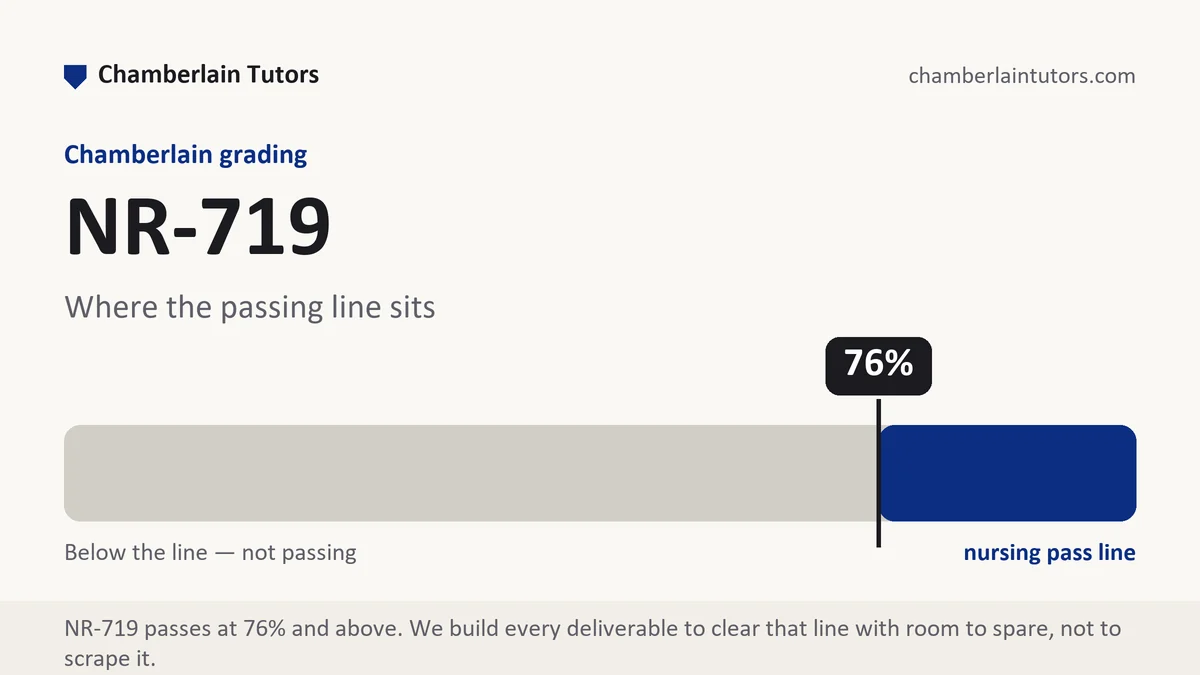
A passing NR-719 case tells a clear story, names a communication framework and concludes that better dialogue resolved or would resolve the issue. It reads well. Core nursing courses at Chamberlain carry a 76 percent floor, and extra work cannot recover an average that has drifted beneath it, which is why the well-told story that skips the analysis rows is a costlier habit than it feels.
Strong cases are uncomfortable in a specific way: they give the opposing party a legitimate reason. A physician who resists a nurse-led protocol may be carrying a liability exposure you do not carry, and writing that plainly is what turns a grievance into an analysis. Strong cases also identify what you would trade, since a negotiation with nothing on offer is a request. And they specify the first conversation, with whom, alone or accompanied, and what it needs to achieve, which is what turns a plan into something a reader believes could happen next week.
Six mistakes that cost points in NR-719
- Retelling a conflict instead of analyzing one. Narrative earns the smallest budget in the guide, and it is where struggling papers spend most of their words.
- Mistaking positions for interests. If every party's interest is what they said in the meeting, the analysis has not started yet.
- No alternatives on either side. Leverage is the structure of a negotiation, and a case without it cannot explain why anyone agreed.
- Treating communication as a personality trait. Preparation, sequence and evidence are the scoreable parts. Warmth is not a strategy.
- Nothing documented at the end. An agreement with no owner, no record and no review date will not survive, and rubrics ask about durability.
- Padding a short deliverable. Two-credit assignments are graded on compression. Repetition to reach a count is visible and it costs more than a short section would.
Questions NR-719 students ask
Can I write about a conflict I actually had, and how do I keep it appropriate?
What if the person I need to negotiate with outranks me significantly?
The prompt asks for reflection. How do I write that without it becoming a diary entry?
Where NR-719 sits in Chamberlain's programs
Open the exact program map for sequence, credit, and option context. The current student schedule and syllabus remain authoritative after transfer evaluation, electives, state rules, and approved plan changes.
The weeks, one by one
Week 1
NR-719 opens where advanced practice leadership actually starts: with a change you want and cannot order. Read the full Week 1 manual.
Week 2
The second stage of a negotiation course almost always turns on the distinction that makes everything after it possible: a position is what a party says they want, and an interest is why they want it. Read the full Week 2 manual.
Week 3
Leverage in an organization does not come from being right. Read the full Week 3 manual.
Week 4
The middle of NR-719 usually moves from preparation to performance, and the first performance is the opening conversation. Read the full Week 4 manual.
Week 5
Somewhere in the middle of a negotiation course the writing moves from understanding the other party to building an offer. Read the full Week 5 manual.
Week 6
Open disagreement is where collaborative communication is actually tested, and this stage of NR-719 typically asks you to write one. Read the full Week 6 manual.
Week 7
A practice change of any size is not one negotiation but a series of them, and the order matters more than any single conversation. Read the full Week 7 manual.
Week 8
Closing stages in a negotiation and collaborative communication course usually ask for two things at once: the document that records what was agreed, and the reasoning about whether the agreement will survive contact with a busy organization. Read the full Week 8 manual.