NR-716 Analytic Methods is a three-credit doctoral course about translation science: taking a practice problem that exists nationally and addressing it in one local setting, using both research and non-research evidence. The graded writing turns on a single question a doctoral reader keeps asking. Does the evidence you found actually apply to the place you intend to change, and how do you know? Everything else in the course, the evidence tables, the leveling, the translation model, exists to make that answer defensible.
What NR-716 actually grades
The first heavy row is the national-to-local move. You establish that a problem is real and documented at scale, then show it in your own setting with your own numbers. Papers fail here in both directions: some cite impressive national data and never come home, others describe a local irritation nobody else has ever reported. The scoring version does both and states how closely the local pattern resembles the national one, because that resemblance is what licenses borrowing the national evidence.
The second heavy row is the handling of non-research evidence. Quality improvement reports, expert consensus, organizational data, regulatory requirements and patient preference are all admissible in translation work, and each carries a different weight. What earns marks is treating them as evidence with rules rather than as filler between the trials: naming the type, saying what it can and cannot support, and being explicit when a recommendation rests on consensus rather than on a controlled study.
How we help in NR-716
Our doctoral writers build translation arguments as a chain: national problem, local mirror, evidence assembled and appraised, model applied with its actual phases, adaptation stated. Evidence tables come back with an appraisal column that carries a judgment rather than a description, which is where most of the marks in this course sit.
Deliverables run the standard promise: a premium original draft in 24 to 48 hours, targeted at the A band of your course's actual scale, through the eight-person pipeline with both QA passes and the floor check, revised free until it lands.
In NR-716 right now?
Send the week and the rubric from Canvas. First premium sample free, floor-checked, back in 24 to 48 hours.
Read the rubric before the prompt
Translation rubrics usually mix a written component with a table or matrix, and the two are scored differently. Copy the rows into a blank file and separate them into narrative rows and artifact rows before drafting anything, because an artifact row is either satisfied by a completed column or it is not, and there is no partial credit for describing what the table would have shown.
Then budget the narrative. A 2,200-word paper with four rows at 30, 30, 20 and 20 percent yields 660, 660, 440 and 440 words. In NR-716 the two 660-word rows are typically evidence synthesis and translation application, which leaves the problem description inside one of the 440 allocations. Students routinely invert this, spending half the paper establishing that the problem matters and then compressing the translation model into a paragraph.
Do one thing before you write: decide which translation or implementation model you will use, and read its actual phases rather than a summary of them. The model has to structure your later sections, and choosing it late almost always means retrofitting a section plan that was built without it. Naming the model in the introduction and then using different headings is one of the clearest signals a grader can see.
The shape of a translation argument
Whether the week calls for an evidence table with narrative, a translation plan or a synthesis paper, the parts below carry the score. Each carries a link in the argument, and a broken link is easy to spot.
| Part | What it has to prove | How a thin version looks |
|---|---|---|
| National problem, documented | The problem shown at scale with a cited source, a denominator and a reporting period. | An assertion that the issue is widespread. |
| Local mirror | The same measure in your setting, defined the same way, so the two can be compared honestly. | A local anecdote offered next to a national statistic. |
| Evidence set assembled | How studies were located, with enough method that someone could find the same set. | A group of articles with no account of where they came from. |
| Level and quality assigned | A consistent leveling scheme applied to every source, with quality judged separately from level. | Level assigned to some sources and not others. |
| Non-research evidence handled | Guidelines, quality reports, expert consensus and patient preference weighted openly and labelled as what they are. | Consensus statements cited as though they were trials. |
| Translation model applied | The chosen model's own phases used as the structure, with content in each phase. | A model named once and never seen again. |
| Transferability judged | What in the studied settings matches yours and what does not, said specifically. | A claim that findings are generalizable. |
| Local adaptation stated | What you would change to fit your setting, and which element must not change. | An intention to tailor the intervention as needed. |
Evidence craft in translation work
Four habits carry most of the marks in this course.
Separate level from quality in every entry. Level describes the design's position in a hierarchy; quality describes how well that design was executed. A poorly conducted randomized trial and a well conducted cohort study are not ranked by level alone, and an evidence table that reports level without quality has skipped the judgment the row was scoring.
Attach setting to every effect you plan to borrow. Write that the intervention was tested in two urban academic medical centers with in-house pharmacist coverage, then report the effect. That single clause is what allows you to argue transferability later, and without it the transferability section becomes assertion.
Match the verb to the design, and to the evidence type. Research evidence buys the usual range: associated with for observational, reduced for controlled. Non-research evidence buys weaker verbs still, such as recommends, is consistent with, and reports. Where your guide sets no recency rule, sources past five years need their justification in the sentence, with the exception of foundational method and model sources.
Every rate carries a denominator and a window, in both directions. The national figure and the local figure must use the same definition before you compare them. Write that 118 of 2,050 discharges in the last twelve months met the criterion locally, then set that against the national estimate and say whether the definitions match. Where they do not, say so; a mismatch openly declared scores better than a comparison that quietly assumes it away.
What separates a pass from a strong pass here
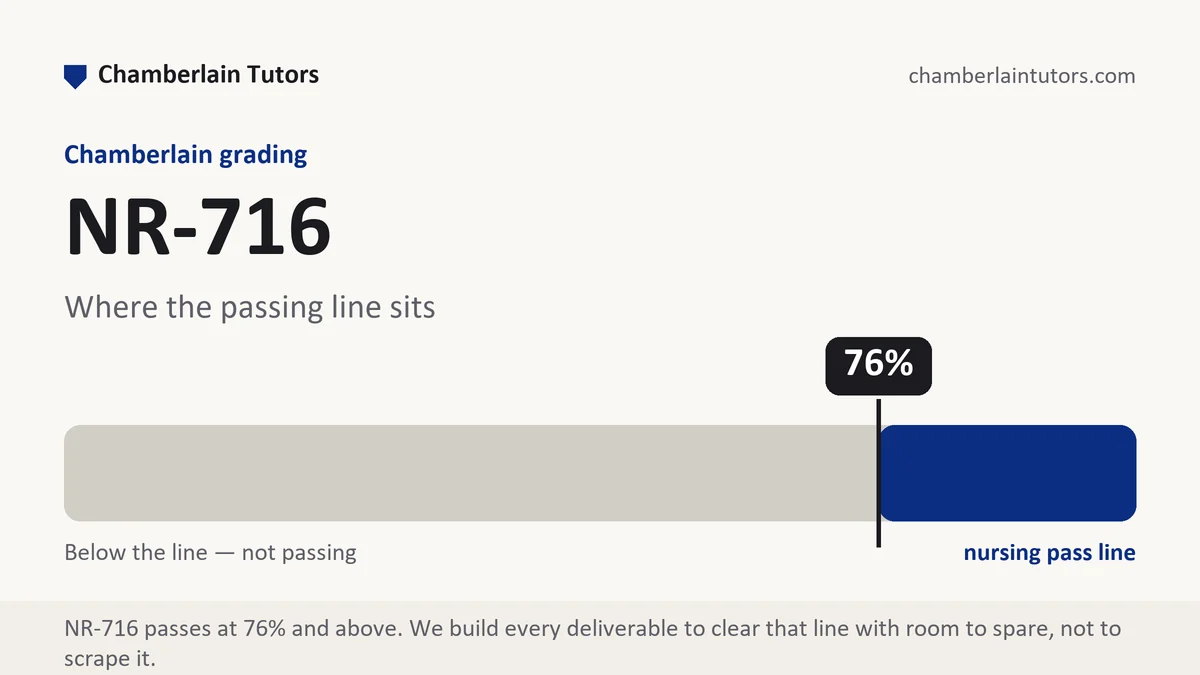
A passing NR-716 paper collects good sources, fills the table and recommends the intervention the literature supports. What it usually omits is the argument that the literature applies here. Chamberlain's floor for core nursing courses is 76 percent with no supplementary route back once an average has weakened, that omission repeats across every week the course spends on the same project and costs more than it looks like it should.
Strong translation writing takes transferability seriously as a scored claim. It names the specific differences between the studied settings and yours, staffing model, patient mix, technology, payer environment, and says which of them threatens the effect. It identifies the elements of the intervention that cannot be adapted without losing the mechanism, which is the difference between tailoring and dilution. And it says what the evidence does not cover, then proposes measurement to fill that gap locally rather than pretending the gap is not there. That combination is what makes a doctoral reader trust the plan.
Six mistakes that cost points in NR-716
- An evidence table with no appraisal column. A table of citations and findings is a bibliography in a grid. The judgment column is the assignment.
- Assuming a national rate describes your unit. It describes the country. Show your own number or argue the resemblance explicitly.
- Discarding non-research evidence. Guidelines, quality reports and patient preference are part of translation science, and rubrics reward handling them well rather than ignoring them.
- Naming a model without its phases. If the model has stages, the paper should move through them visibly, with content under each.
- Overstating transferability. Generalizable is a claim, not a courtesy. Say what matches and what does not.
- Posting a synthesis thread in one pass. Chamberlain discussion posts cannot be edited after submission, so verify every level and quality judgment before pasting.
Questions NR-716 students ask
Which leveling scheme should I use for the evidence table?
My local data is only six months old and covers 40 patients. Is that enough?
How do I choose between the translation models we have been shown?
Where NR-716 sits in Chamberlain's programs
Open the exact program map for sequence, credit, and option context. The current student schedule and syllabus remain authoritative after transfer evaluation, electives, state rules, and approved plan changes.
The weeks, one by one
Week 1
NR-716 opens on the move the whole course is built around: taking a practice problem that is recognized nationally and demonstrating it in the place you actually work. Read the full Week 1 manual.
Week 2
The second stage of NR-716 usually defines the field the rest of the course operates in. Read the full Week 2 manual.
Week 3
This stage of NR-716 asks you to retrieve the evidence for your practice problem in a way somebody else could repeat. Read the full Week 3 manual.
Week 4
Translation projects run heavily on evidence that is not a study, and this stage of NR-716 teaches you to judge it. Read the full Week 4 manual.
Week 5
This stage of NR-716 asks a question that appraisal alone never answers: would this finding survive the trip to my site. Read the full Week 5 manual.
Week 6
By this stage of NR-716 you have evidence worth translating and a site to translate it into, and the writing task is the plan between them. Read the full Week 6 manual.
Week 7
This stage of NR-716 turns to the two forces that decide whether a translated practice survives: the context it lands in, and the tension between delivering an intervention as designed and changing it to fit. Read the full Week 7 manual.
Week 8
The closing stage of NR-716 asks how you will know whether the translated practice worked, and it asks in writing before anything has been implemented. Read the full Week 8 manual.