This stage of NR-716 asks you to retrieve the evidence for your practice problem in a way somebody else could repeat. A doctoral search is documented rather than performed: databases named, terms and combinations recorded, limits stated with reasons, results counted at each step, and inclusion decisions made against criteria written before the screening started. The deliverable is the trail as much as the studies. If a reader cannot reconstruct what you did, the synthesis built on it cannot be trusted. Your section may print this as NR 716 or NR716; it is the same course. Chamberlain publishes no syllabi outside Canvas. The placement here is our teaching judgment from the course's catalog arc; your section's rubric decides what your week actually asks.
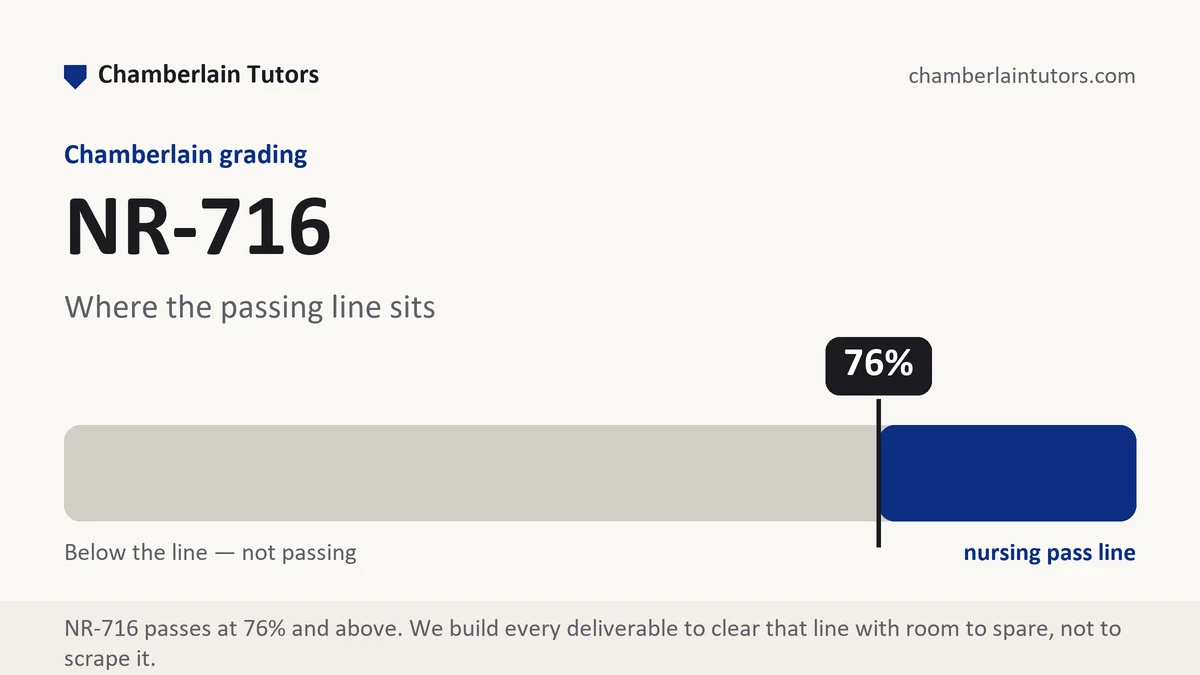
What NR-716 Week 3 asks for
Consider a family practice wanting to strengthen postpartum depression screening at infant well-child visits, where the mother is present but is not the clinic's patient of record. A student searching this topic types a phrase into one database, finds eleven articles, keeps the six with accessible full text, and writes them up. Nothing about that process is reproducible, and the resulting evidence base reflects what happened to surface rather than what exists. The stage exists to replace that with a method.
The territory has four parts. Concept building comes first: each element of your question becomes a concept, each concept gets controlled vocabulary terms and natural language synonyms, and the two are combined so that synonyms are joined one way and concepts another. Source selection comes second: the general biomedical and nursing databases, plus at least one source of guidance or synthesis, plus targeted searching of professional bodies where recommendations live outside journals. Screening comes third, against criteria you wrote in advance covering population, setting, evidence type, language and date. Documentation runs through all of it.
Doctoral graders in this course look for three specific things. They look for a numbered trail, meaning records retrieved, duplicates removed, titles and abstracts screened, full texts assessed and studies included, with reasons for exclusion at the full-text stage. They look for limits justified rather than applied by habit, because a ten-year limit that excludes a foundational trial needs defending. And they look for evidence that you searched for guidance and synthesis first, since translation work starts from the highest available level rather than from individual studies.
Expect a search documentation piece, often with a table of strategies and sometimes a flow diagram or evidence table, occasionally with a posted response. Posts do not reopen once submitted in Canvas.
The NR-716 Week 3 method, step by step
Six moves for building a search a reader could repeat.
-
Write inclusion and exclusion criteria before you search
Population, setting, evidence types accepted, date range, language and any outcome requirement. Criteria written after screening are decisions dressed as rules, and doctoral readers can tell because they always happen to match the studies that were found.
-
Build each concept as a block of synonyms
Put controlled vocabulary and natural language terms for one concept together, joined so that any of them will match, then combine the blocks so that all concepts must be present. Searching a whole sentence at once is the most common reason a search returns eleven results.
-
Search for guidance and synthesis before primary studies
Look for systematic reviews, evidence summaries and professional recommendations first. Finding a current high-quality review changes what the rest of your search is for, and starting with individual trials wastes a stage of work.
-
Record every line as you run it
Database, interface, date searched, exact strategy, limits, and the number of results for each line. Reconstructing a search from memory a week later produces a strategy that never actually ran and numbers that do not add up.
-
Screen in two passes and count the losses
Titles and abstracts first against your criteria, then full text with a recorded reason for each exclusion. The reasons matter: wrong population and no outcome of interest tell a reader something that a bare number does not.
-
Chase citations in both directions
Check the reference lists of your best sources and look for later work citing them. Hand searching finds the evidence that database indexing missed, and saying you did it, with what it yielded, is a mark of a serious search.
A layout and word budget for a search documentation piece
Our frame for this stage, sized for roughly 1,200 to 1,600 words plus tables. It is our own outline rather than anything the university issues, and your week's rubric outranks it wherever the two disagree.
| Section | What belongs in it | Word target |
|---|---|---|
| Question and concepts | The question restated, broken into concepts, each with its controlled and natural language terms. | 180 to 220 |
| Inclusion and exclusion criteria | Written as rules with reasons, covering population, setting, evidence type, dates and language. | 200 to 250 |
| Sources searched and why | Databases, guidance repositories and professional bodies, each with a sentence on what it contributes. | 220 to 270 |
| Strategy table | Database, date searched, exact lines run, limits applied and results per line. | Table |
| Screening and yield | Numbers at each stage with exclusion reasons at full text, presented so the arithmetic reconciles. | 220 to 270 |
| What the search found | The shape of the evidence base: how much guidance, how much synthesis, how much primary work, and where it clusters. | 250 to 300 |
| Limitations of the search | Databases you could not access, languages excluded, grey literature not searched, and the likely effect on your set. | 160 to 200 |
Evidence craft for documenting a search
Report the strategy exactly as run, including operators and truncation. A paraphrased search is not reproducible. Paste the lines. If the interface forced you to alter syntax between databases, say so and show both versions.
Justify each limit in the sentence that applies it. A date limit chosen because guidance changed in a particular year is defensible; a ten-year limit applied because it is conventional is not, especially where a landmark study sits outside it.
Make the numbers reconcile. Records retrieved minus duplicates, minus title and abstract exclusions, minus full-text exclusions, must equal your included set. Arithmetic that does not close is the first thing an experienced reader checks.
Name what you could not reach. Paywalled full texts, databases outside your library, unpublished improvement work and non-English studies all shape a set. Stating the limitation costs one sentence and protects every claim that follows.
Treat professional body recommendations as retrievable evidence. Guidance frequently lives on organizational sites rather than in indexed journals, and a search that never leaves the databases will miss the material a translation project most needs. Document that searching the same way you document the rest.
Search the same concept more than one way. A practice can be indexed under a clinical term, a service term and a workflow term, and each retrieves a partly different set. Running two or three variations and reporting all of them, including the lines that returned little, shows a reader that the coverage of your set was tested rather than assumed.
Save your results in a manageable form as you go. Export each line's records into a reference manager immediately, tag them by the search that found them, and record the date of retrieval. Reconstructing which strategy produced which article at the writing stage is far harder than it sounds, and a documented trail that cannot be tied back to its sources is only half a trail.
Five mistakes that cost points in this week's territory
- A sentence typed into a search box. Natural language phrases retrieve a fraction of what a concept-block strategy finds, and the resulting set is arbitrary.
- Criteria written after screening. Rules that perfectly fit the studies you kept are not rules, and doctoral readers recognize the pattern immediately.
- One database only. Indexing differs, coverage differs, and a single source guarantees a partial set in a course about evidence.
- Numbers that do not add up. A flow that loses records without explanation undermines the entire synthesis built on it.
- No search for guidance. Starting from primary studies in a translation course inverts the hierarchy the whole field works from.
Before you submit
- Criteria are stated before the search and carry reasons
- Each concept has both controlled vocabulary and natural language terms
- Strategies are reported exactly as run, per database, with dates
- Guidance and synthesis sources were searched before primary studies
- Screening numbers reconcile and full-text exclusions carry reasons
- Citation chasing in both directions is documented with its yield
- The search limitations and their likely effect are stated
Documenting your NR-716 search?
Send the rubric and your question out of Canvas. A premium original draft comes back in 24 to 48 hours with concept blocks built, limits justified and the flow reconciled, and revisions run until the grade lands.