NR-716 opens on the move the whole course is built around: taking a practice problem that is recognized nationally and demonstrating it in the place you actually work. Both halves are required. A national problem with no local evidence is a term paper, and a local complaint with no national standing is an anecdote. The written work at this stage establishes both and shows they are the same problem measured the same way. Your section may print this as NR 716 or NR716; it is the same course. Chamberlain publishes no syllabi outside Canvas. The placement here is our teaching judgment from the course's catalog arc; your section's rubric decides what your week actually asks.
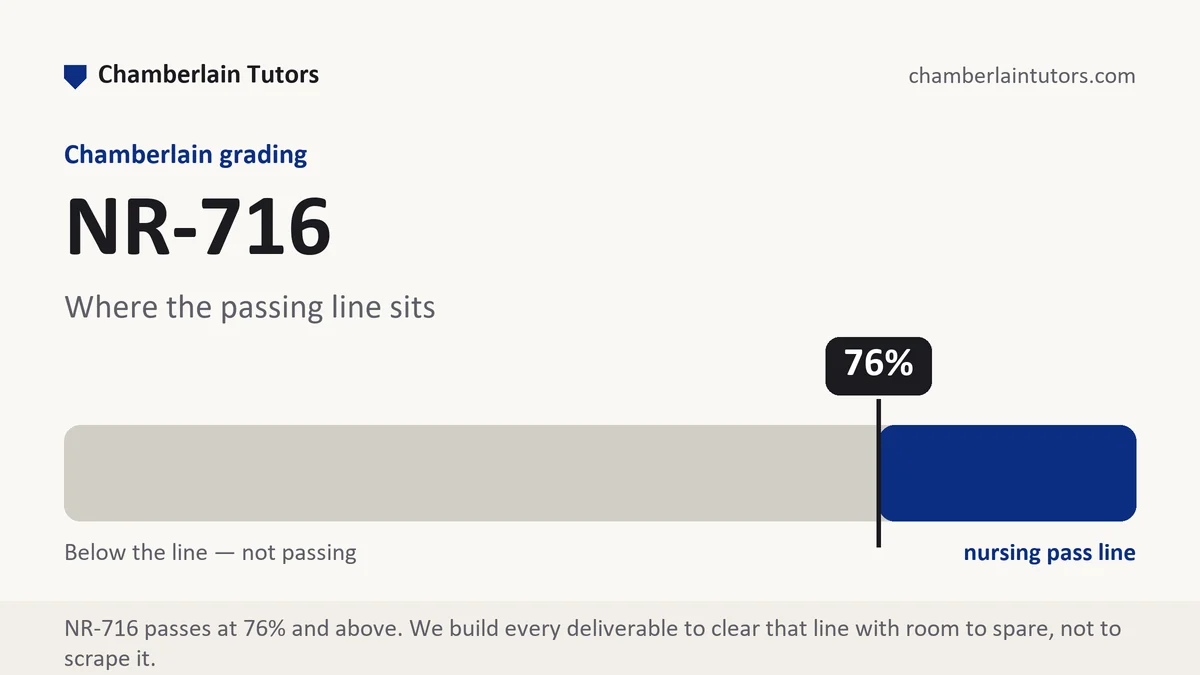
What NR-716 Week 1 asks for
A family practice serving three rural townships completes the childhood immunization series for most of its patients and loses a stubborn minority somewhere between the twelve-month visit and the eighteen-month one. The nurse practitioner who runs the recall list can describe those families in detail. What she has not done, until this stage forces it, is connect that description to a body of national evidence about series completion, recall systems and missed opportunities, and then show that her clinic's pattern is a local instance of a documented phenomenon rather than a quirk of her township.
That connection is the graded work. A national practice problem has three properties you have to establish in writing. It is documented at scale, which means national surveillance, professional body statements or large studies show it exists beyond any one setting. It has consequence, measured in outcomes, cost or equity. And it has an evidence base already pointed at it, because translation requires something to translate. Establishing all three takes sourcing rather than eloquence, and doctoral graders read the reference list as part of the argument.
The local half is harder than students expect because it demands definitional discipline. If a national measure defines completion by a specific set of antigens by a specific age, your local count has to use that same definition or the comparison is meaningless. Most first drafts compare a national figure defined one way against a local figure defined another way, then report a gap that is an artifact of the mismatch. Fixing that before anything else is the single most useful thing this stage teaches.
Expect a written problem and significance piece with a searchable question attached, sometimes with an early evidence scan, often with a discussion post. Posts do not reopen once submitted in Canvas, so treat board entries as final copy from the first keystroke.
The NR-716 Week 1 method, step by step
Six moves that turn a felt problem into a documented one.
-
Find the national measure before you count anything locally
Locate how the problem is defined and reported at national level, including the exact numerator, denominator and age or time window. Everything you count afterward has to match that definition, and discovering it late means recounting.
-
Establish scale and consequence with separate sources
One source showing how widespread the gap is, another showing what it costs in outcomes, utilization or equity. Students often use a single citation for both and end up asserting the consequence they meant to evidence.
-
Verify that an evidence base exists to translate
Run a scoping search for reviews, guidance and improvement reports addressing the gap. Finding a substantial body is the point of the exercise. Finding almost nothing means the problem belongs to research rather than to translation, and the topic should move now.
-
Produce one honest local number
Count what you can legitimately access using the national definition, and report it with its denominator, its window and how you obtained it. Sixty-two of 214 children reaching the milestone in the last full year is a finding. Our completion is low is not.
-
Explain the difference between the two figures
If your local rate is worse than the national one, say what plausibly drives that in your setting. If it is better, say so plainly and reframe the problem around the subgroup where it is not. Doctoral honesty here reads as strength.
-
Write the question so it can be searched
Break your question into concepts, list synonyms for each, and check that the intervention concept is broad enough to retrieve a body of evidence rather than one favoured approach. A question naming a specific product will return almost nothing.
A layout and word budget for a national-to-local problem piece
Our frame for this stage, sized for roughly 1,300 to 1,700 words. It is our own outline rather than anything the university issues, and your week's rubric outranks it wherever the two disagree.
| Section | What belongs in it | Word target |
|---|---|---|
| The problem in one paragraph | The national gap and your local instance stated together, both measured the same way, before any background. | 120 to 160 |
| National documentation | Surveillance or large-study evidence of scale, with the measure's exact definition quoted or paraphrased precisely. | 250 to 300 |
| Consequence and equity | What the gap costs in outcomes, utilization or disparity, sourced separately from the scale evidence. | 220 to 270 |
| Local demonstration | Your count, denominator, window, extraction method and the limits of what the source can see. | 250 to 300 |
| Comparison and explanation | How local and national figures relate, and what in your setting plausibly accounts for the difference. | 200 to 250 |
| Evidence availability | Confirmation that reviews, guidance or improvement literature exist to translate, named at that level. | 180 to 220 |
| Searchable question | The formal question plus the concept and synonym list it produces for the retrieval stage. | 140 to 180 |
Evidence craft for establishing a practice problem
Quote the measure definition rather than the headline figure. National reports lead with a rate and bury the definition in a technical note. The definition is what you need, because it determines whether your local count is comparable at all.
Date every source and prefer the most recent reporting period. Surveillance figures move, and a rate quoted from a report three cycles old will be challenged. Name the reporting period in the sentence, not only in the reference.
Separate scale from consequence. A citation showing how many children are affected does not show what being affected costs. Use two sources and say which does which, because evaluation rows in this course reward that discipline specifically.
Report your extraction method with the number. A count from a recall report, a manual review of a defined sample, and a scheduling export are three different kinds of evidence with three different blind spots. Say which you used, how many records were involved, and what it misses.
De-identify any illustrative case. If a family's experience makes the gap concrete, remove anything that could identify them and say in the text that identifying details have been changed or omitted.
Show the gap as a trend where the data allow it. A single year's figure invites the response that the year was unusual. Three or four consecutive periods, local or national, demonstrate that the problem is stable rather than seasonal, and a stable problem is far easier to sponsor than a bad quarter. Where you only have one period, say so and treat that as a limitation rather than leaving the reader to notice it.
Five mistakes that cost points in this week's territory
- Mismatched definitions. A local rate counted one way against a national rate counted another produces a gap that exists only in the arithmetic.
- National evidence with no local demonstration. The course is about a national problem addressed locally, and half the argument scores half the rows.
- A problem with no evidence base behind it. If nothing published addresses the gap, translation has nothing to move and the topic is wrong for the course.
- Consequence asserted rather than sourced. Poor outcomes and higher costs need a citation the same way any other claim does.
- A question too narrow to search. Naming one branded approach in the question retrieves nothing and stalls the retrieval stage before it starts.
Before you submit
- The national measure definition is stated exactly, with its reporting period
- Your local count uses that same definition
- Scale and consequence are supported by separate sources
- The extraction method and its blind spots appear beside your number
- The difference between local and national figures is explained rather than ignored
- An existing body of evidence is confirmed and named
- The question yields a workable concept and synonym list
Starting NR-716 this week?
Send the instructions and the rubric out of Canvas. A premium original draft comes back in 24 to 48 hours with the national measure matched to your local count, and revisions run until the grade lands.