NR-715 Scientific Underpinnings is the three-credit doctoral entry course. The catalog describes it as an introduction to the DNP degree, its historical and philosophical underpinnings, the domains that define practice at this level, and the DNP scholarly project. Its writing is positioning writing: you argue what a practice doctorate is for, place yourself against the domains honestly, and sketch a project idea small enough to survive contact with a real setting. Students who treat it as a warm-up week lose the head start it is designed to give.
What NR-715 actually grades
The first scoring demand is that you can state the difference between a practice doctorate and a research doctorate without caricaturing either. The practice doctorate is built to translate existing evidence into change at the point of care and in systems; the research doctorate is built to generate new knowledge. Papers that reduce this to one degree does research and the other does practice miss the part that matters, which is that translation is itself a scholarly activity with its own methods and its own standards of proof.
The second demand is candor about your own starting point. Rows in this course usually ask you to read the domains that define doctoral practice and locate yourself against them. A self-assessment claiming strength everywhere is unscoreable, because it gives the grader nothing to evaluate and nothing to develop across the program. The submissions that score name two or three specific gaps, attach evidence for each, and connect them to what the coming courses will be asked to fix.
How we help in NR-715
Our doctoral bench treats the entry course as the place where the whole degree gets easier or harder. Drafts arrive with the degree argument built from primary professional documents, the self-assessment written as evidence rather than adjectives, and any project sketch scoped to something a single student could actually complete.
Deliverables run the standard promise: a premium original draft in 24 to 48 hours, targeted at the A band of your course's actual scale, through the eight-person pipeline with both QA passes and the floor check, revised free until it lands.
In NR-715 right now?
Send the week and the rubric from Canvas. First premium sample free, floor-checked, back in 24 to 48 hours.
Read the rubric before the prompt
Entry-course prompts read as reflective, and reflective prompts tempt students into memoir. The rubric is the correction. Copy the rows into a blank document and mark each one according to what it wants evidence for: a claim about the degree, a claim about the profession, a claim about yourself, or a claim about a practice problem. Every one of those requires a source except the third, and even the third scores better with examples attached.
Then convert weights into words. A 1,500-word paper with four rows at 48, 22, 18 and 12 percent leaves 720, 330, 270 and 180 words. In NR-715 the 720-word row usually belongs to the analysis of the degree and its scholarship, not to personal narrative, which typically sits at the 180-word end. Seeing those numbers early stops the most common structural error in the course, which is a beautifully written personal essay with a short paragraph of doctoral content stapled to it.
Keep a separate list of sources you have located for each claim. Professional position statements, accreditation documents and the peer-reviewed literature on the practice doctorate are the material this course expects, and finding them in week one pays for the rest of the program because the same documents recur in later courses.
The shape of a doctoral positioning paper
Whether the week calls it a reflective analysis, a scholarly essay or a program plan, this is the structure that satisfies the rows. Each part makes one claim, and a grader can see whether the claim was supported.
| Part | What it has to prove | How a thin version looks |
|---|---|---|
| Why the practice doctorate exists | The problem in healthcare the degree was created to address, sourced from professional documents rather than opinion. | A statement that nursing needed a terminal practice degree. |
| The contrast with research doctorates | Both paths described fairly, with the difference located in purpose and method rather than in prestige. | One degree praised at the expense of the other. |
| The domains as a map | The published expectations for doctoral practice used as a framework to organize your reading of yourself. | A list of domain names quoted without application. |
| Self-assessment with evidence | Two or three named gaps, each supported by something you have or have not done in practice. | General claims of strength in leadership and communication. |
| First sketch of a practice problem | A setting, a population and an outcome gap, offered as a candidate rather than a commitment. | A broad healthcare topic with no setting attached. |
| What the scholarly project is and is not | Translation of evidence into a measured change, separated clearly from original research. | A project described as a study or an experiment. |
| Development plan | What you will read, do and seek across the program to close the gaps you named. | A promise to work hard and grow as a leader. |
Evidence and citation craft in the entry course
Four habits set the tone for every course that follows.
Cite the profession's own documents, not descriptions of them. Position statements, accreditation standards and association reports are primary sources for what the degree is meant to be. Cite the document itself with its edition or year, because these are revised, and a claim sourced to a superseded version invites a correction you cannot argue with.
Reflection still carries evidence. A self-assessment claim becomes scoreable when it points at something that happened: a project you were asked to lead and could not size, a report you could not interpret, a policy you could not read. Two sentences of specific evidence per gap outperforms a page of adjectives.
Handle the history carefully. Claims about when and why the degree emerged, and about how quickly programs grew, are checkable facts and should be sourced as such. Where your guide sets no recency rule, foundational documents are exempt because they are the origin, while claims about the current state of the profession need current sources.
Any number arrives with a denominator and a window. Even in a reflective course, figures appear: program counts, workforce projections, prevalence of a problem you are eyeing for a project. Write that a state workforce report counted 4,200 licensed nurse practitioners in the most recent reporting year, then draw the inference. Match the verb to the design when you cite a study, because habits formed here follow you into the analytic courses.
What separates a pass from a strong pass here
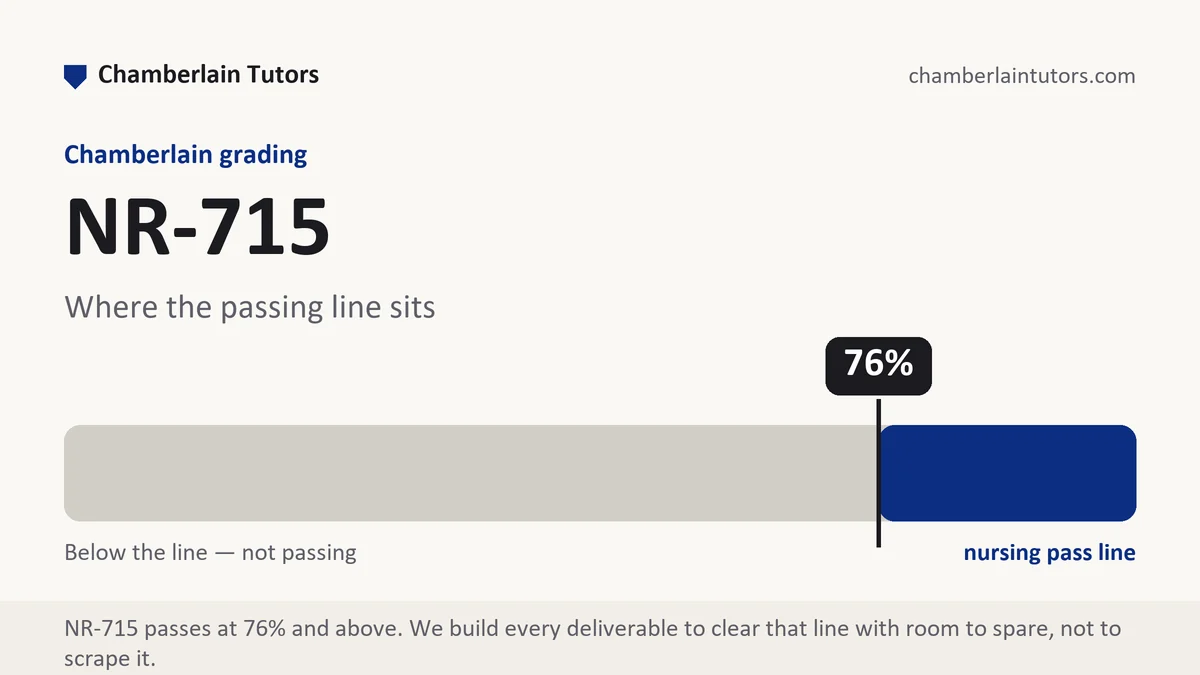
A passing NR-715 paper is sincere, well organized and largely unsourced in the places that matter. It says what the degree means to the writer rather than what it means, and it proposes a project topic rather than a project. Chamberlain awards no pass beneath 76 percent in a core nursing course, and supplementary work does not repair an average that has weakened, so the habit of writing sincerity instead of evidence is worth breaking in the first course rather than the fourth.
Strong entry papers do three things. They argue a position about the degree and defend it against a stated objection, usually the objection that a practice doctorate duplicates a master's degree. They name gaps precisely enough to be uncomfortable, which is what makes a development plan credible. And they scope the project sketch down until it is embarrassingly small: one unit, one measurable outcome, one change. Every experienced faculty reader has watched ambitious project ideas collapse under their own size, and a student who arrives already scoped is starting the program a full course ahead.
Six mistakes that cost points in NR-715
- Writing an admissions essay. Motivation and gratitude are not scoring rows. The analysis of the degree and its scholarship is.
- Confusing the project with research. A translation project applies existing evidence and measures a local change. Describing it as generating new knowledge misstates the whole degree.
- Quoting the domains without using them. A framework only earns marks when it organizes something. Apply it to yourself paragraph by paragraph.
- Proposing a project with no setting. A topic is not a project. Attach a unit, a population and an outcome that someone already measures.
- Posting an unrehearsed introduction thread. Chamberlain board posts do not reopen once submitted, and first impressions in a doctoral cohort last the whole program.
- Leaving every claim unsourced because the paper is reflective. Reflective format does not suspend the citation rows, and this course is where that lesson is cheapest to learn.
Questions NR-715 students ask
How specific should my project idea be this early?
I have been a nurse for twenty years. How do I write a self-assessment that admits gaps without undermining myself?
Which sources count as authoritative for claims about the DNP degree itself?
Where NR-715 sits in Chamberlain's programs
Open the exact program map for sequence, credit, and option context. The current student schedule and syllabus remain authoritative after transfer evaluation, electives, state rules, and approved plan changes.
The weeks, one by one
Week 1
Before any framework, any problem statement and any project, this course asks you to say what a practice doctorate is for, where it came from, and what separates a doctorally prepared clinician from an experienced one. Read the full Week 1 manual.
Week 2
The second stage of NR-715 usually turns the published competency domains of doctoral nursing education into an instrument you point at yourself. Read the full Week 2 manual.
Week 3
The third stage of NR-715 usually asks you to distinguish practice scholarship from research scholarship and to defend the distinction rather than recite it. Read the full Week 3 manual.
Week 4
Midway through NR-715 the course usually stops describing the degree and starts pointing it at something. Read the full Week 4 manual.
Week 5
By the middle of NR-715 the loose topic has to become a formal problem statement with a searchable question attached. Read the full Week 5 manual.
Week 6
This stage of NR-715 usually asks you to choose the framework your future project will run on and to defend the choice against alternatives. Read the full Week 6 manual.
Week 7
Late in NR-715 the course raises the altitude. Read the full Week 7 manual.
Week 8
The closing stage of NR-715 usually asks you to assemble everything the session produced into one coherent concept for a scholarly project: the problem, its magnitude, the evidence available to translate, the framework that will carry it, the setting and its stakeholders, a preliminary evaluation. Read the full Week 8 manual.