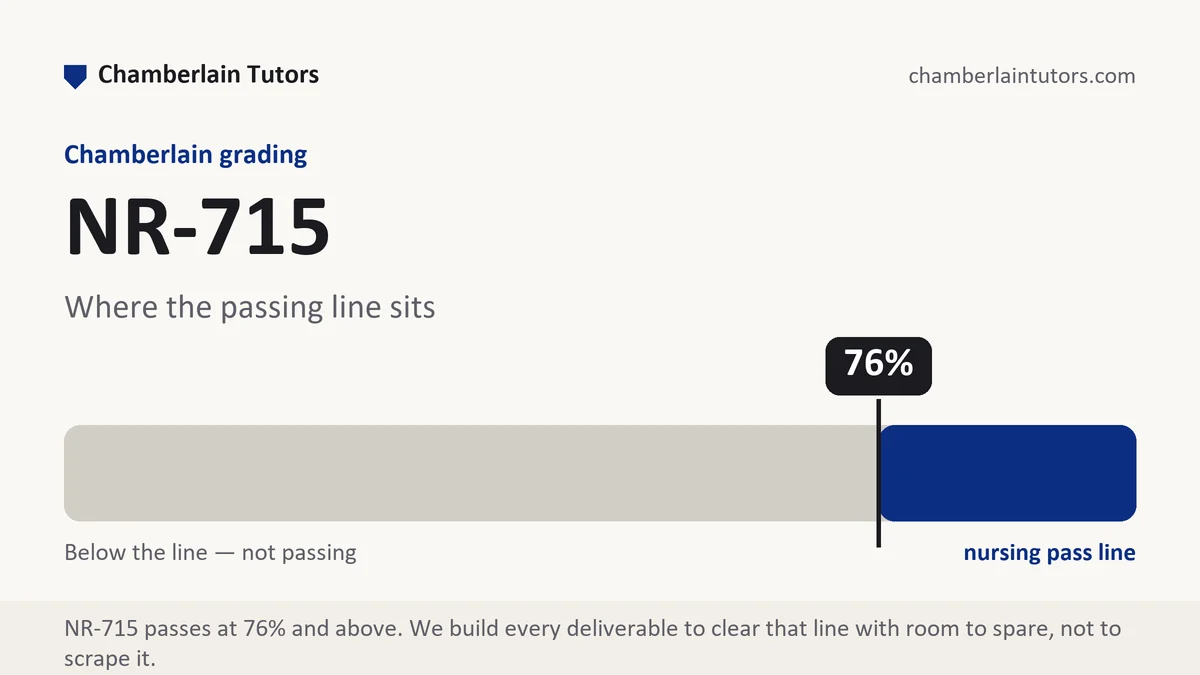
NR-715 opens on the degree itself. Before any framework, any problem statement and any project, this course asks you to say what a practice doctorate is for, where it came from, and what separates a doctorally prepared clinician from an experienced one. The written work is an argued account of the degree rather than a personal statement about wanting it. Hold one distinction from the first paragraph: the DNP translates knowledge that already exists into practice change at a site, and it does not exist to generate new knowledge. Your section may print this as NR 715 or NR715; it is the same course. Chamberlain publishes no syllabi outside Canvas. The placement here is our teaching judgment from the course's catalog arc; your section's rubric decides what your week actually asks.
What NR-715 Week 1 asks for
Picture the clinical lead of a pediatric urgent care sitting down to her first doctoral submission after twenty-two years of practice. She has run a four-site call schedule, rebuilt a triage protocol twice, and taught half the nurse practitioners currently working in her county. Her instinct is to write about that. The instinct is understandable and it will not score, because an opening underpinnings stage is not asking who you are. It is asking what kind of doctorate you have enrolled in, why that kind exists, and what work it was created to do that the professions around it were not doing.
The territory is the history and design of the practice doctorate. Professional nursing spent decades preparing its senior clinicians at master's level while medicine, pharmacy, physical therapy and audiology moved their entry or advanced preparation to doctoral level. The argument for a nursing practice doctorate was built on three observable pressures: the complexity of the systems advanced nurses were being asked to lead, the persistent gap between what the evidence supports and what patients actually receive, and the credential asymmetry that placed nursing's most senior clinicians below their interprofessional peers at the same table. A doctoral reader wants those pressures named as reasons, not recited as history.
Alongside the history sits the architecture. Practice doctorates in nursing are described through published competency domains that organize what the graduate should be able to do: scientific foundations for practice, systems and quality leadership, evidence translation and analytics, health policy and advocacy, interprofessional collaboration, population and prevention work, informatics and technology, and the ethical and professional formation that runs under all of it. The graded move in an opening stage is to show that you can read those domains as a description of a job rather than a list of headings.
Expect a modest deliverable carrying heavy register, often a short scholarly paper with a posted classroom response beside it. Faculty use the opening stage of a doctoral session to calibrate how you write before the applied stages arrive. If your section runs a discussion this week, treat every post as final copy: posts do not reopen once submitted in Canvas, and an opening thread of unsupported opinion sets an expectation that follows you for seven more stages.
The NR-715 Week 1 method, step by step
Six moves that turn a topic about a degree into doctoral prose about practice.
-
Strip each rubric row to the verb that governs it
Copy the scoring rows into an empty document and reduce each to its driving verb before you read anything else. Describe, differentiate, analyze, evaluate and justify demand different depths, and a row carrying justify is telling you a defended position is expected rather than a summary of the degree's history.
-
State the problem the degree was built to solve, not the year it appeared
Open on the gap between available evidence and delivered care, then show the practice doctorate as a response to it. Dates and milestones belong in a supporting clause. A paper that leads with chronology reads as a report; a paper that leads with the problem reads as an argument.
-
Separate translation from generation in one explicit paragraph
Write the boundary in your own words: which questions require new knowledge and belong to research preparation, and which require existing knowledge moved into a setting where it is not yet reliably delivered. Graders read this paragraph as the test of whether you understand the degree you are enrolled in.
-
Read the competency domains against one real setting
Take a setting you actually work in, such as a five-provider family practice or a hospital-based pediatric clinic, and walk two or three domains across it. Name what the domain would require someone to do there that nobody currently does. That is analysis; listing the domains is not.
-
Describe the scholarly project by what it produces
The culminating work of a practice doctorate is a change implemented and evaluated at a site, reported to an audience that can act on it. Say that plainly, name the kind of product it yields, and avoid the vocabulary of hypotheses, trials and original contribution that belongs to a research degree.
-
Close on a consequence a colleague could observe
Finish with one thing that would be different in your setting because a doctorally prepared nurse is in it: a decision made from data rather than habit, a protocol reconciled with a current guideline, a meeting where the nursing voice arrives with evidence attached. Abstraction without a consequence is where these papers lose the application row.
A layout and word budget for an opening degree paper
Below is the frame our doctoral tutors keep beside a first underpinnings submission, sized for roughly 1,400 to 1,800 words. It is our own outline rather than anything the university issues, and your week's rubric outranks it wherever the two disagree. Scale the targets proportionally if your assigned length differs.
| Section | What belongs in it | Word target |
|---|---|---|
| Opening claim about the degree | What the practice doctorate is for, argued in three sentences, before any history or personal context appears. | 90 to 120 |
| The pressures that produced it | Evidence-to-practice lag, system complexity and credential parity, each attributed to scholarship rather than to memory. | 280 to 340 |
| Translation versus generation | The boundary in your own words, with an example of a question on each side drawn from one setting. | 240 to 300 |
| Competency domains read as work | Two or three domains walked across a real practice, naming what each would require that is currently absent. | 300 to 360 |
| The scholarly project | What the culminating work produces, who receives it, and why that makes it a practice product rather than a research one. | 200 to 250 |
| Your position in the degree | Where your current scope sits against the domains, written as an evidenced gap rather than an aspiration. | 160 to 200 |
| Practice consequence | One observable change your setting would see, written so a colleague could tell whether it happened. | 110 to 150 |
Evidence craft for writing about the degree
Attribute every claim about the profession to a document with a year. Statements about what practice doctorates prepare graduates to do, or how competency expectations are organized, belong to published professional documents that are revised on schedules of their own. Name the issuing body and the edition inside the sentence where the idea does its work, not only in a closing parenthesis.
Use position papers and scholarship rather than program marketing. Recruitment pages describe degrees persuasively and cite nothing. Peer-reviewed commentary and professional consensus documents describe the same degree with reasoning attached, and a doctoral grader reads the difference in one glance at your reference list.
Keep your clinical history as illustration, never as warrant. The sequence that scores is claim, published support, then the scene from your practice showing the claim operating. Twenty-two years in pediatric urgent care is context. What those years exposed about a gap between guideline and delivery is evidence, and only in that order.
Give every number a base and a window. If you report that follow-up visits after a wheezing episode are missed in your clinic, write the count over the total across a stated period before any proportion appears. Forty-one of 268 visits over one quarter is something a reader can weigh; fifteen percent is a figure floating free of its denominator.
Say what the degree does not do. One honest sentence naming the limits of a practice doctorate, including the questions it is not equipped to answer, is worth more in an evaluation row than another supporting quotation, because it demonstrates exactly the judgment that row is scoring.
Five mistakes that cost points in this week's territory
- Writing a personal statement. Why you chose the program answers an admissions question. The graded task is an account of what the degree is designed to do and why that design exists.
- Calling the culminating work a thesis. One word signals to a doctoral grader that the translation model has not landed, and it is the single most reliable tell in an opening paper.
- Listing competency domains without touching a setting. Headings copied in order demonstrate reading. Domains walked across a real clinic demonstrate analysis, and only one of those earns the application row.
- History with no argument. A chronology of when doctoral preparation appeared in other professions is background. The reasons those moves happened are the paper.
- Master's register carried upward. Warm, confident summary reads as competent at MSN level and underpowered at doctoral level, where argued judgment with the reasoning shown is the expected default.
Before you submit
- Your claim about the degree appears before any history or biography does
- The translation versus generation boundary is stated in your own words
- At least two competency domains are examined against a named real setting
- The scholarly project is described by what it produces and who receives it
- Every professional document is named with its issuing body and year in the sentence
- The close names a consequence someone else could observe
- Every reference appears in the text and every in-text citation appears in the list
Starting NR-715 this week?
Send the instructions and the rubric out of Canvas. A premium original draft comes back in 24 to 48 hours written in doctoral register from the first line, and revisions run until the grade lands.