NR-669 closes the capstone practicum with 0.5 theory credits, 3.5 clinical credits and 168 clinical hours, and it ends in two things: a manuscript ready paper and a presentation to the people at the organization where the work happened. The presentation is where students lose points they did not expect to lose, because a talk is not a paper read aloud. It has a different unit of measurement, and that unit is minutes.
What NR-669 actually grades
The first thing scored is completion. Not activity, completion: the change went in, the measure was collected across a stated window, the result exists, and somebody at the site owns what happens next. Papers that describe a project still underway have to say so plainly and report what is genuinely known, which is a legitimate result and a very different paper.
The second is the written record, held to manuscript standards. A reader with no connection to your site should be able to reconstruct the setting, the intervention, the measures and the analysis without asking a question. Everything vague in the paper turns into a question in the room later.
The third is the presentation itself, judged as an act of persuasion in front of people who can act. Structure, timing, the honesty of the visuals and how you handle a challenge all show, and the rubric rows generally reward the same thing a director would: knowing what you are asking for and saying it early.
How we help in this course
What stays with you: 168 clinical hours, your preceptor or mentor, every conversation at the site, all placement paperwork and any log. We do not complete hours, contact anyone at your organization, sign forms, or deliver a presentation for you.
What we build is the material. Send the scoring guide and your results and a premium original draft returns in 24 to 48 hours: the paper written to manuscript standards, a deck timed against the minutes you actually have, speaker notes that sound like speech rather than prose, and backup slides for the three questions your audience is most likely to ask. Two quality reviews and the floor check run ahead of delivery, and revisions keep coming free until the piece lands.
Writing this course's deliverables from the rubric
Chamberlain publishes no syllabus for NR-669, and the scoring guide arrives inside Canvas with each assignment, so no honest page can hand you a week by week grid. The transferable craft is here instead: how a talk is budgeted in minutes, how a slide earns its place, how a claim is spoken so it survives a question. Keep your guide in front of you and let this page fill in around it.
Presenting your NR-669 capstone?
Send the scoring guide, your results and the time slot. First premium sample free, back in 24 to 48 hours.
The passing line, and a room that books early
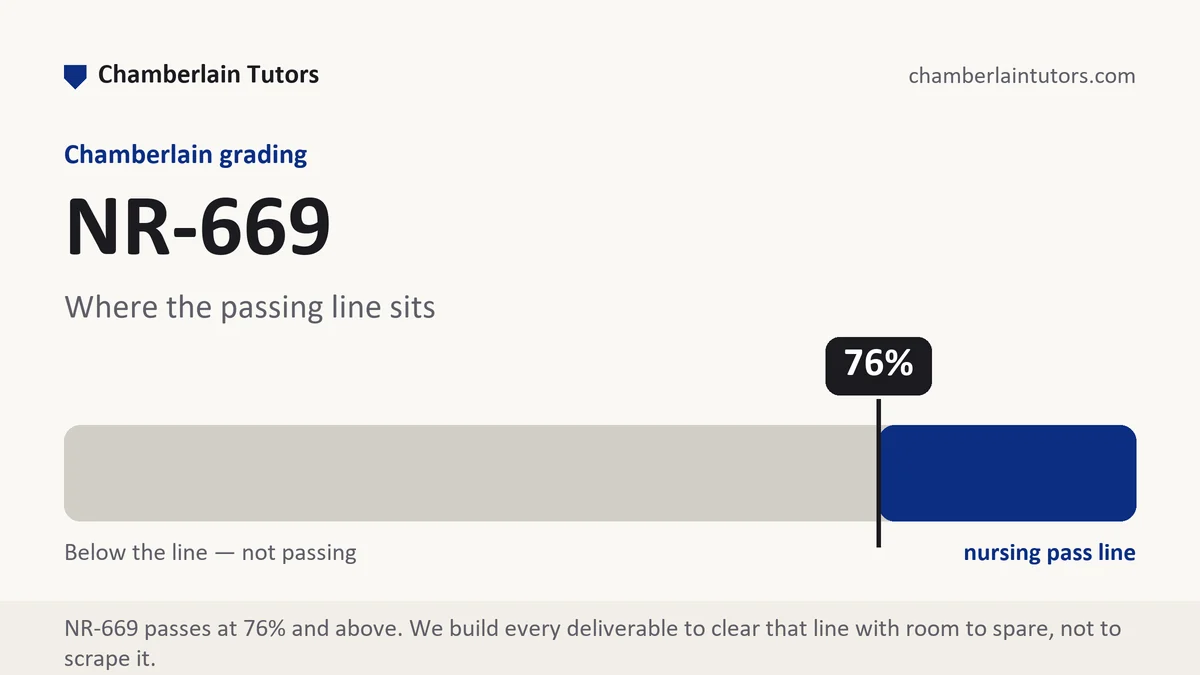
Core nursing courses pass at 76 percent, while nurse practitioner specialty courses run on a scale with no C band where anything below 84 fails. Confirm which one your section publishes before the final weeks, since a capstone is the worst place to be wrong about the floor. The grade is a weighted average either way, and supplementary work cannot repair it.
Sixteen week semesters, two eight week sessions, up to six starts a year, deliverables most weeks. The scheduling trap in this course is the audience. Committees, leadership councils and unit meetings fill their agendas weeks ahead, and the people you most want in the room travel. Ask for a slot in week one, ask how long it is, and ask who will be there, because a 10 minute update to a unit council and a 25 minute presentation to a leadership group are different products. Boards remain uneditable at Chamberlain, so check any result before posting it.
Turn the criterion rows into a minute budget
A paper is budgeted in words, a talk in minutes, and the conversion is the single most useful thing to know here. A comfortable spoken pace under pressure is about 120 words a minute, so a 15 minute presentation is roughly 1,800 spoken words, not the 3,000 word paper you are tempted to read from.
Now apply the rubric. Suppose four rows carry 35, 30, 20 and 15 percent. Against 1,800 words that is 630, 540, 360 and 270 words, which converts to about five and a half minutes, four and a half, three, and two and a quarter. Then turn minutes into slides, since one idea occupies 60 to 90 seconds of speech, giving somewhere between 10 and 14 slides for a 15 minute talk. Anything past that is either being skipped live or is not being explained. Hold two minutes back for questions even if the schedule does not, because the questions are where a stakeholder audience decides whether to believe you.
The shape of a stakeholder presentation
Every audience of working clinicians and managers wants the same things in roughly this order, whatever your guide calls the sections.
| Segment | What it has to do | What the weak version does |
|---|---|---|
| Opening claim | Say in 30 seconds what you did and what changed, before any background. | Introduces yourself, the course and the assignment. |
| Why here | The local problem with its number, so the room recognizes itself. | National statistics the audience has heard before. |
| What was done | The change described so a manager could repeat it on their unit. | A model diagram with no actions on it. |
| The number | Baseline and after, with counts and the window, on one readable chart. | A table of every measure collected. |
| What it cost | Hours, training time, anything the room will have to keep paying. | Silence, which the finance minded read as a hidden bill. |
| What sustains it | The owner, the interval, the trigger for a response. | A hope that the unit will keep it going. |
| The ask | One sentence naming the decision you want from this room. | Thank you for your time, with no request. |
| Backup slides | Method detail, full data, limits, ready if a question calls for them. | All of that in the main deck, unread. |
Write the ask first and the opening second. Everything between them exists to make that one sentence believable.
Evidence craft when the evidence is spoken
- One claim per slide. The slide title should be the claim, not a category label. A reader who only reads titles should still get your argument.
- Say the denominator out loud. Nine of 47 eligible patients over eight weeks takes three seconds and prevents the first challenge from the room.
- Provenance in the sentence. In a two hospital study of 1,400 admissions, then the finding. Spoken evidence needs its source attached because nobody can see your reference list.
- Verbs the design can pay for. Speech tempts overstatement. Coincided with and was associated with are still the honest verbs for uncontrolled before and after work.
- Current sources, stated by year. Say the year of any guideline you lean on, and check it has not been revised the week before you present.
- No new data in the conclusion. Anything that appears for the first time in your final minute reads as an afterthought and invites the question you have the least time to answer.
What separates a passing capstone from a strong one
A passing NR-669 finishes everything and presents it accurately. The paper is complete, the deck is tidy, the talk runs slightly long, and the room thanks you politely without deciding anything.
Strong ones aim the material at the people in the chairs. They open with the finding rather than working toward it. They admit the limit before anyone raises it, which is the fastest route to being trusted by a skeptical audience. And they end with a specific request, addressed to whoever in the room can grant it. That habit is worth more than the grade, because a capstone presentation is often the first time senior people at your organization watch you think in public.
Six mistakes that cost points here
- Reading the paper aloud. Written sentences are too long to say, and an audience hears the difference immediately.
- Burying the ask. A request that arrives in the last ten seconds arrives after the room has stopped deciding.
- Slides written for reading. Paragraphs in small type mean the audience is reading instead of listening.
- Charts without labels. No axis titles, no counts, no window, and the first question will be about the chart rather than the work.
- Causal language in speech. Overclaiming out loud is harder to walk back than overclaiming in print.
- Identifiable detail in a deck. Screens, names and patient particulars have no place on a slide that will be emailed onward.
Questions NR-669 students ask
How many slides should a 15 minute presentation have?
What do I do if someone in the room challenges my numbers?
My project is not finished. What do I present?
The weeks, one by one
Week 1
NR-669 is the closing immersion, and its opening stage is about arriving at a shared understanding of where the project actually stands. Read the full Week 1 manual.
Week 2
Second stage of NR-669 is the unglamorous one that decides whether the rest of the session works: you close the data window, verify what you have, and write the account of how the data were produced. Read the full Week 2 manual.
Week 3
Stage three of NR-669 is the analysis: turning a closed data set into a stated result. Read the full Week 3 manual.
Week 4
Stage four of NR-669 is the discussion, and it is the section that separates a competent capstone from a strong one. Read the full Week 4 manual.
Week 5
Stage five of NR-669 answers the question every stakeholder audience eventually asks: what happens when you leave. Read the full Week 5 manual.
Week 6
Manuscript-ready means one specific thing: a reader with no connection to your organization can reconstruct the setting, the intervention, the measures and the analysis without asking you a single question. Read the full Week 6 manual.
Week 7
Its unit of measurement is minutes, and stage seven of NR-669 is where you build a presentation for people at the organization who can actually act: a structure that leads with the ask, slides that carry one idea each, speaker notes written in speech rather than prose, and a rehearsal against a clock. Read the full Week 7 manual.
Week 8
The last stage of NR-669 carries two pieces of writing that look unrelated and are not. Read the full Week 8 manual.