Second stage of NR-669 is the unglamorous one that decides whether the rest of the session works: you close the data window, verify what you have, and write the account of how the data were produced. Every number in your final paper and every claim in the stakeholder presentation traces back to this stage, and errors caught now cost minutes rather than weeks. Your section may print this as NR 669 or NR669; it is the same course. Chamberlain publishes no syllabi outside Canvas. The placement here is our teaching judgment from the course's catalog arc; your section's rubric decides what your week actually asks.
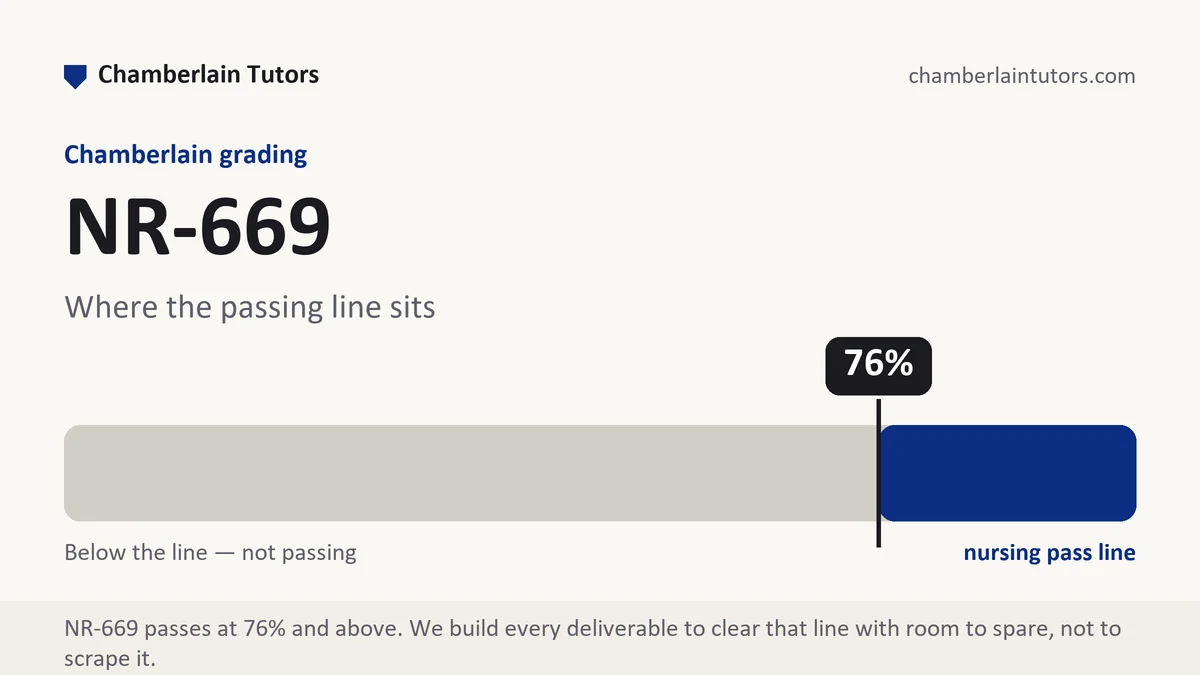
What NR-669 Week 2 asks for
Weight-check return visits for infants flagged at a two-week appointment are the kind of measure that looks simple until you close the window on it. Does a visit count if it happened at eleven days rather than at the scheduled fourteen. Does a weight taken at an urgent visit for another reason count as the return check. What about the family who came in twice. What about the child who transferred out of the practice in the middle of the window. Somebody has to answer those questions in writing, once, before the numbers get counted, and this is the stage where that happens.
Closing a data window has three parts. First, deciding and recording the end date, including how encounters near the boundary are handled. Second, extracting and verifying: pulling the data, checking it against a sample by an independent route, and reconciling the differences. Third, writing the data account, which is the passage in your final paper that lets a reader judge whether your numbers can be trusted. That passage is short, and it is one of the most heavily weighted things in a manuscript-standard document.
Verification is the part students skip and reviewers notice. A report pulled from the record system is only as good as the definition behind it, and definitions written by a builder who was not in the room often differ subtly from yours. Checking twenty records by hand against the report, and reporting the agreement, converts your data from a printout into evidence. Where a section runs a discussion here, it usually asks about a data problem you hit. Post it as final copy, since Canvas responses do not reopen.
Where the boundary sits in a data stage. The 168 clinical hours, the immersion, your presence at the organization and every relationship there remain yours and cannot be delegated or reconstructed. Hour logs, encounter counts, patient census entries, site paperwork, signatures and any evaluation completed about you are your own record, never drafted, reconstructed or estimated with help. Support applies only to the written layer: how to define boundary rules in prose, how to describe a verification procedure, how to report data quality honestly. Data you work with is de-identified and aggregated wherever aggregate will do, and any list needed for review stays inside the organization's systems.
The NR-669 Week 2 method, step by step
Six moves for closing a window and writing the data account.
-
Freeze the window with a written rule
State the last date included and how an encounter that straddles the boundary is treated. Write it before you look at the data, because a boundary rule decided after seeing which side helps is a rule a reviewer will not respect.
-
Restate every operational definition in one place
Numerator, denominator, exclusions and edge cases for each measure, in a single passage. If two people applying your definition to the same record would disagree, the definition is not finished and the count that follows will not be defensible.
-
Verify a sample by a second route
Take twenty or thirty records and check them by hand against the automated extract. Report agreement as a fraction. This one paragraph does more for a manuscript's credibility than any amount of statistical presentation.
-
Reconcile every discrepancy you find
When the hand check disagrees with the report, find out why before deciding which is right. The usual causes are a definition mismatch, a visit type included differently, or documentation stored somewhere the report does not read. Each cause changes what you do next.
-
Account for every excluded observation
Transfers, duplicates, records unavailable, encounters outside the eligible population. Count them, categorize them and keep the tally, because a reader comparing your denominator with your described volume will ask.
-
Write the data account while the details are fresh
Source, extraction method, dates, verification procedure and result, exclusions with counts, and known limitations of the source. Written now it takes an hour; written in week six from memory it is guesswork wearing methodological clothing.
A layout and word budget for a data integrity account
Our frame for the data closure document, sized for roughly 1,200 to 1,500 words plus any tables. It is our own outline rather than anything the university issues, and your scoring guide outranks it wherever they disagree.
| Section | What belongs in it | Word target |
|---|---|---|
| Window and boundary rules | Start and end dates for each period, and how encounters at the edges are assigned. | 150 to 190 |
| Operational definitions | Each measure as numerator over denominator, with exclusions and the edge cases you resolved. | 260 to 310 |
| Extraction method | Where the data came from, who pulled it, what query or report was used and on what date. | 170 to 210 |
| Verification | Sample size checked, method of the independent check, agreement rate and what the disagreements were. | 220 to 270 |
| Exclusions and missing data | Counts by reason, with a statement of whether the pattern of missingness could bias the result. | 200 to 240 |
| Source limitations | What the data cannot see, stated as concrete limits rather than as a general caution. | 170 to 210 |
Evidence craft for data quality writing
Documentation is not the same as care. A record-derived measure captures what was recorded, and the gap between a service delivered and a service documented is real in every setting. Say this once, concretely, naming which direction it would bias your result, rather than leaving it as a vague caveat in the limitations paragraph.
Report agreement as a fraction with its numerator. Twenty-eight of thirty hand-checked records matched the extract is a verification statement. Data were verified for accuracy is a sentence that could describe anything, including nothing.
Examine whether missingness is random. If the records you could not retrieve cluster on particular clinic days, providers or visit types, the missing data are informative and the pattern must be reported. Missingness that follows a pattern related to your outcome is a threat to the result, not a footnote.
Date the extract and name the version. Record systems change, reports get rebuilt, and a query run in March may not return what the same query returns in May. Recording the date and the report name makes your work reproducible and protects you if a number is later challenged.
Handle identifiers with a stated protocol. Say in the document that data were de-identified before analysis, describe how any linkage list was protected and destroyed, and name the review route the project followed. A manuscript-standard paper is expected to carry this paragraph and its absence is conspicuous.
Five mistakes that cost points in this week's territory
- A window closed after looking at the data. Choosing an end date that improves the result is the clearest form of bias a reviewer can identify.
- No verification at all. An unchecked extract is a printout, and treating it as evidence puts every number in the paper on unexamined ground.
- Exclusions without counts. Saying some records were excluded, without how many and why, makes the denominator unverifiable.
- Definitions that changed quietly. A measure applied one way in the baseline and another way afterwards compares two definitions rather than two periods.
- Limitations written as boilerplate. Data quality may be limited says nothing; naming what the source cannot see, and in which direction, says everything.
Before you submit
- The data window has stated dates and a written boundary rule
- Every measure appears as numerator over denominator with edge cases resolved
- A verification sample is reported with its agreement fraction
- Every discrepancy found has an explanation, not just a correction
- Exclusions are counted by reason and missingness is examined for pattern
- The de-identification and review route are stated explicitly
Closing NR-669 data this week?
Send the scoring guide and your aggregate extract out of Canvas. A premium original draft comes back in 24 to 48 hours with definitions written so two readers would agree and a verification account a reviewer would accept, and revisions run until the grade lands. Your hours, your site and your logs stay entirely yours.