NR-662 is a role immersion capstone carrying 1 theory credit, 3 clinical credits and 144 clinical hours, built around an evidence based process improvement project that ends in a submission ready manuscript and a poster. The poster is the part students underestimate. Compressing a project into roughly 800 words of panels is a harder test of understanding than writing 3,000, because every sentence that survives has to be one a reader could not work out for themselves.
What NR-662 actually grades
The first strand is the improvement project judged as evidence based practice. That means a problem with a local number attached, a change chosen because evidence supports it rather than because it was available, a measure defined before the change went in, and an honest account of what the measure did. Projects assembled backwards, where a favored idea acquires supporting citations afterwards, are visible to anyone who reads the evidence section closely.
The second strand is dissemination, in two formats with different rules. The manuscript is judged on completeness and reproducibility. The poster is judged on selection: what you left out is as scoreable as what you kept, and a panel crowded with paragraphs signals that the author could not decide what mattered.
The third strand is the synthesis itself. The course asks what the advanced role you are entering actually involves, argued from the 144 hours you spent in it. Definitions copied from a professional organization sit mid band. An argument built from decisions you watched or made, with what each one required, moves above it.
How we help in this course
The boundary first, because a capstone is exactly where it matters. Clinical hours are yours. We do not complete them, contact a preceptor, mentor, site or school, sign placement paperwork, fill an hour log or sit any assessment for you.
The writing and the design of the artifacts are ours. Send the scoring guide and your results and a premium original draft returns in 24 to 48 hours: a manuscript with methods a stranger could follow, a poster built panel by panel to a word budget, figures that survive scrutiny, and a role synthesis argued from evidence rather than sentiment. The floor check and both quality passes clear the draft before it reaches you, and revision stays free until it lands.
Writing this course's deliverables from the rubric
Chamberlain publishes no syllabus for NR-662, and the scoring guide arrives attached to each assignment inside Canvas, so there is no defensible week by week grid to give you. Method transfers instead: how a poster is budgeted, how a figure is made honest, how a role argument is built out of specifics. Your own scoring guide outranks anything on this page.
Building your NR-662 poster and manuscript?
Send the scoring guide and your data. First premium sample free, floor-checked, back in 24 to 48 hours.
The passing line, and a capstone clock
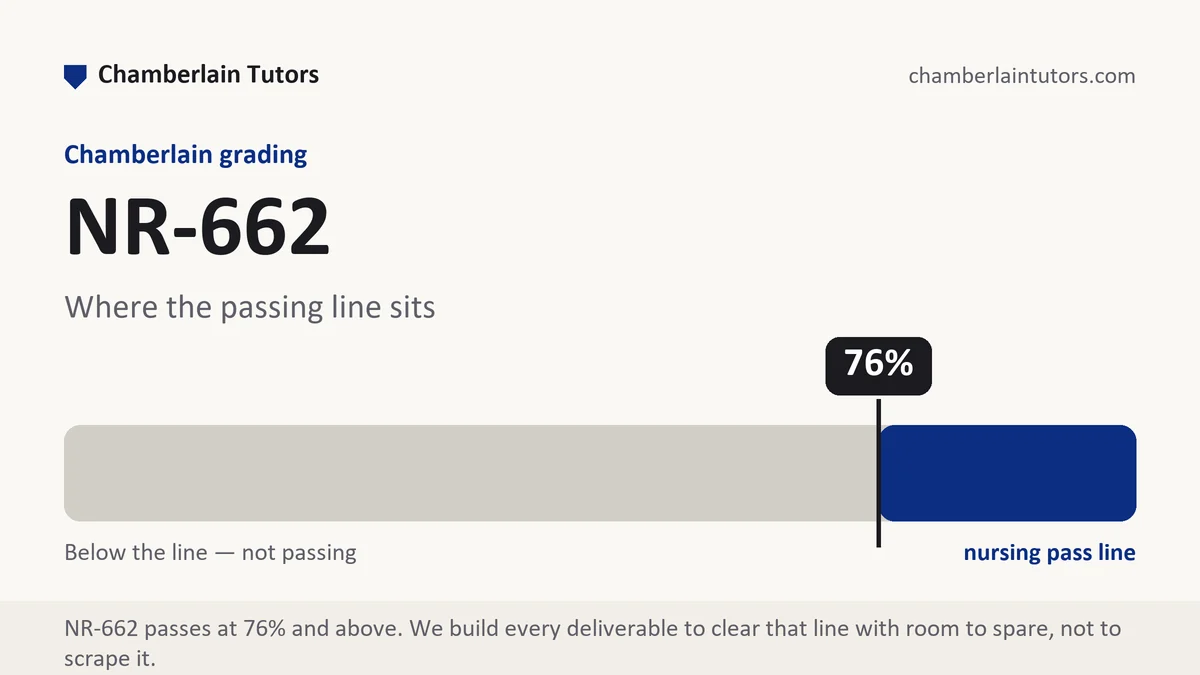
Core nursing courses pass at 76 percent, while the specialty scale with no C band applies in nurse practitioner specialty courses, where anything under 84 fails. Check which scale your section publishes, because a capstone is a bad place to guess. Either way the grade is a weighted average, and supplementary work cannot rescue a weak one.
Sixteen week semesters split into two eight week sessions, up to six starts a year, weekly deliverables. In a course carrying 144 clinical hours the arithmetic is unforgiving: hours, data collection, a manuscript and a poster inside one session. Build the poster from the manuscript's own sections as soon as your results stop changing, since it is the deliverable most often started the night before. Discussion posts cannot be edited after submission at Chamberlain, so check any figure before it goes up permanently.
Turn the criterion rows into a word budget
Posters have a physical ceiling rather than a stated one. A readable academic poster carries roughly 700 to 900 words in total, because text below about 24 point cannot be read from a metre away and nobody stands closer. Take 800 words as your cap and apply the rubric's weights to it.
Say four rows carry 30, 30, 25 and 15 percent. That is 240 words, 240, 200 and 120 across the whole poster. Now watch what that means physically: a background panel of about 100 words is three sentences, methods gets perhaps 150, results is one figure with 80 words of caption and interpretation, and conclusions are two sentences. Everything else is white space, and white space is a design decision rather than a failure to fill the board. The manuscript then holds what the poster could not: full methods, the evidence appraisal, limits, and the sentences you argued about deleting.
The panels of a poster, and what each has to carry
Whatever your guide calls them, these panels recur, and a reader walking past gives the board about thirty seconds to earn a stop.
| Panel | What it has to do | What the weak version does |
|---|---|---|
| Title | Name the population, the change and the outcome in about a dozen words. | A question with a colon and no content. |
| Background | Two or three sentences: the problem, its local size, the gap. | A literature review in six point font. |
| Aim | One sentence with a number, a population and a date. | To improve care and enhance outcomes. |
| Methods | Setting, what was done, to whom, over which weeks. | A framework diagram instead of the actual steps. |
| Measures | Each measure with its denominator and source, in one line each. | Data were collected and analyzed. |
| Results | One figure that answers the aim, plus counts in the caption. | Three charts of the same data and no counts. |
| Conclusions | What the result supports, in two sentences, no new data. | A summary of the entire project. |
| Next step | What happens now, and who owns it. | Further research is recommended. |
Design the results figure before you write anything else. If no single graphic answers the aim, the aim is probably two aims wearing one sentence.
Evidence craft, and figures that survive scrutiny
- Label every bar with its count. A bar chart without n values is a shape. With them it is evidence, and the labels cost nothing.
- Denominator and window before any rate. Twenty two of 149 eligible patients across nine weeks is reportable. A 15 percent improvement floating alone is not.
- Keep the axis honest. A truncated axis exaggerates small changes. Start at zero, or state plainly why you did not.
- Design and sample before the finding. Say that a cluster randomized trial in eleven clinics reported the effect, then report it. On a poster that fits in a caption.
- Verbs the design can pay for. One unit, one season, no control group earns coincided with and was associated with. Caused and reduced belong to controlled work.
- Currency, checked once more before printing. Guidance and standards get revised, and a poster is public. Confirm the edition of anything you cite and print the year.
What separates a passing capstone from a strong one
A passing NR-662 submission has all the pieces: a project, a manuscript, a poster, a reflection. It is complete and slightly generic, and it usually shows the same seam, where the poster is the paper shrunk and the reflection is a summary of the paper in the first person.
Strong submissions treat each artifact as a different argument for a different reader. The manuscript proves the work. The poster sells the finding in thirty seconds and survives being questioned by a stranger standing next to it. The synthesis explains what the role demanded of you, using moments specific enough that nobody else could have written them. Doing that well matters beyond the grade, since these are the two artifacts you can carry into an interview.
Six mistakes that cost points here
- The poster as a shrunken paper. If a reader has to lean in, the panel has already failed.
- Results that report activity. Sessions delivered and staff educated are process. Say what changed for patients or for the measure.
- Aims that drift. The aim on the poster, in the manuscript and in the reflection must be the same sentence.
- Unlabeled or misleading graphics. No axis titles, no units, no counts, or a scale chosen to flatter.
- Identifiable material on a public board. No patient data, no staff names, no unit identifiers, and no internal document reproduced without permission.
- A synthesis made of adjectives. Rewarding, eye opening and transformative are not evidence. Decisions, constraints and consequences are.
Questions NR-662 students ask
Is my project quality improvement or research, and does it need review?
My results are thin. What goes in the results panel?
How do I write the role synthesis without repeating the project?
Where NR-662 sits in Chamberlain's programs
Open the exact program map for sequence, credit, and option context. The current student schedule and syllabus remain authoritative after transfer evaluation, electives, state rules, and approved plan changes.
The weeks, one by one
Week 1
NR-662 opens with the two documents that decide whether the rest of the capstone runs smoothly: a plan for the immersion itself and a problem statement narrow enough to improve inside one session. Read the full Week 1 manual.
Week 2
The second stage of NR-662 is where the project stops being an idea and starts being situated. Read the full Week 2 manual.
Week 3
By the third stage of NR-662 the project needs an intervention, and the intervention needs a reason that came from evidence rather than from availability. Read the full Week 3 manual.
Week 4
Midway through NR-662 the project has to become measurable. Read the full Week 4 manual.
Week 5
Stage five is the methods section of your capstone, written while the change is going in. Read the full Week 5 manual.
Week 6
Stage six of NR-662 is where the numbers arrive and the writing gets harder, because a results section is judged on restraint. Read the full Week 6 manual.
Week 7
The seventh stage of NR-662 turns eight weeks of documents into one submission-ready manuscript. Read the full Week 7 manual.
Week 8
The final stage of NR-662 asks for two very different pieces of writing. Read the full Week 8 manual.