The last stage of NR-669 carries two pieces of writing that look unrelated and are not. One is the question preparation document that stands behind your delivered presentation: the challenges you expect, written out and answered in advance from your own data. The other is the closing role transition reflection, where you argue what the immersion changed about how you practice at an advanced level. Both are analysis, and both are marked down when they turn into narration. Your section may print this as NR 669 or NR669; it is the same course. Chamberlain publishes no syllabi outside Canvas. The placement here is our teaching judgment from the course's catalog arc; your section's rubric decides what your week actually asks.
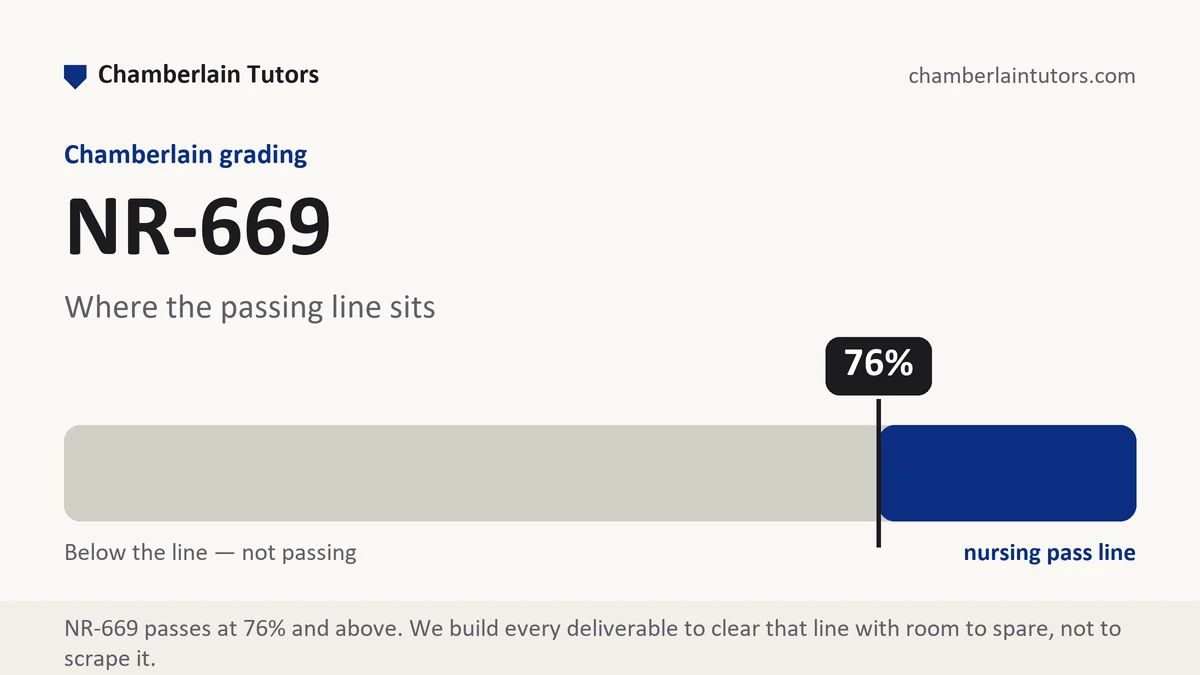
What NR-669 Week 8 asks for
Fifteen seconds after a student finished presenting a well-child immunization catch-up process to a pediatric practice's quality council, the practice's senior physician asked whether the improvement was really the process or really the two new medical assistants hired in March. It is a fair question and a fatal one if it arrives unrehearsed. The student who has written that question down in week eight, answered it against her own timeline, and knows that the staffing change landed six weeks after the measured shift began, gives a forty-second answer and keeps the room. The student who has not gives a shrug dressed as humility, and everything she said before that moment loses a little weight.
That is the first half of this stage: written question preparation. It is unglamorous, it is rarely the headline deliverable, and it is where the difference between a capstone that closes well and one that closes adequately usually shows. You are not memorizing answers. You are building a short document that pairs each anticipated challenge with the specific fact from your own project that addresses it, so that under pressure you are retrieving rather than inventing.
The second half is the closing role transition piece. After 168 clinical hours across the immersion, a program does not want a summary of what you did. It wants an argument about what changed in your practice: which competencies you can now evidence with a concrete instance, where you are still developing and what you will do about it, and how you understand the advanced role differently than you did before you led a project inside a real organization. The failure mode is a chronological account of the practicum. The passing shape is a claim with instances attached.
These two pieces also share a discipline, which is that both are written from evidence you already hold. The question document draws on your data account, your timeline and your process detail. The reflection draws on specific moments that can be described precisely enough for a reader to see what competency was in play. Neither one is improved by adjectives, and both are weakened by them.
Where the boundary sits in a closing stage. The 168 clinical hours, the immersion experience, the relationships you built at the organization, and the delivery of and answers given in your presentation are your own work and nobody else's. Hour logs, encounter counts, census entries, site paperwork, signatures and any preceptor or faculty evaluation completed about you are your own record, and they are never drafted, reconstructed or estimated with help. What a manual supports is the written layer only: how a question preparation document is organized, how a competency claim is evidenced, how a reflection is structured to analyze rather than narrate. Anything drawn from a real encounter is de-identified before it reaches the page, and in a closing reflection that means no names, no dates of service, and no detail specific enough that a colleague at your site could identify a child or a family.
The NR-669 Week 8 method, step by step
Six moves for closing an immersion in writing rather than trailing off.
-
List the questions before you answer any of them
Write out every challenge you can imagine, including the ones you hope nobody asks. Cost, staffing, whether it holds without you, whether something else explains the result, what happens to the children who were missed. A list built while you are calm is worth more than composure built on the day.
-
Answer each question in three sentences and no more
The fact, the source of the fact, and what it means for the question asked. Longer answers in a live room read as uncertainty. If an answer will not compress to three sentences, the underlying analysis is not finished yet, and that is useful to discover now.
-
Mark the questions you cannot answer and say so in writing
Some challenges have no answer available from your design. Write the honest version: what you would need to know, why you do not know it, and what a next cycle would collect. Deciding that sentence in advance is what stops it becoming a stammer.
-
Choose three competencies and one instance each
Do not survey every competency in the framework you are writing against. Pick the three the immersion genuinely exercised and attach one described moment to each, specific enough that a reader could picture it and de-identified enough that nobody could place it.
-
Name a real developmental gap and put a plan under it
The reflection row that separates strong from adequate is usually the one about continued development. A gap named with a situation, a consequence and a concrete next step reads as professional self-assessment. A gap named as continue to grow as a leader reads as filler.
-
Write the closing paragraph as a position, not a farewell
End on what you now understand about leading change inside an organization that you did not understand in the first session. Gratitude and reflection on the journey belong in a message to your preceptor, not in the last paragraph of a graduate paper.
A layout and word budget for the closing reflection
Our frame for a role transition piece of roughly 1,300 to 1,600 words, kept beside the question preparation document rather than replacing it. It is our own outline rather than anything the university issues, and your scoring guide outranks it wherever the two disagree. Scale proportionally if your assigned length differs.
| Section | What belongs in it | Word target |
|---|---|---|
| The claim about change | One sentence naming what is different about how you practice, stated before any account of the immersion. | 80 to 110 |
| Competency one, with its instance | The competency in the framework's own language, then a de-identified moment where it was exercised and what it produced. | 210 to 250 |
| Competency two, with its instance | A second competency and a moment from a different phase of the project, so the evidence is not all from one week. | 210 to 250 |
| Competency three, with its instance | A third, ideally one exercised in the harder direction: an obstacle, a refusal, a change that had to be renegotiated. | 210 to 250 |
| The developmental gap and plan | What the immersion exposed as still weak, the situation that exposed it, and the specific next step with a window. | 230 to 280 |
| Sustained contribution | What remains at the organization after you leave, stated as structure and ownership rather than as hope. | 170 to 200 |
| Position close | What you now hold to be true about advanced practice leadership, argued in two or three sentences. | 90 to 120 |
Evidence craft for question preparation and reflective writing
Answer challenges with counts you have already verified. The strongest response to a staffing question is a date and a number: the shift appeared in the six weeks before the new hires started, across a stated number of visits. Rehearsed confidence persuades nobody in a room full of clinicians; a checkable fact does.
Attach a scene to every competency claim. Writing that you developed skill in interprofessional collaboration is an assertion. Writing that a front desk lead refused a workflow change until you rebuilt it around her scheduling constraints, and that documented completion then rose, is evidence a grader can score in the analysis row.
Cite the framework you are measuring yourself against. Advanced practice competencies are described in published professional documents, and naming the source with its year converts self-assessment into assessment against an external standard. Say which document and which edition inside the sentence rather than leaving it to the reference list.
Report the failures at their real size. A reflection that reports only success reads as either incurious or unfinished. The parent education handout that nobody used, the report nobody opened, the week when data collection lapsed: named plainly, with what you drew from it, these are the passages that most often lift a reflection score.
De-identify every clinical instance, including the ones that seem harmless. A composite scene is safer than a real one, and where you use a composite, say so in the sentence. Colleagues who work in the same building can recognize a family from three ordinary details, and that is precisely the audience a capstone reflection is read by.
Five mistakes that cost points in this week's territory
- Narrating the practicum. A week-by-week account of what you did answers a question the scoring rows did not ask, and it consumes the words the analysis needed.
- Surveying every competency at once. Twelve competencies covered in one sentence each is a checklist. Three covered with evidence is a paper.
- Manufacturing a developmental gap. A safe, decorative weakness chosen to look humble is transparent to readers who mark these every session. Name the one that actually cost you something.
- Improvising the hard question. The challenge you decided not to write down is the one that gets asked, and the answer invented on the spot is the one that gets quoted back.
- Sentimental closing. Thanking the site, the faculty and the profession in the final paragraph converts a graduate argument into a card, and the last thing a grader reads sets the tone of the score.
Before you submit
- Your claim about what changed appears before any account of the immersion
- Each competency carries one described, de-identified instance rather than a summary
- The developmental gap has a situation, a consequence and a dated next step under it
- Every anticipated question has a written three-sentence answer or an honest limit
- The published competency framework is named with its year inside a sentence
- The final paragraph argues a position rather than closing with thanks
Closing out NR-669 this week?
Send the scoring guide, your paper and your presentation out of Canvas. A premium original draft comes back in 24 to 48 hours as a question preparation document and a role transition piece built on evidence rather than adjectives, and revisions run until the grade lands. Your hours, logs, site paperwork and evaluations stay entirely yours.