NR-667 sits in Chamberlain's FNP capstone, on the MSN-FNP path. This is its help page: what the course really grades and how our team carries it, floor check included.
What NR-667 actually grades
The FNP capstone, with board-review intensity folded into its close. The written components integrate the track; the preparation components point at certification, and the two compete for the same weeks.
How we help in this course
We split the load cleanly: capstone writing through the pipeline on a staged plan, board preparation as structured coaching, drills, plans, practice questions organized. The certification sit is yours alone, and everything before it can be shared.
Deliverables run the standard promise: a premium original draft in 24 to 48 hours, targeted at the A band of your course's actual scale, through the eight-person pipeline with both QA passes and the floor check, revised free until it lands.
How to write this course's capstone deliverables
Chamberlain does not publish capstone syllabi outside Canvas, and a manual invented around week numbers would be worse than none at all in a course where the schedule is the whole difficulty. So this section works from the document you do hold: the scoring guide attached to each capstone deliverable. Below is how to stage a capstone against it, what its written components have to establish, and how to keep board review from being eaten by writing deadlines. Bring your own guide; where it disagrees with this page, your guide wins.
In NR-667 right now?
Send the week and the rubric from Canvas. First premium sample free, floor-checked, back in 24 to 48 hours.
Two workloads wearing one course code
NR-667 folds board-review intensity into the FNP capstone, and the two halves compete for the same weeks: integrative written components on one side, certification preparation pointing at the boards on the other. The desk's answer is a clean split. Capstone writing runs staged through the pipeline with dates attached; board preparation runs beside it as organized coaching, drills, study plans, and practice questions sequenced so review hours stay whole instead of being cannibalized by paper deadlines. Each half keeps its own calendar, and the two calendars meet weekly in one plan your manager keeps current.
The boundary this page will not blur
The certification sit is yours alone. Everything before it can be shared, the writing, the structure, the drilling, the scheduling, but the exam seat has one name on it and that line does not move regardless of what anyone offers to sell you. What the desk guarantees is arriving at that seat with the capstone's written side already banked at the A band and the review hours protected by the staging plan.
When should the capstone staging plan be built?
Before the course's first submission if possible. A capstone planned backward from its final week keeps the board-review calendar honest; one planned week to week donates review time to whichever deadline shouts loudest.
Does the floor check still matter in a capstone?
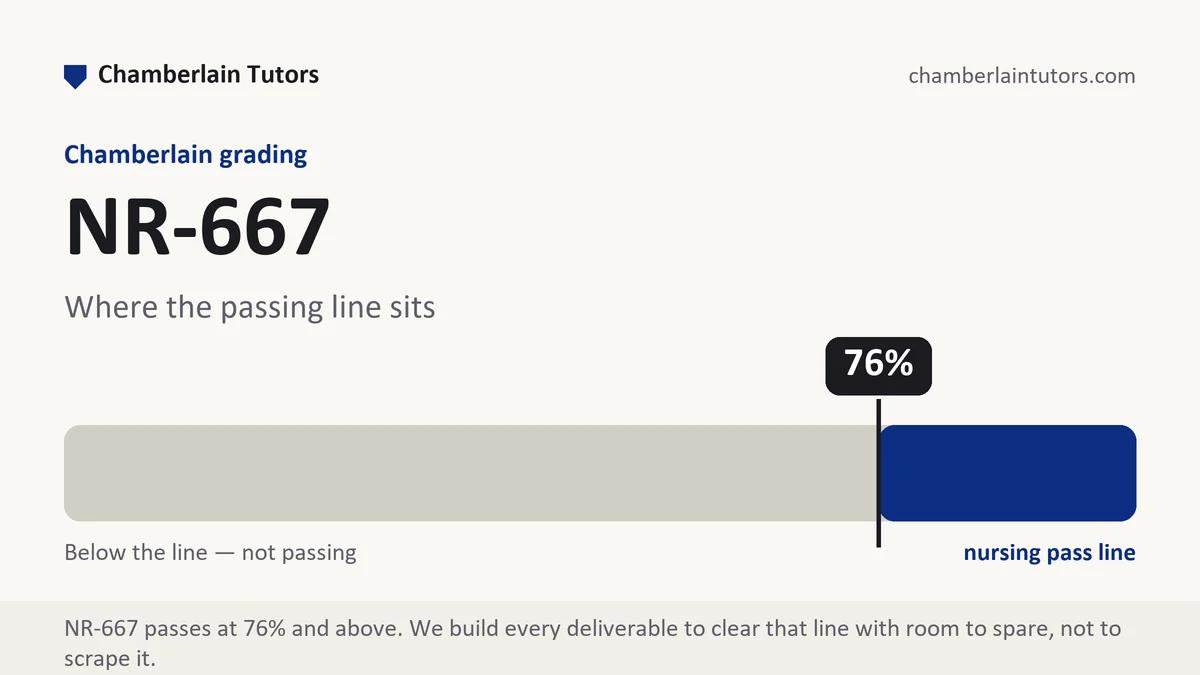
More than ever. This is still a specialty-scale course, 84 still ends careers here, and every staged section is pre-scored before it reaches you. Delivery stays inside 24 to 48 hours per staged section.
Stage the capstone backward from its scoring guide
A capstone is not a long paper written late. It is several deliverables that depend on each other, which means the scoring guide has to be read before the first one is drafted, not before the last one is due. Read every guide you have been given in one sitting, list the rows, and mark which rows depend on work you have not done yet.
Then convert weight into words and words into weeks. Suppose the written side runs to 3,000 words across four rows weighted 30, 30, 25 and 15. That is roughly 900, 900, 750 and 450 words. Spread across a session that runs eight weeks, two 900 word rows are one substantial writing block each, not a weekend. Book those blocks in a calendar now and put board review in the gaps between them rather than after them, because whichever one you schedule last is the one that gets sacrificed.
Weighting varies by term and section, so run this on your own guides. The point is the order of operations: rows first, words second, dates third, and only then the writing.
What the written components have to establish
Capstone rubrics differ in wording but they are asking the same sequence of questions, and each stage below has to answer its own.
| Stage | What you produce | What it has to establish |
|---|---|---|
| The question or practice gap | A narrow, answerable statement of the problem, with the population, the setting and the outcome named | That the project is about something specific. Broad topics produce broad papers and middle-band scores. |
| The search you actually ran | Databases, date limits, search terms and inclusion rules, written so a reader could repeat it | That the evidence was found by method rather than by whichever articles appeared first. |
| Appraisal of what you found | A table or structured summary carrying design, sample, setting and findings for each source, in that order | That you can weigh evidence, not only collect it. Findings without design and sample are unweighted. |
| Synthesis into a position | What the body of evidence supports, where it disagrees with itself, and where it runs out | That you reached a conclusion the sources can carry. Naming the limits of the evidence earns the row rather than weakening it. |
| Application to a real setting | What would change in practice, who does it, what it costs, what would block it, and how it gets measured | That the project could survive contact with an actual clinic. |
| Self-appraisal and next steps | Specific strengths and specific gaps against the outcomes of the track, each with a plan and a date | That the reflection is evidence about you, not a paragraph of gratitude. |
The last stage is where capstones most often go thin. A reflection that names one gap and attaches one dated plan to it outscores three paragraphs of general enthusiasm every time, and it is also the section a reader remembers, since it is the only place in the document where you are the subject.
Evidence craft for capstone-level synthesis
Everything in a capstone rests on how the evidence is handled, so handle it visibly. Report design and sample before findings for every source you rely on, and keep those as columns in your appraisal table so the reader never has to take a finding on trust.
Any number describing your practice gap needs a denominator, a measurement window and a source: how many of how many, over what period, measured where. A percentage with none of those attached is the single fastest way to make an otherwise strong project look assembled from memory.
Keep the verbs matched to the designs. Cohort, registry and quality-improvement reports support was associated with; only randomized designs support reduced or caused. Set a recency rule at the start, state it in your search description, and hold the exceptions to work you can name as foundational. When a guideline is central to the argument, cite the current edition, put its year in the sentence, and check before submission that it has not been replaced since you drafted.
The difference between a finished capstone and a strong one
A finished capstone contains every required component, cites correctly and reads cleanly. A strong one keeps a visible thread: the question stated at the start is the question the evidence answers, and the application section acts on that same answer instead of drifting to a general recommendation. Its appraisal weighs rather than summarizes. Its implementation names a person, a cost and an obstacle. Its self-appraisal is specific enough to be uncomfortable, and its measurement plan says what number would prove the change worked.
The scale still applies at the end of the track. There is no C band on the specialty ladder, 84 is the first passing number, and no supplementary work rescues a weighted average, which is why staged sections that each clear the top band matter more here than one heroic final week.
Six capstone mistakes worth avoiding
- Starting the writing in the week it is due. Dependent deliverables cannot be parallelized, and the last one inherits every delay before it.
- A practice-gap number with no denominator. Say how many of how many, over what window, and where the figure came from.
- An appraisal table of findings only. Without design, sample and setting columns, the table summarizes instead of appraising.
- An application section that stops at educate staff. Name who, when, at what cost, against what obstacle, measured by what.
- Self-appraisal in generalities. Grew as a provider scores nothing. One named gap with a dated plan scores.
- Board review scheduled after the writing. Whatever is scheduled last is what gets donated to the nearest deadline.
Three questions NR-667 students send
When should capstone writing start relative to board review?
What counts as evidence for a practice gap?
Can anyone sit my certification exam or its practice sittings for me?
The weeks, one by one
Week 1
NR-667 Week 1 opens the FNP capstone, and everything the next seven weeks build rests on what gets written now: a practice gap stated narrowly enough to answer, with a population, a setting, an outcome, and a number a reader can check. Read the full Week 1 manual.
Week 2
NR-667 Week 2 usually turns the capstone question into a hunt with rules: which databases, which terms, which limits, and which screening decisions, all recorded so completely that a stranger could rerun the search and land on the same pile of studies. Read the full Week 2 manual.
Week 3
NR-667 Week 3 generally takes the studies the search retained and asks the question that separates appraisal from book-reporting: how much weight can each one bear? Read the full Week 3 manual.
Week 4
NR-667 Week 4 usually asks for the intellectual center of the capstone: the synthesis, where a table of appraised studies becomes one argued position. Read the full Week 4 manual.
Week 5
NR-667 Week 5 typically converts the synthesis into consequences: one concrete change the evidence funds, planned to the level where a clinic could actually run it. Read the full Week 5 manual.
Week 6
NR-667 Week 6 usually foregrounds the course's second identity: preparation for the FNP national certification exam. Read the full Week 6 manual.
Week 7
NR-667 Week 7 typically moves the capstone from the page to the room: presenting the project and answering for it, the skill the course's on-ground intensive exists to exercise. Read the full Week 7 manual.
Week 8
NR-667 Week 8 usually closes both the capstone and the FNP track with a document about you: a self-appraisal against the program's outcomes, gaps named precisely enough to schedule, plans with dates, and a transition map into certification and a first advanced practice role. Read the full Week 8 manual.
Where NR-667 sits in Chamberlain's programs
Open the exact program map for sequence, credit, and option context. The current student schedule and syllabus remain authoritative after transfer evaluation, electives, state rules, and approved plan changes.