NR-667 Week 3 generally takes the studies the search retained and asks the question that separates appraisal from book-reporting: how much weight can each one bear? The deliverable territory is the appraisal table, where design, sample, findings and bias are laid side by side until the strong studies and the decorative ones sort themselves. Your section may print this as NR 667 or NR667; it is the same course. Chamberlain publishes no syllabi outside Canvas. The placement here is our teaching judgment from the course's catalog arc; your section's rubric decides what your week actually asks.
Appraisal is desk work stacked on top of clinic weeks, and only the desk half is shareable: the reading, the table, the grading of evidence. The precepted half of this course keeps its own ledger, in your program's hands, where it belongs.
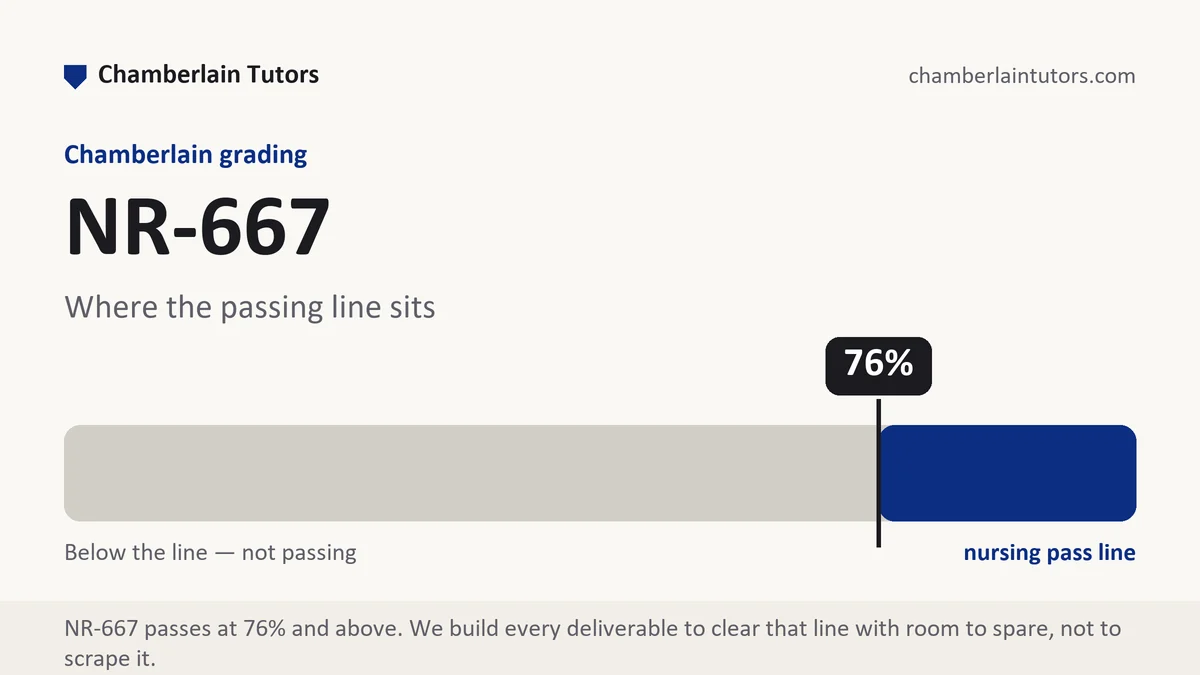
What NR-667 Week 3 asks for
Expect the territory to run through the mechanics of critical appraisal: identifying a study's actual design rather than its self-description, reading methods before results, extracting sample and setting as limits on what a finding can claim, naming the bias most likely to distort each study, and applying a levels-of-evidence scheme consistently instead of decoratively. The through-line is proportion, letting each study speak exactly as loudly as its architecture allows.
The deliverable is most often a structured appraisal table covering the retained studies, sometimes with a short narrative of the strongest and weakest entries, and sometimes as the evidence section of the building capstone document. If your section runs a discussion this week, it often asks which single study best supports your project and why, which is an appraisal question disguised as a favorite-picking one.
Your week's rubric will likely reward consistency above all: the same columns filled for every study, the same grading scheme applied by the same logic, and relevance to your specific question judged explicitly rather than assumed.
The NR-667 Week 3 method, step by step
Six moves that turn a reading pile into an instrument of judgment.
-
Fix the columns before opening a single study
Decide the fields every study must answer: citation and year, design, sample and setting, intervention or exposure, findings, the threatening bias, the evidence grade, and fit to your question. A table designed after reading bends toward what the reading found.
-
Read for design first and label it yourself
Abstracts advertise; methods confess. Establish from the methods what the study actually did, randomization or its absence, comparison groups, follow-up, and assign the design label from the architecture, not from the title.
-
Extract the finding as the authors earned it
Carry the result with its numbers: effect size, confidence bounds where given, the comparator, and the outcome as measured, not as popularly paraphrased. A finding stripped of its comparator has already started to overclaim.
-
Name the one bias that threatens each study most
Selection, measurement, attrition, confounding: pick the single most dangerous one for each entry and say in a phrase why it matters here. One named, argued threat per study beats a recited list of every bias known to methodology.
-
Grade with one scheme, cited and obeyed
Choose the levels-of-evidence framework your program teaches, cite it, and apply it identically down the column. The grade is a function of design and execution, never of whether the finding helps your project.
-
Close each row with fit, then format
End every entry with one honest line: how close this study's population, setting and outcome sit to yours. Then the mechanics: current APA in the citation column, table formatted to your section's template if one is given.
The appraisal table, column by column
Word targets here are per study rather than per section; a table of eight to twelve entries at these depths lands in normal range for this deliverable. Your own template, if the section provides one, wins over this layout.
| Column | What belongs there | Per-study target |
|---|---|---|
| Citation and year | Full current-APA reference, so the table stands alone | reference only |
| Design, self-labeled | The architecture as you determined it from the methods | 5 to 15 words |
| Sample and setting | Who, how many, where, and how recruited | 15 to 30 words |
| Intervention or exposure | What was done or observed, with dose, duration or intensity where relevant | 15 to 30 words |
| Findings as earned | The result with its numbers, comparator and measured outcome | 25 to 45 words |
| Threatening bias | The one most dangerous flaw and why it matters for this finding | 15 to 30 words |
| Grade and fit | The level under your named scheme, plus one line of distance from your question | 15 to 30 words |
The discipline is horizontal: a reader should be able to run a finger across any row and meet the same kinds of facts in the same order, twelve times.
Verbs, denominators, and reading past the abstract
Appraisal has its own grammar. Randomized designs earn causal verbs; cohorts, registries and cross-sections earn association verbs; and the table is where that discipline is enforced, because a "reduced" sitting in a row whose design column says observational is a self-documenting error.
Numbers travel with their denominators or not at all. An improvement experienced by 40 of 62 completers is a different fact from one experienced by 40 of 100 enrolled, and attrition is precisely the kind of detail abstracts round away. Pull your figures from the results tables, not the abstract, and note where the authors' summary and their own data part company, because finding one such gap is worth more appraisal credit than ten clean summaries.
For guidelines and systematic reviews entering the table, appraise the synthesis itself: how the source studies were found, whether their quality was graded, and the year of the evidence cutoff, which can sit surprisingly far behind the publication date. Citing a review's conclusion without its cutoff year silently ages your whole evidence base.
Five mistakes that cost points in an appraisal week
- Rows that only summarize. A findings column with no design, sample or bias beside it is an annotated bibliography wearing a table's borders.
- Hierarchy applied as arithmetic. Ranking a weak randomized trial above a strong cohort automatically, without engaging execution, misses what the hierarchy is for.
- Boilerplate bias entries. "Small sample size" pasted down the column signals the studies were never individually interrogated.
- Grading schemes mixed mid-table. Levels drawn from different frameworks in different rows make the column meaningless, and faculty check.
- Appraisal from the abstract. Numbers that match the abstract but not the results tables are the tell, and it is a tell graders know.
Before you submit
- Every study answers the same columns in the same order
- Each design label was assigned from the methods, not the title
- Findings carry numbers, comparators and outcomes as measured
- Each bias entry is specific to its study and argued in a phrase
- One named grading scheme governs the whole column
- Every row ends with an honest fit line to your question
Twelve studies deep with no table yet?
Send the retained citations and your template. A complete appraisal table, graded consistently and fit-lined, returns inside 24 to 48 hours with the floor check run.