The final stage of NR-662 asks for two very different pieces of writing. A poster compresses the whole project into roughly 800 words of panels, where what you cut is scored as heavily as what you keep. And a role synthesis argues, from the 144 hours you actually spent, what the advanced nursing role involves. Both reward selection over coverage, and both are usually underestimated. Your section may print this as NR 662 or NR662; it is the same course. Chamberlain publishes no syllabi outside Canvas. The placement here is our teaching judgment from the course's catalog arc; your section's rubric decides what your week actually asks.
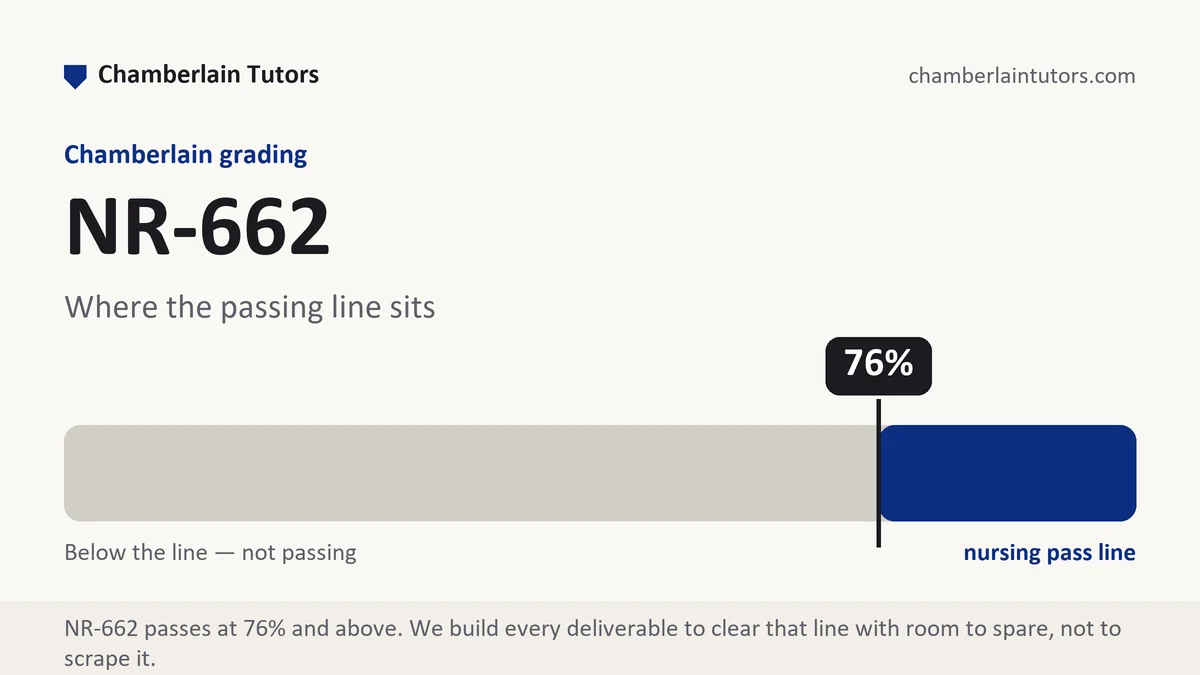
What NR-662 Week 8 asks for
A student closing an adolescent depression screening project in a family practice has a 3,200-word manuscript and eleven weeks of data. The poster has room for perhaps eight hundred words and one figure that matters. Every sentence that survives has to be one the reader could not have worked out alone: not that depression screening is important, not that the practice serves adolescents, but that documented screening at well visits moved from a stated baseline to a stated post-change figure while visit length held steady. Deciding which sentences those are is the intellectual work of the poster, and it is why compression is a harder test of understanding than expansion.
A poster is read standing up, in about ninety seconds, by someone who may not have your context. That reality dictates its physics. Panels carry short blocks, not paragraphs. The visual is the argument, not an illustration of it. Titles say what happened rather than announcing a topic. Font sizes are dictated by reading distance rather than by how much you want to include. And the empty space is functional, because a panel crowded to the margins tells the viewer that the author could not decide what mattered.
The role synthesis is the other half, and it is where the immersion earns its place. The question is what the advanced role you are entering actually involves, argued from what you observed and did across your hours. Definitions copied from a professional organization sit mid band because anyone could have written them without leaving home. An argument built from decisions you watched being made, with what each one required in judgment, authority and communication, moves above that. Sections often close with a final discussion post. Treat it as final copy; Canvas responses do not reopen.
Where the boundary sits in a closing stage. The 144 clinical hours, the immersion itself and every relationship at the practice are yours and cannot be delegated, reconstructed or condensed by anyone else. Hour logs, encounter counts, site paperwork, signatures and any evaluation completed about you are your own record, never drafted, reconstructed or estimated with help. What a manual can teach is the written layer: how to compress a project into panels, how to build a figure that argues, how to turn observation into a synthesis about a role. Everything you observed reaches the page de-identified, with the site and its people unidentifiable.
The NR-662 Week 8 method, step by step
Six moves for a poster that works at reading distance and a synthesis that argues.
-
Write the poster title as a finding
A title that states the result orients a passing reader in one line. Improving Adolescent Screening in Primary Care announces a topic. Documented Screening Rose After a Rooming-Step Change in a Two-Provider Practice tells the reader what happened before they read a single panel.
-
Build the figure first and let the panels serve it
Decide which single display carries the finding, size it to dominate the poster, and label it so it stands alone. Then write panels that fill the gaps the figure leaves rather than restating what it already shows.
-
Cut to the sentences only you could write
Delete background a professional audience already knows, delete method detail the manuscript carries, and keep the local numbers, the specific intervention step and the honest result. Test each sentence by asking whether a knowledgeable stranger could have supplied it.
-
Size type to the room, not to the content
Title readable from several meters, headings from about two, body from arm's length. If the text will not fit at those sizes, the answer is less text, never smaller type. This is the constraint that forces the selection the panel is scored on.
-
Ground the role synthesis in observed decisions
Pick three or four moments from the immersion where the advanced role did something a staff nurse could not, then say what each required: what authority, what evidence, what negotiation. De-identify completely and describe roles rather than people.
-
Close the synthesis with your own gap and next step
Name one capability the immersion showed you still need, with the evidence for that judgment and what you will do about it in the first year of practice. Self-appraisal with a scene attached is analysis; self-appraisal in adjectives is a wish list.
A panel budget for the poster and a shape for the synthesis
Our frame for the closing artifacts. The poster column assumes a total around 800 words across panels; the synthesis assumes a separate document of roughly 1,000 to 1,300 words. This is our own outline rather than anything the university issues, and your scoring guide outranks it wherever they disagree.
| Panel or section | What belongs in it | Word target |
|---|---|---|
| Poster: background | The local problem in two or three lines with the baseline number, and nothing a professional audience already knows. | 70 to 100 |
| Poster: aim and setting | The aim as written, plus the practice type and volume, enough for a viewer to judge transferability. | 60 to 90 |
| Poster: intervention | The change at encounter level in bullet form, including who performs the step and when. | 110 to 150 |
| Poster: results | The figure with a self-contained caption, plus counts for outcome, process and balancing measures. | 120 to 160 |
| Poster: conclusion and next step | What the site should do now, sized to what a single-site project supports, in two or three lines. | 70 to 100 |
| Role synthesis | Three or four observed decisions with what each required, then your own remaining gap and its evidence. | 900 to 1,200 |
Evidence craft for a poster and a synthesis
Every number on the poster carries its denominator. Space pressure tempts students to drop the base, and a lone percentage on a panel is the easiest thing in the world for a viewer to misread. Twenty-six of forty-one fits in the same line and cannot be misunderstood.
Citations on a poster are few and load-bearing. Two or three references, chosen because a viewer would otherwise doubt the claim, set in the smallest readable size. A poster carrying twenty citations has imported the manuscript's habits into a medium that cannot hold them.
Attribute the role language in the synthesis. Where you draw on published descriptions of advanced practice competencies, name the issuing body and the year in your sentence, then immediately show the competency operating in something you observed. The pairing of published expectation and observed instance is what lifts a synthesis above definition.
Keep observed material role-based and unidentifiable. Write the medical assistant, the collaborating provider, the practice manager. No names, no dates, no detail that could locate a specific person or child. This is both an ethical requirement and better writing, because it keeps the focus on what the role required rather than on who was in it.
Acknowledge contribution honestly. If the project depended on a team, say so in the poster's acknowledgment line and in the synthesis. Improvement work is collective, and a capstone that presents a clinic-wide change as a solo achievement misrepresents the very competence, working through others, that the advanced role is built on.
Five mistakes that cost points in this week's territory
- The manuscript pasted onto panels. Paragraph blocks in eighteen-point type are unreadable at distance and signal that no selection was made.
- A decorative figure. If the visual only illustrates a sentence, it is wasting the largest and most valuable space on the poster.
- A topic title. Announcing the subject rather than the finding costs the one line every passing viewer reliably reads.
- Synthesis by definition. Quoting what an advanced role is, without evidence from the immersion, is the single most common way this document lands mid band.
- No stated remaining gap. A closing self-appraisal claiming full readiness reads as unexamined, and reviewers weigh honest self-assessment heavily at this stage.
Before you submit
- The poster title states the finding rather than the topic
- Every figure and table on the poster is legible and self-explaining
- All poster numbers appear with their denominators
- The synthesis argues from observed decisions, not from definitions
- Published role expectations are named with an issuing body and a year
- Nothing on either artifact identifies a patient, a colleague or the site
Closing NR-662 this week?
Send the scoring guide, your manuscript and your results out of Canvas. A premium original draft comes back in 24 to 48 hours with a poster built around one figure that argues and a synthesis grounded in what the role actually required, and revisions run until the grade lands. Your hours and your site relationships stay entirely yours.