NR-652 implements and evaluates the policy project you designed in NR-651, and it ends in two deliverables with opposite manners: a manuscript ready paper written for readers who have never heard of your organization, and a presentation to the stakeholders who live inside it. Most of the grade sits in the manuscript, and the row students underestimate is methods, because an outside reader has to be able to picture exactly what was done without ever asking you a question.
What NR-652 actually grades
The first strand is what actually became of the policy. Approved as drafted, amended in committee, piloted on two units, deferred pending a budget cycle: each of those is a legitimate result, and each demands a different paper. What fails is a submission that reports the plan and hopes the reader assumes it happened.
The second strand is manuscript craft. Course writing is allowed to assume a reader who knows the assignment. A manuscript may not. Setting, dates, population, what was changed, who was trained, how compliance was measured and over which weeks all have to be on the page, in an order journals expect, in a register that is neither promotional nor apologetic.
The third strand is the audience switch. The same work told to a journal and told to a room of stakeholders is not the same document. The journal wants method and limits. The room wants what changed, what it costs them and what you are asking for. Students who write one artifact and reformat it into the other lose points in whichever one came second.
How we help in this course
The limit stays fixed: practicum hours, mentors, committees, site forms and logs are yours. We do not do hours, contact your organization, sign anything, or present on your behalf.
What we do is the writing. Send the scoring guide and whatever results exist and a premium original draft comes back in 24 to 48 hours, built as a manuscript rather than as an essay: structured abstract, methods a stranger could follow, results with counts and denominators, a discussion that separates what the data supports from what you believe, and speaker material that carries the same evidence in a different manner. Two quality passes and the floor check run before delivery, and revision stays free until it lands.
Writing this course's deliverables from the rubric
No syllabus is published for NR-652, and each scoring guide arrives with its assignment inside Canvas, so no honest page can print a week by week grid. The method is what carries over: how a manuscript is proportioned, how policy results are reported without overclaiming, and how the same evidence is retold for a room. Keep your guide beside this page.
Turning NR-652 into a manuscript?
Send the scoring guide and your results. First premium sample free, floor-checked, back in 24 to 48 hours.
The passing line, and two deadlines at once
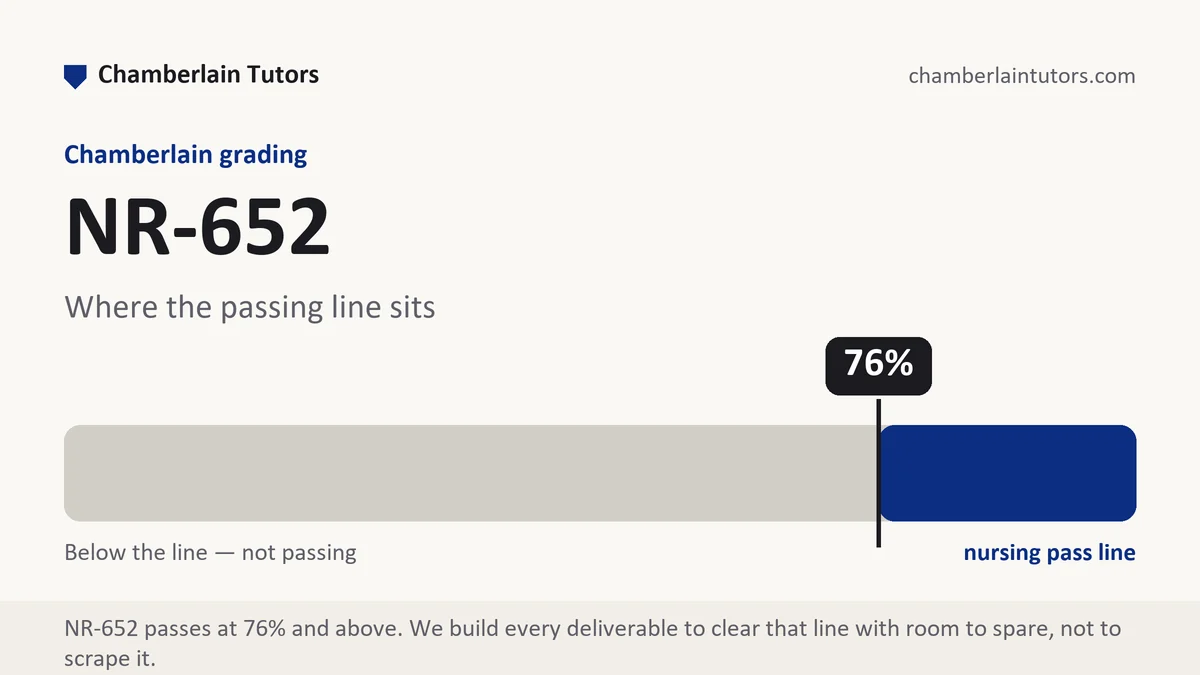
Core nursing courses pass at 76 percent, and the no C specialty scale belongs to nurse practitioner specialty courses rather than to this track. The grade is a weighted average, supplementary work cannot repair it, and a finishing course is a poor place to discover that.
Eight week sessions inside sixteen week semesters, up to six starts a year, deliverables most weeks. The particular pressure here is that the manuscript and the presentation often land within days of each other, and the presentation is the one students postpone. Build the slides from the manuscript's own structure as soon as the results are stable, then rewrite the language for speech. Note too that a discussion post is permanent once submitted at Chamberlain, so any post containing a compliance figure should be checked in a document first.
Turn the criterion rows into a section plan
Copy the rows in printed order, reduce each to its verb, and use those verbs as headings. Then price them, remembering that a manuscript carries a second ceiling: the journal's.
Say your target journal caps papers at 3,500 words and the scoring guide carries four rows weighted 30, 25, 25 and 20 percent, giving 1,050 words, 875, 875 and 700. The abstract normally sits outside that count with its own limit near 250 words, and a structured abstract is unforgiving in a useful way, because a heading marked Results has to be followed by a number. Draft the abstract early as a test of whether you have a finding at all, then rewrite it last when the numbers are final. Tables and figures usually sit outside the word count as well, which makes them the right home for compliance data and the wrong home for your argument.
The manuscript, section by section
Most of what NR-652 grades is a manuscript, whatever the assignment calls it. Each section answers one question for a reader who knows nothing about your site.
| Section | The question it answers | What the weak version does |
|---|---|---|
| Title and abstract | What was done, where, and what was found, in a form someone can scan. | Announces a topic and promises a discussion. |
| Background | Why this policy gap mattered, with evidence and the local number. | Three pages of general context before the problem appears. |
| Methods: setting | The kind of organization, its size, the units involved, the period covered. | A named employer, or nothing at all. |
| Methods: intervention | What the policy required, who was trained, when it took effect, what changed in the record. | A policy was implemented, undated and unspecified. |
| Measures | Each measure defined, with source, denominator and collection window. | Compliance was audited monthly. |
| Results | Counts before percentages, matched periods, no interpretation yet. | Discussion wearing a results heading. |
| Discussion | What the numbers mean, what else could explain them, what the design cannot show. | Restates results and adds enthusiasm. |
| Implications | What another organization could take from this, and what would have to be true first. | A call for further research. |
Write methods first, before results and long before background. Every ambiguity you leave in methods reappears as a question a reviewer, or a grader, asks about your results.
Evidence craft in a policy manuscript
- Separate approval, adoption and outcome. A committee vote is not compliance, and compliance is not benefit. Name which one each number measures.
- Denominator and window on every rate. Sixty two of 187 eligible admissions over ten weeks is reportable. An 86 percent compliance figure with no base and no period cannot be reviewed.
- Verbs the design can pay for. Uncontrolled before and after work earns coincided with, followed and was associated with. Caused and drove require a comparison you did not have.
- Name the co travelers. Policies rarely arrive alone. A new form, a staffing change or a regulatory deadline in the same weeks is a competing explanation, and disclosing it is what makes your claim credible.
- Follow a reporting standard. Improvement and implementation work has published reporting guidance, and following one gives your methods a shape reviewers recognize. Name the version you used.
- Keep sources current and primary. Cite the regulation or standard itself with its effective date, recheck it before submission, and prefer recent comparable studies for anything you benchmark against.
What separates a passing manuscript from a strong one
A passing manuscript narrates a project, reports a favorable number and concludes that policy change improves care. It reads like a report to a supervisor, and it would come back from any editor with the same three questions attached.
Strong manuscripts are reproducible, honest and portable. Reproducible, because the methods let another organization do the same thing. Honest, because the discussion names what else could explain the result before anyone else does. Portable, because the implications say what would transfer and what depended on your particular setting. Those qualities also happen to be what a stakeholder audience trusts, which is why the presentation gets easier once the manuscript is right.
Six mistakes that cost points here
- Assignment voice in a manuscript. Phrases such as this paper will discuss belong to coursework, not to a submission.
- No target journal. Without one there are no author guidelines, and the formatting row has nothing to be scored against.
- Reporting approval as the outcome. Getting a policy passed is a milestone. The result is what changed afterwards.
- Percentages with no counts. Especially with small denominators, where a single case moves the number several points.
- Identifying the site or its staff. Describe the organization by type and size, and remove names, unit identifiers and quoted internal documents.
- Reading the paper aloud as the presentation. A room needs the ask up front, not a literature review it cannot follow.
Questions NR-652 students ask
My policy was not approved before the course ended. What do I write?
How do I choose a target journal, and does it affect my grade?
How do I de-identify my organization if this might really be published?
Where NR-652 sits in Chamberlain's programs
Open the exact program map for sequence, credit, and option context. The current student schedule and syllabus remain authoritative after transfer evaluation, electives, state rules, and approved plan changes.
The weeks, one by one
Week 1
The second concluding experience begins where the first one ended, and its opening written work is almost always a readiness document: what changed between approval and today, what the plan now says, what has been confirmed, and what still has to be true before the first measurable event occurs. Read the full Week 1 manual.
Week 2
Once a project is live, the written work shifts from planning to observation, and the observation that matters most is fidelity: whether the change is actually being delivered as specified, where it is not, and why. Read the full Week 2 manual.
Week 3
A capstone project reaches a point where enough data exists to look at and not enough to conclude from, and the written work of that moment is an interim analysis. Read the full Week 3 manual.
Week 4
A results section reports what happened and refuses to say what it means. Read the full Week 4 manual.
Week 5
The discussion is where a capstone earns or loses its claim to be scholarship. Read the full Week 5 manual.
Week 6
Manuscript preparation is a conversion task, not a polishing task. Read the full Week 6 manual.
Week 7
A stakeholder presentation is not a manuscript on slides. Read the full Week 7 manual.
Week 8
The closing stage of a concluding graduate experience does three separate jobs and students routinely treat it as one. Read the full Week 8 manual.