Manuscript preparation is a conversion task, not a polishing task. A course report is written to prove to a grader that every required element was completed; a manuscript is written to persuade a stranger in another organization that a finding is worth their attention and their time. The conversion means cutting roughly half the words, moving the contribution to the front, rebuilding the introduction as a case for the problem rather than a summary of your program, and choosing one target audience so that every remaining sentence knows who it is speaking to. Your section may print this as NR 652 or NR652; it is the same course. Chamberlain publishes no syllabi outside Canvas. The placement here is our teaching judgment from the course's catalog arc; your section's rubric decides what your week actually asks.
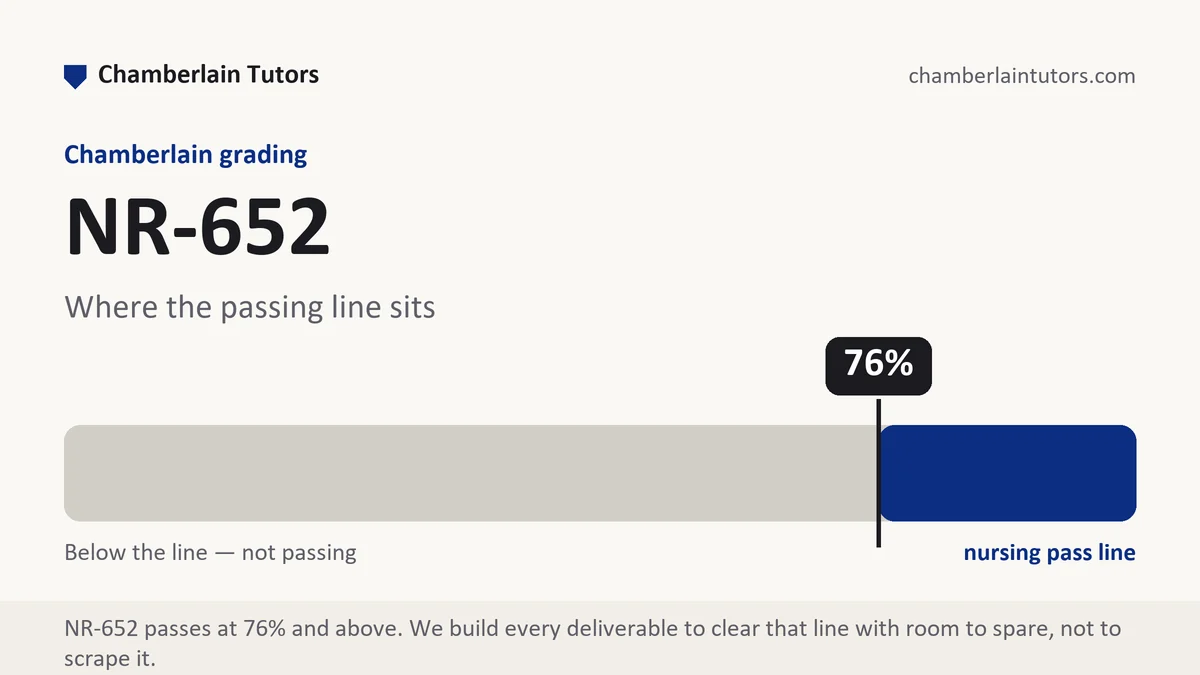
What NR-652 Week 6 asks for
A nurse finishing a project on medication reconciliation at the point of transfer from a skilled nursing facility back to primary care had a forty-page report and a deadline to produce something submittable. Her first attempt at a manuscript was the report with the appendices removed, and it failed in a way that is worth naming: it still opened with three paragraphs about her practicum site, still described her stakeholder meetings in sequence, and still told the reader what she had learned about herself. None of that is wrong in a course report. All of it is invisible to an editor, because an editor's first question is not what happened to you but what a reader elsewhere can now do differently.
So the territory of a manuscript preparation stage is audience conversion. Everything you wrote across the sequence was addressed to a faculty reader who already knew the assignment and was checking whether you had met it. A manuscript is addressed to a practicing colleague who has never heard of your building, has no obligation to keep reading, and will decide within a page whether this problem resembles one of theirs. The same evidence supports both documents, but the order, the emphasis and the proportions are different, and most of the work this week is structural rather than stylistic.
The second demand is compression with judgment. Practice-focused nursing journals commonly run articles in the range of two thousand to four thousand words, and a capstone report is often three or four times that. Compression cannot be achieved by tightening sentences. It is achieved by deciding what the article is about and deleting whole sections that served the course but not the argument: the theoretical framework recital, the full search strategy narrative, the week-by-week implementation chronology, the personal reflection. What survives is the problem, the setting in enough detail to judge transferability, what was done, what happened, what it means, and what a reader should take away.
The third demand is conformity to a target. A manuscript that is not written for a named publication is an essay. Choosing a target journal or an internal outlet early determines your length ceiling, your section headings, your reference style, your tolerance for tables and figures, and even how technical your language may be. Deliverables at this stage usually include a manuscript-formatted version of the project and sometimes a short rationale for the outlet selected. Where a discussion board runs alongside, post final copy; contributions do not reopen after submission in Canvas.
Boundary setting: authorship, hours and the record behind the paper
A manuscript reports a project you led at a site you were physically present in. The practicum record behind it stays entirely yours: clinical and practicum hours, hour logs, activity or encounter documentation, attendance verification, site agreements and every preceptor, mentor, sponsor or faculty evaluation are produced and signed by you and the people who supervised you, and are never drafted, reconstructed or estimated with outside help. That line does not soften in the final weeks of a sequence, and it does not soften because a submission deadline is close.
What can be taught is the craft of conversion: how to move a contribution to the front, how to write an introduction that argues a problem rather than announces a project, how to decide which of your tables earns space, how to compress a methods section without losing reproducibility, and how to match a manuscript to the conventions of an outlet. Those are transferable writing skills and they are exactly what a graduate program is supposed to leave you with.
Two further cautions belong to this stage specifically. First, de-identification tightens when a document may travel outside the organization. A course report read by one faculty member and a manuscript circulating to reviewers are different exposures, so remove building names, city-level detail that makes a facility identifiable, unusual bed counts, distinctive program names and any resident or employee detail that could be pieced back together. Describe the site by type, size band, ownership model and payer mix instead. Second, authorship and permission are real questions rather than formalities. Many organizations require review before staff publish anything drawn from internal data, and colleagues who contributed substantively have a claim to acknowledgement or authorship. Ask early, in writing, and record what you were told.
The NR-652 Week 6 method, step by step
Six moves that turn a capstone report into something an editor would recognize.
-
Choose the outlet before you touch the text
Pick a practice-focused journal or an internal publication whose readers plausibly face your problem, then read three recent articles in it for length, heading conventions, reference style and how technical the prose runs. Write those parameters at the top of your working file. Every later cut becomes easy once there is a number to cut to.
-
Write the takeaway sentence first and let it govern
One sentence stating what a reader elsewhere should now believe or do, calibrated to what your evidence actually supports. Pin it above the draft. Any paragraph that does not serve that sentence is a candidate for deletion regardless of how much work it took to produce.
-
Rebuild the introduction as an argument about the problem
A course introduction describes the assignment and the site. A manuscript introduction establishes that a problem exists beyond your walls, sizes it with published evidence, names the gap in what is known or done, and states the purpose in one sentence. Your practicum site appears for the first time in the methods, not in the opening paragraph.
-
Compress methods to what a reader would need to repeat it
Setting described by type and scale, population and eligibility, what was delivered and by whom, over what period, what was measured and how, and what analytic approach was used. Delete the chronology of your approvals and meetings. Keep anything a colleague would need in order to run the same thing in their own building.
-
Let one table or figure do the work of five paragraphs
Most projects earn one display item, occasionally two. Choose the one that carries the finding, make it fully self-explanatory with denominators and time period in the title, and then delete the prose that duplicates it rather than narrating the table cell by cell.
-
Cut by section, then edit by sentence, then read it aloud
Take the whole draft to the target length by removing sections and paragraphs before you start trimming words, because sentence-level editing on an overlong draft produces a cramped article of the wrong shape. Only when the structure fits should you tighten, and only after that should you read it aloud, which is where the remaining seam lines from the course version become audible.
A layout and word budget for a practice manuscript
Our frame for a practice-focused manuscript drawn from a capstone project, sized for roughly 2,500 to 3,000 words of body text. It is our own outline rather than anything the university issues, and your week's rubric and your target outlet's author guidance both outrank it wherever they disagree.
| Section | What belongs in it | Word target |
|---|---|---|
| Title and abstract | A title naming the change, the setting type and the outcome, then a structured abstract that already contains the finding. | 200 to 250 |
| Introduction | The problem sized with published evidence, the gap in practice, and the purpose in one sentence. | 400 to 500 |
| Background and evidence | The two or three strands of literature that justify this specific change, not a full review. | 350 to 450 |
| Methods | Setting by type and scale, population, intervention, period, measures and analytic approach. | 500 to 600 |
| Results | Delivery, outcome and balancing measures with denominators, plus the single display item. | 400 to 500 |
| Discussion | Interpretation calibrated to the design, comparison with the literature, directional limitations. | 450 to 550 |
| Implications and conclusion | What a reader in a comparable setting should take from this, stated as a usable recommendation. | 200 to 260 |
Evidence craft for manuscript conversion
Size the problem with published evidence, not with your building. An introduction that opens with what happens on your unit invites the reader to conclude that this is a local matter. Open with what is known about the problem across settings, then narrow to the type of setting you worked in, then to the specific site. The funnel is a convention because it works.
Report every number with its denominator and its window. This rule held through the results and discussion stages and it tightens in a manuscript, where a reader cannot ask you for clarification. Fifty-eight of sixty-three eligible admissions over an eleven-week period is a fact; ninety-two percent is a claim the reader has to take on trust.
Trim the reference list to what carries weight. Course papers accumulate citations because rubrics count them. Manuscripts cite what the argument needs, which usually means the studies that establish the problem, the evidence that justified the intervention, the sources behind your measures, and the work you compare your finding against. Remove citations that support sentences no longer in the paper.
Use reporting conventions for the kind of work you did. Improvement projects, implementation studies and evaluations each have published reporting guidance that names the elements readers expect. Following one of those checklists improves the paper and gives you a defensible answer when a reviewer asks why a section is structured as it is.
Keep the verb calibration you established in the discussion. Compression tempts writers to sharpen claims because short sentences sound decisive. A single-site project still supports was associated with and is consistent with, and a manuscript is the document where an overreaching verb is most likely to be caught and quoted back to you.
Five mistakes that cost points in this week's territory
- Submitting the report with a new cover page. Removing appendices is not conversion, and a grader who has read manuscripts can see the course scaffolding in the first paragraph.
- No named target outlet. Without one there is no length ceiling, no house style and no audience, so every structural decision becomes arbitrary.
- An introduction about the practicum. The site belongs in the methods; the opening belongs to the problem as it exists in the wider literature.
- Narrating the table. If the prose walks through every cell, either the table or the paragraph is redundant, and space in a manuscript is finite.
- Reflection left in the paper. Personal learning is a legitimate deliverable elsewhere in the sequence and does not belong in a manuscript's argument.
Before you submit
- A specific outlet is named, with its length limit and reference style followed
- The abstract contains the finding, not just the intention
- The introduction argues the problem from published evidence before the site appears
- Methods contain enough detail for a colleague to repeat the work
- Every result carries its denominator and its measurement window
- One display item carries the finding and is self-explanatory without the text
- Site and people are de-identified to a level appropriate for external circulation
Converting the report into a manuscript this week?
Send the rubric out of Canvas with your full report and the author guidance for the outlet you are targeting. A premium original draft comes back in 24 to 48 hours, restructured to the target length with the contribution moved to the front and the claims calibrated to your design, and revisions run until the grade lands. Hours, logs and evaluations remain your own record.