NR-651 is the first half of the healthcare policy concluding graduate experience: 1.5 theory credits, 1.5 practicum credits and 72 hours developing an evidence based policy proposal with the stakeholders at your site. That last phrase is the whole difference. This is not a paper about a bill in a distant legislature. It is a proposal to change a document that governs how people at one organization are required to work, and it is graded on whether the change could survive a committee.
What NR-651 actually grades
The first strand is locating the policy that actually governs the problem. Students routinely propose changing something that no policy controls, or aim at a state regulation when the barrier is a unit protocol written eleven years ago. The rubric wants the governing document named, with its effective date, so the reader knows exactly which text you are proposing to amend and who owns it.
The second strand is evidence, appraised rather than gathered. A policy proposal needs two kinds: evidence that the practice you want mandated works, and evidence about how similar mandates behave once they are in place. The second kind is what most drafts omit, and it is the difference between a policy that changes a document and a policy that changes behavior.
The third strand is feasibility inside a real organization. Who approves this, which committee sees it first, what has to change alongside it in forms, training or the record, and what it costs in time. A proposal written as though the only obstacle were persuasion has skipped the part of the course the practicum hours exist to teach.
How we help in this course
The boundary, stated once and kept: your practicum hours, your mentor, your committee meetings and any form your site or school requires are yours alone. We do not complete hours, contact anyone at your organization, sign paperwork or fill logs.
Writing is our half. Send the prompt and the scoring guide from Canvas and a premium original draft returns in 24 to 48 hours: the governing document identified and dated, the evidence graded rather than listed, draft language written so a committee could vote on it, and an adoption plan with a compliance measure attached. Two rounds of quality review plus the floor check happen before it reaches you, and revisions stay free until the piece lands.
Writing this course's deliverables from the rubric
Chamberlain publishes no syllabus for NR-651, and the scoring guide reaches you attached to each assignment inside Canvas, so an honest page cannot print a week by week grid. Method transfers instead: how a policy proposal is scoped, how weight becomes word count, how law and guidance get cited without going stale. Work from your own guide first; this page fills the gaps it leaves.
Shaping your NR-651 policy proposal?
Send the scoring guide and the policy you want changed. First premium sample free, back in 24 to 48 hours.
The passing line, and the committee calendar
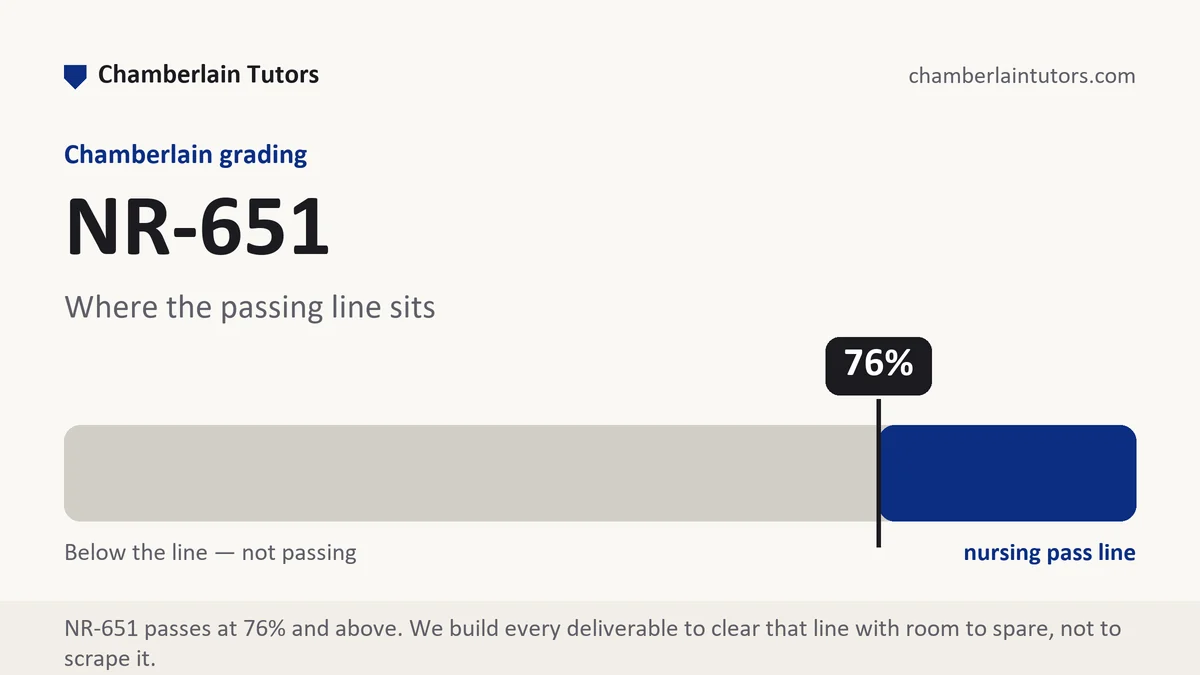
Core nursing courses pass at 76 percent, and the specialty scale with no C band applies to nurse practitioner specialty courses rather than to this track. The grade is a weighted average that supplementary work cannot repair afterwards, so keep the early deliverables clean instead of relying on the proposal to carry the course.
Sixteen week semesters split into two eight week sessions, up to six starts a year, something due most weeks. Policy work has its own clock problem: committees meet monthly, some quarterly, and a document that needs three approvals may need three months. Find out in week one when your policy or practice council meets and what it requires from a submission, then design a proposal that could realistically reach that agenda. Draft any discussion post carefully too, since posts cannot be edited once submitted at Chamberlain and a misquoted regulation stays visible all session.
Turn the criterion rows into a section plan
Copy the rows into a blank document in printed order and strip each to its verb: identify, appraise, draft, analyze, plan. Keep the guide's sequence for your headings so a grader never has to search for the row they are scoring.
Then convert weight into words. Say the proposal is capped at 2,300 words with five rows weighted 25, 20, 20, 20 and 15 percent, which gives 575 words, then 460, 460, 460 and 345. Policy students hit a particular snag here: the draft language row is the shortest thing on the page and the hardest to write, because good policy text is spare. Put the clauses themselves in a boxed excerpt or an appendix, then spend the row's words defending them one at a time. Why must, rather than should. Why within two hours. Why this exclusion. Each of those sentences is scoreable and none of them is padding.
The shape of a site level policy proposal
Most graded writing in NR-651 is a proposal to change or create a governing document, whether it appears as a problem analysis, a policy brief, a stakeholder plan or a board post defending your scope.
| Part | What it has to establish | What the weak version does |
|---|---|---|
| The practice problem | What is happening, to how many, how often, with the local number where one exists. | A national statistic doing the work of a local number. |
| The governing document | Which policy, protocol, rule or standard controls this today, with its date and owner. | Assumes there is no policy without having looked. |
| Evidence for the practice | What the strongest available evidence supports, with the grade or strength of the recommendation. | A list of studies that all agree, none appraised. |
| Evidence about implementation | What happened when comparable mandates were introduced elsewhere. | Nothing, so adoption is assumed to follow approval. |
| Draft language | Who must do what, when, with definitions and exclusions that leave no room to argue. | A paragraph of intent that nobody could be audited against. |
| Stakeholders and approval path | Who is affected, who must be consulted, which body votes, in what order. | A list of departments with no route through them. |
| Adoption plan | Education, forms or record changes, go live date, and who tells whom. | Staff will be educated on the new policy. |
| Compliance measure | The number that shows the policy is being followed, with denominator and interval. | Compliance will be monitored by leadership. |
| Review cycle | When the policy is revisited, by whom, and what would trigger an early review. | Ends at approval, which is where most site policies go to sleep. |
Draft the compliance measure at the same time as the language. A clause that cannot be audited is a sentence, not a policy, and the pairing usually improves the wording of both.
Evidence craft when you are citing rules
- Go to the instrument, not the article about it. Cite the statute, the regulation, the accreditation standard or the organizational policy itself, and give the version or effective date. Secondary summaries drift, and they are frequently written by people with a position.
- Guidelines carry a grade and an issuer. Name the body, the year and the strength of the recommendation. A strong recommendation from a specialty society and an expert consensus statement do not carry the same weight in a policy argument.
- Design and sample before the finding. Write that a stepped wedge trial across nine units and 2,600 admissions reported a change, then say what changed. Provenance first turns a claim into evidence.
- Verbs the evidence can pay for. Was associated with and followed suit observational work. Reduced belongs to controlled designs. In policy writing an overstated verb is what an opponent quotes back at you.
- Denominator and window on every rate. Thirty one of 214 charts audited over eight weeks is a compliance finding. An 86 percent compliance rate with no base and no period is a slogan.
- Check currency before you build on it. Regulations and standards are revised on schedules, so confirm the current version and say when you checked. A proposal citing a superseded rule loses the feasibility row on its own.
What separates a passing proposal from a strong one
A passing proposal argues that something should change, cites literature that agrees and closes with a plan to educate staff. It could be submitted at almost any organization, which is what keeps it mid band.
Strong proposals are anchored. They quote the document being changed and show the amended text, so the reader can see exactly what would be different. They treat approval as a route with named stations rather than an event. And they say how anyone would know, six months later, whether the policy is being followed. That last habit is what makes the second course possible, since NR-652 has to report on the thing this course set in motion.
Six mistakes that cost points here
- Aiming at the wrong level. Proposing legislation when a unit protocol is the obstacle wastes the whole analysis. Find the document that actually binds.
- Writing intent instead of requirement. Should, encourage and strive cannot be audited. Policy language names the actor, the action and the timeframe.
- No exclusions. Every rule meets an exception, and a policy that has not named its exclusions invites the first nurse who meets one to ignore it.
- Reproducing internal documents without permission. Ask before quoting your organization's policy, and keep identifiers out of the paper.
- Skipping the people who have to do the work. A policy written without the staff who will follow it fails at adoption, and the stakeholder row will say so.
- Letting the citation age. Rules change mid session. Recheck every legal or accreditation source before you submit.
Questions NR-651 students ask
The policy I want to change belongs to another department. Can I still use it?
How do I write actual policy language instead of a paper about it?
My site has a policy already, it just is not followed. Is that a project?
Where NR-651 sits in Chamberlain's programs
Open the exact program map for sequence, credit, and option context. The current student schedule and syllabus remain authoritative after transfer evaluation, electives, state rules, and approved plan changes.
The weeks, one by one
Week 1
A concluding graduate experience begins the moment an abstract interest in healthcare policy has to survive contact with a real building, a real administrator and a real problem that someone at that site will admit exists. Read the full Week 1 manual.
Week 2
Once a problem is named, somebody has to prove it. Read the full Week 2 manual.
Week 3
Policy projects fail on people far more often than they fail on evidence, and the third stage of a concluding experience is usually where that reality enters the writing. Read the full Week 3 manual.
Week 4
Midway through a policy concluding experience the argument has to stop resting on the site and start resting on the literature. Read the full Week 4 manual.
Week 5
The middle of a policy concluding experience is where a good problem becomes a commitment. Read the full Week 5 manual.
Week 6
By the sixth stage of a policy concluding experience the proposal has a problem, an evidence base and an aim, and what remains is the hardest engineering question in the document: exactly what will be done, by whom, in what order, with what resources, and what happens when part of it fails. Read the full Week 6 manual.
Week 7
An evaluation plan is the promise a project makes about how it will be judged, and it has to be written before results exist or it is worth nothing. Read the full Week 7 manual.
Week 8
The closing stage of the first concluding experience is assembly, and assembly is a skill of its own. Read the full Week 8 manual.