NR-643 finishes the informatics scholarly project started in NR-642, with 1.5 theory credits, 1.5 practicum credits and 72 more hours in the role. The writing changes job. This report has to prove that what was built does what it was specified to do, then report what the data showed once real people used it, and the section students routinely under-write is the one asking how they know their own number is right.
What NR-643 actually grades
The first thing scored is validation. A report, an alert or a documentation change can be live and still be wrong, and a graduate informatics paper is expected to say how the output was checked: test cases run before release, a sample of records compared by hand against the automated count, the mismatch found and what caused it. Skipping this row is the fastest way for an otherwise impressive project to read as unfinished.
The second is the result, reported with the discipline that system data demands. Adoption and outcome counts come with denominators, the comparison periods are equal in length and comparable in season and census, and anything that disturbed the data is disclosed: a downtime, a build change, a backfill, a unit that went live two weeks late.
The third is the handoff. When you finish the course, someone else owns the report, the alert or the workflow, and the paper has to name the role, the maintenance path and what happens when the underlying build changes. Projects that end at go live are the ones that get quietly retired the following quarter, and faculty who have watched that happen grade accordingly.
How we help in this course
What stays yours: the practicum hours, every conversation with your mentor or your organization, any site paperwork, and anything touching a live system. We do not do those, ever.
What we do is the report. Send the scoring guide and whatever results you have, however uneven, and a premium original draft returns in 24 to 48 hours: validation described so it can be judged, results printed as counts before percentages, limits written as appraisal rather than apology, and a handoff section that names a role instead of hoping. Both quality passes and the floor check run before it reaches you, and revision stays free until it lands.
Writing this course's deliverables from the rubric
No syllabus is published for NR-643, and your scoring guide arrives with each assignment inside Canvas, so nobody can honestly give you a week by week grid. Method is what transfers: how a completion report is proportioned, how log based results are defended, and what a reader checks before deciding whether to believe a number. Keep your guide open beside this page.
Writing up your NR-643 results?
Send the scoring guide and your output, messy is fine. First premium sample free, back in 24 to 48 hours.
The passing line, and a short measurement window
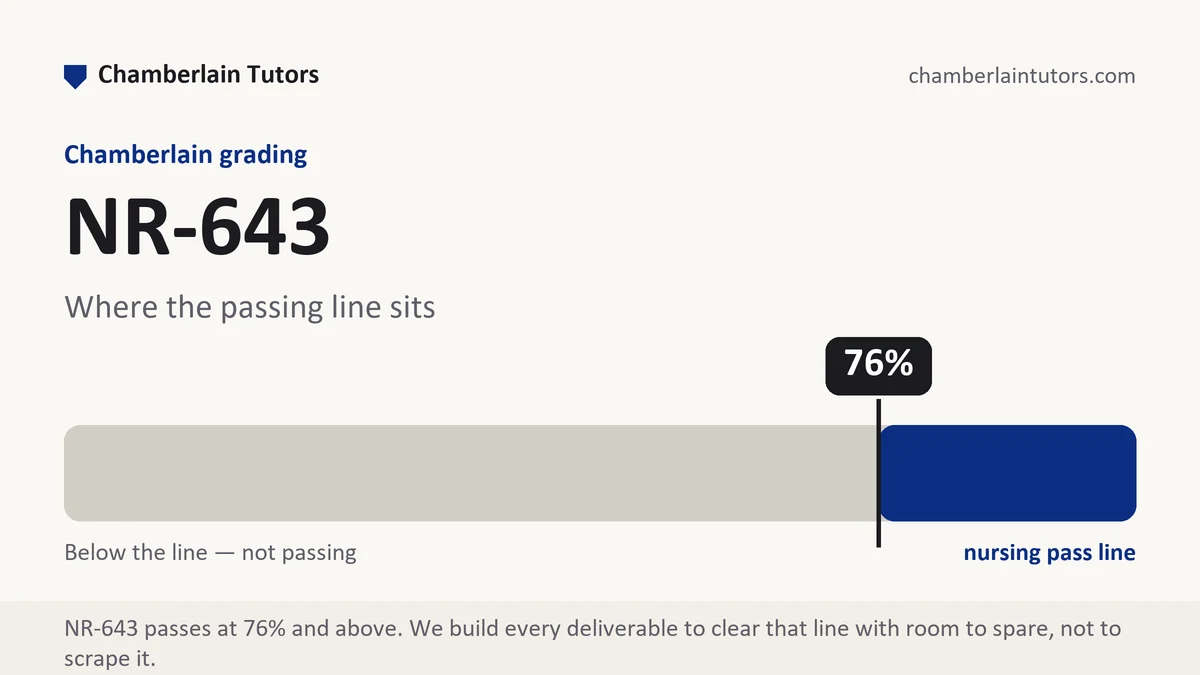
Core nursing courses pass at 76 percent, and the no C specialty scale belongs to nurse practitioner specialty courses rather than to this one. The grade is still a weighted average, and supplementary work cannot repair a weak one, so the safest plan in a finishing course is to keep the mid session pieces clean rather than staking everything on the final report.
Eight week sessions inside sixteen week semesters, up to six starts a year, weekly deliverables. The structural squeeze in informatics is that the build, the testing and the training all have to happen before measurement can start, which frequently leaves three or four usable weeks. Write the report around the window you actually got, state its length plainly, and say what a longer one would have shown. Since discussion posts cannot be edited after submission at Chamberlain, draft any post carrying a result in a document and check the number first.
Turn the criterion rows into a section plan
Copy the rows in printed order, reduce each to its verb, and keep those verbs as headings so nothing has to be hunted for. Then convert the weights into a word count.
Suppose the report is capped at 2,100 words with four rows weighted 25, 30, 25 and 20 percent, giving 525 words, 630, 525 and 420. Notice that the heaviest row is the second one rather than the first, which is normal in a results course and rarely matches how students write. Most drafts spend their first thousand words re-describing the project from NR-642 and arrive at the analysis exhausted. Compress the background to what a reader needs to interpret the result, and let the 630 word row carry the numbers, their validation and their comparison.
The shape of an informatics completion report
Most graded writing here is a completion report wearing one costume or another: a project summary, an evaluation paper, a board post defending a finding. These parts recur.
| Part | What it has to establish | What the weak version does |
|---|---|---|
| What was built | The final specification as released, including anything changed from the proposal and why. | Repeats the NR-642 plan as though nothing shifted. |
| Validation and testing | How you know the output is correct, including the manual check and what it found. | The report was reviewed and appeared accurate. |
| Training and release | Who was trained, how, when the change reached each area, and any staggered rollout. | Go live is stated as a date with no audience. |
| Adoption from the logs | Use counts against the population who could have used it, by unit or shift. | Staff responded positively to the new tool. |
| The measure, before and after | Counts and denominators for matched periods, with the query definition unchanged. | A percentage improvement with no periods named. |
| Unintended effects | Added clicks, overrides, workarounds or downstream surprises, sought rather than stumbled on. | Silence, which informatics faculty read as inexperience. |
| Limits of the data | What the fields cannot see, what was missing, what a default value hid. | A generic sentence about small sample size. |
| Handoff and maintenance | Who owns the build now, who reruns the report, what happens at the next upgrade. | Ends at go live with no owner named. |
Write the validation section before the results section. If you cannot say how the number was checked, the results paragraph is describing an output rather than a finding.
Evidence craft when the data comes from logs
- Check the automated count by hand. Twenty five or thirty records reviewed against the query is a small effort that turns an output into evidence, and reporting the agreement rate is worth more than an extra citation.
- Denominator and window on every rate. Uses per 100 eligible encounters over six weeks is a finding. A 34 percent adoption figure with neither base nor period is a claim nobody can audit.
- Equal periods, comparable conditions. Compare six weeks with six weeks, and say if census, staffing or season differed. Unequal windows are the most common flaw in student informatics reports.
- Disclose what disturbed the data. Downtime, a mid period build change, a backfilled field or a late going unit all belong in the methods, not in a footnote.
- Verbs your design can pay for. Was associated with, coincided with and followed are honest for uncontrolled before and after work. Caused and improved need a comparison group.
- Keep comparison literature current and matched. Any published result you are measuring yourself against needs a recent date and a system close enough to yours to be worth the comparison.
What separates a passing report from a strong one
A passing report says what was built, prints a number and concludes that the project was successful. Nothing in it is false and nothing in it is checkable, which is why it sits mid band.
Strong reports do three things. They prove the number before they interpret it, so the reader is not asked to take the query on faith. They look for the harm the change might have caused rather than waiting to be asked, which is the mark of someone who has seen implementations go sideways. And they finish with an owner, an interval and a plan for the next upgrade, so the work survives your graduation. That last section is also the one you can talk about in an interview, which is a decent reason to write it properly.
Six mistakes that cost points here
- Treating go live as the outcome. Shipping is an activity. The outcome is what changed for the people using it.
- Changing the query between baseline and post. Any edit to the definition invalidates the comparison unless you rerun both periods.
- No validation at all. An unchecked report is an assertion with a timestamp.
- Ignoring downtime and backfills. Both distort counts, and both are easy to disclose once you look.
- Live data in a screenshot. Use test data, remove identifiers, and confirm your organization permits screens to be reproduced at all.
- Ending without an owner. A build with no maintainer named is a build with a retirement date.
Questions NR-643 students ask
My report returns different numbers than the quality department's. Which one do I use?
Adoption was low. How do I write that up?
How do I write the limits of system data without undermining my project?
Where NR-643 sits in Chamberlain's programs
Open the exact program map for sequence, credit, and option context. The current student schedule and syllabus remain authoritative after transfer evaluation, electives, state rules, and approved plan changes.
The weeks, one by one
Week 1
NR-643 concludes the scholarly project begun in the first concluding graduate experience and carries its own 72 clinical hours. Read the full Week 1 manual.
Week 2
Once a capstone project is executing, the writing has to describe what was actually done in enough detail that someone else could repeat it. Read the full Week 2 manual.
Week 3
Every system change succeeds or fails on whether clinicians actually use it, which makes adoption its own written territory in a capstone project. Read the full Week 3 manual.
Week 4
Around the midpoint of a capstone practicum the data arrives and has to be reported. Read the full Week 4 manual.
Week 5
After the numbers are on the page, the capstone has to say what they mean and what they cannot mean. Read the full Week 5 manual.
Week 6
Late in a capstone practicum the writing turns outward, toward the people who will own the work after you leave. Read the full Week 6 manual.
Week 7
Dissemination is part of the informatics role, and a capstone usually asks you to produce it. Read the full Week 7 manual.
Week 8
NR-643 Week 8 in our arc is assembly and closure: pulling seven stages of separately written sections into one manuscript that reads as though a single person wrote it in one sitting, and then writing the reflection that closes the concluding graduate experience by arguing what the immersion made. Read the full Week 8 manual.