NR-642 is the first half of the informatics concluding graduate experience: 1.5 theory credits, 1.5 practicum credits and 72 hours in the informatics nurse specialist role while a scholarly project gets started. The row that decides most grades is the measure. An informatics proposal has to name a number that a real query could return, from fields that exist, filtered the way you say, or the whole evaluation is theoretical.
What NR-642 actually grades
The first strand is a problem the system's own data can see. Plenty of genuine informatics problems are invisible to the database, and a proposal built on one of those cannot be evaluated. The rubric rewards a problem statement written so that both the gap and its eventual improvement are observable: which documentation, which order, which alert, in which encounter type, over which period.
The second strand is the evidence behind the change you propose. Informatics has a real literature, and it is not only about software. Decision support studies, documentation burden research, alert override analyses and human factors work all count, and the rubric expects you to argue from what happened when other people tried this rather than from what the tool is supposed to do.
The third strand is specification. A graduate informatics proposal defines its measure the way an analyst would need it: numerator, denominator, source field, inclusion and exclusion filters, refresh interval and who runs it. Written that loosely elsewhere, an assignment survives. Written loosely here, it fails the evaluation row and leaves the second course with nothing to report.
How we help in this course
The boundary is fixed. Hours are yours, your mentor is yours, your organization is yours. We do not complete practicum hours, contact anyone at your site, sign forms or fill logs, and we do not build, query or configure anything in a live system.
The proposal is where we work. Send the prompt and the scoring guide out of Canvas and a premium original draft comes back in 24 to 48 hours: the problem written in observable terms, the evidence appraised rather than summarized, the measure specified field by field, the evaluation designed before the intervention is described. Two quality passes plus the floor check run before delivery and revision stays free until it lands.
Writing this course's deliverables from the rubric
Chamberlain publishes no syllabus for NR-642, and scoring guides arrive attached to assignments in Canvas, so an honest page cannot give you a week by week grid. What it can give you is method: how the proposal is proportioned, how a measure is written down, how technical and clinical evidence get cited without either one being oversold. Keep your own guide open beside this.
Scoping your NR-642 project?
Send the scoring guide and the problem you are chasing. First premium sample free, back in 24 to 48 hours.
The passing line, and the approval path
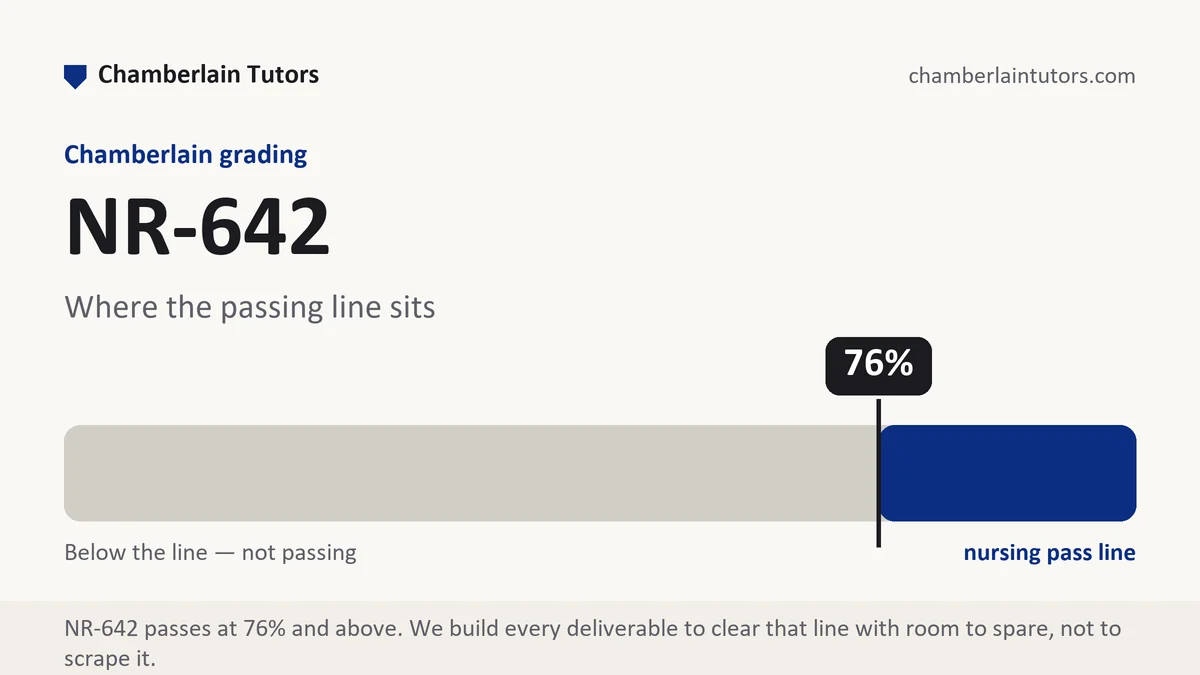
Core nursing courses pass at 76 percent, and the specialty scale without a C band belongs to nurse practitioner specialty courses rather than to this track. The grade stays a weighted average that supplementary work cannot repair, so a run of adequate weekly pieces is a worse position than students assume.
Two eight week sessions per sixteen week semester, up to six starts a year, and something graded almost every week. The informatics specific problem is that a proposal usually needs more than your instructor's approval. Data access, privacy review, a change control slot and an analyst's time all queue somewhere, and each queue is longer than a session. Ask in week one who approves what and how long each step normally takes, then write the proposal around a path that can actually be walked. Anything posted to a discussion board is permanent once submitted at Chamberlain, so draft posts containing system detail in a document first.
Turn the criterion rows into a section plan
Copy the rows in printed order, reduce each to its verb, and let those verbs be your headings so a grader meets each row where they expect it. Then price the rows in words.
Say the proposal is capped at 1,900 words with five rows weighted 30, 20, 20, 20 and 10 percent. That gives 570 words, then 380, 380, 380 and 190. The trap sits in the measurement row. Specification is naturally written as a table, so students fill a table, count it as done and hand back 90 words where 380 were budgeted. The missing words are the defense: why that denominator and not a wider one, why encounters rather than patients, what the field misses, how you know the data is complete enough to trust. Check whether tables and appendices count toward the cap before you allocate.
The shape of an informatics scholarly proposal
Most graded writing here is a proposal in one form or another, whether it appears as a project plan, a workflow and data analysis, or a board post defending your measure. These parts recur.
| Part | What it has to establish | What the weak version does |
|---|---|---|
| Problem, stated observably | The gap named in things the system records, with its frequency and its consequence. | A complaint about the software with no measurable footprint. |
| Current state information flow | Where data is captured, who enters it, where it travels, where it stops. | A diagram of the department rather than of the information. |
| Evidence for the change | Studies of what happened when comparable changes were made, appraised for setting and system. | Vendor claims and a general argument that technology helps. |
| The intervention, specified | Exactly what changes on the screen, in the report or in the workflow, and for whom. | Implement clinical decision support, unspecified. |
| Measure specification | Numerator, denominator, source field, filters, interval and who runs the pull. | Documentation compliance will be monitored. |
| Approvals and review path | Change control, privacy and security review, and whether the work is improvement or research. | Assumes permission because the mentor is enthusiastic. |
| Evaluation design | The comparison you will make, the period, and what would count as no effect. | Pre and post, with neither period defined. |
| Unintended consequences | The plausible harms, such as added clicks, alert fatigue or a workaround, and how you would spot them. | Silence, which reads as inexperience to informatics faculty. |
Write the measure and the evaluation before you finalize the intervention. If no available field can show the change, the intervention needs rethinking while rethinking is still cheap.
Evidence craft when the source is a system
- Currency runs faster here. Systems, regulations and interfaces change, so a five year old evaluation of decision support may describe software nobody uses. Where your guide sets no rule, treat five years as the outer edge and justify anything older in the sentence that cites it.
- Design and sample before the finding. Write that an interrupted time series across two hospitals covering 41,000 orders reported a change, then report it. Provenance first is what separates appraisal from repetition.
- A different system is a different intervention. Results from another vendor, another build or another specialty transfer only partly. Say what is comparable and what is not.
- Verbs the design can pay for. Was associated with, coincided with and followed fit observational and before and after work. Reduced and prevented need a control group you probably do not have.
- Denominator and window on every rate. Overrides per 1,000 alerts fired, missing fields per 100 admissions, both across a stated period. A bare percentage tells a reader nothing they can check.
- Log data measures behavior, not opinion. Usage counts and survey satisfaction answer different questions. Name which one your source measured, and which one your project will.
What separates a passing proposal from a strong one
A passing proposal identifies a reasonable informatics problem, cites some literature and promises to evaluate the result. It reads as sensible and stays general, and general is the middle band.
Strong proposals are specific in three places. The problem is quantified from the system rather than asserted from experience. The measure is written so precisely that an analyst could build it without calling you, which is the clearest signal of graduate level informatics thinking on the page. And the risk of unintended harm is named openly, because a student who has anticipated alert fatigue or a workaround is a student who has watched real implementations. Getting these right also buys you a project you can finish, since the second course reports the number this course defined.
Six mistakes that cost points here
- A measure nobody can pull. If the number requires a manual chart review of 400 encounters, the evaluation will not happen.
- Counting clicks and calling it an outcome. Process measures are useful, but say which is which and connect the process to something patients or staff feel.
- Assuming a firing alert is a working alert. The literature on overrides exists precisely because that assumption fails.
- Skipping the workflow owner. A build that changes a nurse's screen needs the person who owns that workflow to agree, and the proposal has to name them.
- Designing the evaluation last. Evaluation written after the intervention almost always measures what is convenient rather than what matters.
- Borrowing evidence across settings silently. Citing an academic medical center study for a critical access hospital plan is fine if you say so, and a problem if you do not.
Questions NR-642 students ask
How do I write a measure the analysts could actually build?
My mentor wants a dashboard and my instructor wants a scholarly project. How do I satisfy both?
How recent do informatics sources have to be?
Where NR-642 sits in Chamberlain's programs
Open the exact program map for sequence, credit, and option context. The current student schedule and syllabus remain authoritative after transfer evaluation, electives, state rules, and approved plan changes.
The weeks, one by one
Week 1
NR-642 opens a mentored informatics immersion carrying 72 clinical hours, and the written work at the front of a practicum is almost always planning: the objectives you will pursue with a mentor, the setting you will pursue them in, and the shape of the scholarly project the rest of the sequence will build. Read the full Week 1 manual.
Week 2
Once a practicum plan is on file, the written work that typically follows is assessment: describing the setting, the workflow and the technology environment accurately enough that a problem becomes visible in the description rather than announced on top of it. Read the full Week 2 manual.
Week 3
A scholarly project is only ever as good as the problem it names, and the stage that follows assessment is usually the one where a broad observation gets narrowed into a defensible problem statement and an answerable question. Read the full Week 3 manual.
Week 4
Mid-sequence in a concluding graduate experience, the written work usually turns to evidence: assembling and synthesizing the literature that will justify whatever the project proposes to do. Read the full Week 4 manual.
Week 5
Somewhere past the midpoint, a scholarly project has to declare the lens it reasons through. Read the full Week 5 manual.
Week 6
With a problem named, evidence assembled and a lens chosen, a scholarly project has to become a plan somebody could actually execute. Read the full Week 6 manual.
Week 7
Late in a proposal sequence, the written work turns to how anyone will know whether the project did anything, and to the rules governing the data that would show it. Read the full Week 7 manual.
Week 8
The closing stage of a first concluding graduate experience usually does two jobs at once: assembling everything written across the session into one coherent proposal, and writing an analytic reflection on the immersion itself. Read the full Week 8 manual.