Once a practicum plan is on file, the written work that typically follows is assessment: describing the setting, the workflow and the technology environment accurately enough that a problem becomes visible in the description rather than announced on top of it. NR-642 Week 2 in our arc is that stage, and the craft is observational writing that stays analytic. Your section may print this as NR 642 or NR642; it is the same course. Chamberlain publishes no syllabi outside Canvas. The placement here is our teaching judgment from the course's catalog arc; your section's rubric decides what your week actually asks.
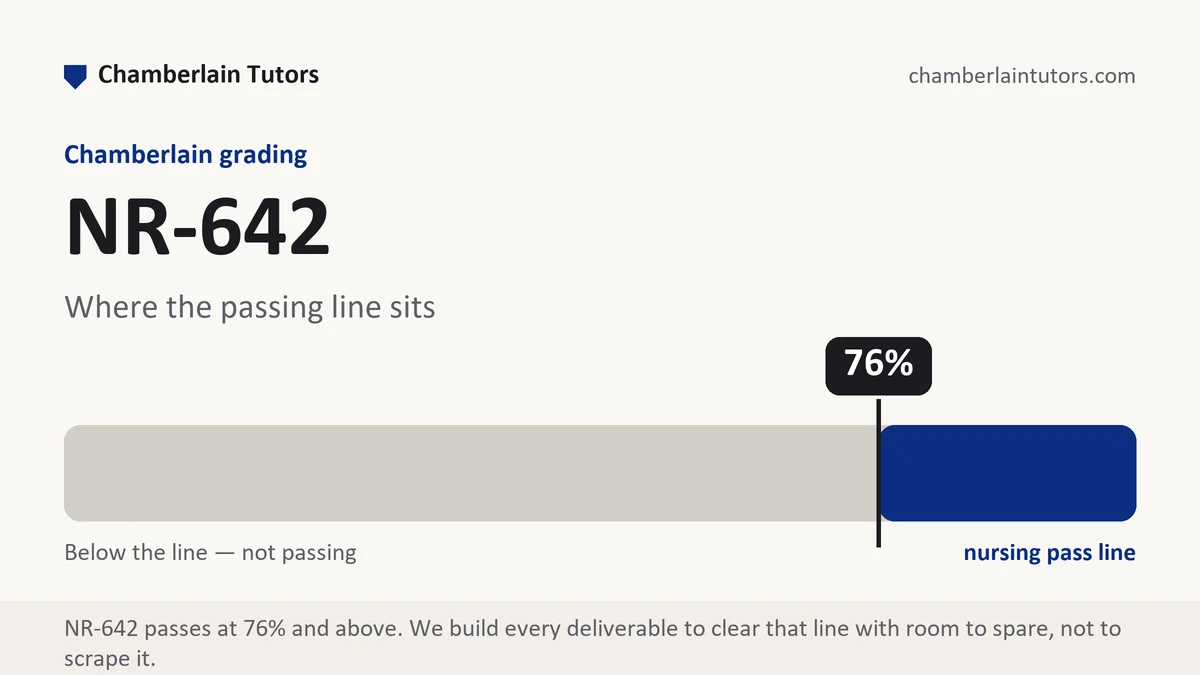
What NR-642 Week 2 asks for
Count the fields. In one intensive care unit, documenting a single turn and reposition touches a flowsheet row, a skin assessment cluster, a mobility score, a device-site check and a comment box, and a nurse repeating that every two hours across a twelve-hour shift produces something close to two hundred discrete entries for one element of care. Nobody designed that on purpose. It accumulated, one well-intentioned request at a time, from six committees that never met each other. Writing an assessment means describing exactly that accumulation without editorializing, and letting the reader arrive at the conclusion you want by walking through what you saw.
An assessment at this stage is usually part environment and part process. The environment layer describes the organization, the units and populations affected, the record system in general terms, the interfaced devices, the governance structures, and the people who own decisions. The process layer follows one workflow end to end and says what actually happens, in sequence, including the steps that exist only as workarounds. The gap between the documented process and the observed process is often where the entire scholarly project eventually lives.
The habit to install here is separating observation from interpretation on the page. A paragraph that says the scan step is skipped when the handheld will not connect is an observation. A paragraph that says staff are noncompliant with scanning policy is an interpretation, and a weak one, because it names a behavior without naming the condition producing it. Graduate readers in informatics reward the first shape consistently, because system design is done from conditions, not from blame.
Deliverables at this depth are commonly a written assessment with a workflow description, sometimes with a diagram or a table, and sometimes an accompanying post where classmates read each other's settings. Keep any post precise and final. Posts do not reopen after submission in Canvas, and a setting described loosely in a post is a setting you will have to describe twice.
The NR-642 Week 2 method, step by step
Six moves for writing an assessment that earns its conclusion.
-
Pick one workflow and bound it in a sentence
From the moment an order is released to the moment the administration is documented. A bounded workflow can be described completely. An unbounded topic like medication safety produces four pages that describe nothing at all.
-
Write the process as it is documented, then as it happens
Two passes, clearly labeled. The official version comes from policy and system configuration. The observed version comes from watching. The distance between them is the finding, and it should be visible on the page rather than asserted.
-
Count the steps, the screens and the hands
How many discrete actions, how many application screens, how many people touch the process, how many times information is re-entered. Counts convert a story about frustration into an assessment a reader can weigh.
-
Mark every workaround without judging it
Workarounds are data. Each one tells you where the designed path costs more than clinicians can afford. Record what the workaround is, what it costs the record, and what it saves the clinician, then leave the moral judgment out.
-
Map the governance around the workflow
Who can change a screen, who approves an alert, which committee owns the policy, and how long a change request typically takes. A problem no one has authority to fix is a different problem from one nobody has noticed.
-
Close with a gap statement, not a solution
One paragraph naming the distance between what the system is designed to produce and what it produces. Solutions belong to a later stage, and offering one here almost always narrows the project prematurely.
A layout and word budget for a setting and workflow assessment
Our frame for a written assessment, sized for roughly 1,200 to 1,500 words. It is our own outline rather than anything the university issues, and your week's rubric outranks it wherever they disagree.
| Section | What belongs in it | Word target |
|---|---|---|
| Organizational context | Type and scale of the organization, the units and populations involved, and the record and device environment described generically. | 180 to 220 |
| The workflow as documented | The sequence policy and configuration say should happen, attributed to the source you read it in. | 200 to 250 |
| The workflow as observed | The sequence that actually occurs, with counts of steps, screens, handoffs and re-entries. | 280 to 340 |
| Workarounds and their economics | Each deviation, what it costs the record, what it saves the clinician, and the condition that produces it. | 200 to 250 |
| Governance and change capacity | Decision owners, committees, request pathways, and realistic timelines for a configuration change. | 170 to 210 |
| Gap statement | The distance between designed and delivered, stated as a condition with consequences and no proposed fix. | 120 to 160 |
Evidence craft for observational assessment writing
Attribute the official version. When you describe what the process is supposed to be, say where you read it: a policy document, a build specification, a training material, a super-user guide. An unattributed official version is indistinguishable from your assumption about the official version.
Separate what you saw from what you were told. Both are legitimate, and they carry different weight. Observed during two morning medication passes is one class of evidence. Reported by the unit's documentation lead is another. Label them and the reader can calibrate.
Ground the problem in published literature. Documentation burden, alert fatigue, workaround behavior and usability in clinical systems all have substantial research behind them. A local observation gains authority when it is placed next to what the field already knows, and it gains it fastest when you name the pattern the literature has already described.
Every count carries its base and window. Forty-one fields per repositioning entry, observed across three shifts, is evidence. Too much charting is not. If you cannot obtain a count, say so and say why, then describe what you can observe directly.
Describe the technology without naming its vendor in a criticism. The certified electronic record in use across the system carries the same analytic weight as a product name and none of the reputational exposure. Save vendor specificity for a place where it is genuinely load-bearing, such as a documented interoperability standard.
Where help stops in a practicum course
This stage sits inside a mentored immersion carrying 72 clinical hours, and the boundary is absolute. Your hours, your activity log, your record of what you observed and when, and any evaluation your mentor completes about you are your own record of your own work. They are never drafted, reconstructed, estimated or filled in with outside help. Nothing on this page is a method for producing documentation that a mentor, a site or the university verifies, and no observation should ever be written up that you did not personally make.
What can be taught is the written layer: how to structure an assessment so observations become analysis, how to separate the documented process from the observed one on the page, how to keep counts honest, how to describe governance accurately. The value on offer is clearer written reasoning about time you genuinely spent in the setting. An assessment written from an imagined observation is worthless as scholarship and dishonest as a record, and it is usually obvious to a reader who has worked in the specialty.
De-identification is not optional in observational writing and it is where this stage is most exposed. You are describing real people doing real work with real patients. No patient names, record numbers, dates of service or combinations of unit, diagnosis and timing that would identify anyone. Staff are described by role rather than by name, and a workaround is attributed to a condition rather than to an individual who could be recognized by a colleague reading the paper.
Five mistakes that cost points in this week's territory
- An unbounded workflow. Describing medication safety instead of one traceable sequence produces pages that never reach a finding.
- Blame language. Noncompliance and resistance name behaviors and hide conditions, which is the opposite of the analytic move the specialty requires.
- Only the official version. An assessment built from policy documents alone has not assessed anything, because the gap is the point.
- Counts without bases. Numbers presented without how many, out of what, over what period cannot be weighed and read as impressions.
- A solution smuggled into the assessment. Closing with the fix collapses the stage into a proposal and forfeits the reasoning the scoring rows were built to reward.
Before you submit
- One workflow is named and bounded in the opening paragraphs
- The documented process and the observed process appear as separate labeled passes
- Steps, screens, handoffs and re-entries are counted with their base and window
- Each workaround is paired with the condition producing it, not with a person
- Governance and realistic change timelines appear somewhere in the paper
- Published literature is cited for at least one pattern your observation matches
- Nothing patient-identifiable and no named staff appear anywhere
- The closing paragraph states a gap rather than proposing a solution
Writing up an assessment for NR-642?
Send the rubric and your own observation notes out of Canvas. A premium original draft of the written layer comes back in 24 to 48 hours with observation kept separate from interpretation, hours and logs left entirely to you, and revisions run until the grade lands.