NR-640B carries 1.5 theory credits, 1.5 practicum credits and 72 hours inside the informatics nurse specialist role, and it pairs that immersion with formal project management. That second half is what the writing is really about. The graded documents are project artifacts, and project artifacts are scored on precision: what is in scope, what is deliberately out, who decides, what could go wrong and who owns each risk.
What NR-640B actually grades
The first strand is problem framing in workflow language rather than product language. An informatics problem is not that the documentation screen is bad. It is that nurses on nights enter the same assessment in two places, that the second entry is missed on roughly a third of admissions, and that the downstream report therefore undercounts. Written that way the problem names a population, a frequency and a consequence, and every later document can point back to it.
The second strand is project management discipline, which is where most points move. Scope with a written out of scope list, work broken into tasks that somebody could actually be assigned, a sequence with dependencies, a risk register whose entries have owners and triggers, and a communication plan that says who hears what and when. Graders are checking whether these documents hold together, so a timeline that contradicts the work breakdown costs points in both rows.
The third strand is the role itself. An informatics nurse specialist spends the day translating between clinicians who describe outcomes and technical staff who need specifications, and the immersion writing asks you to analyze that translation. What did your mentor have to convert, what got lost, which meeting decided something that a build ticket then reversed. Description of duties scores mid band. Analysis of specific translations scores above it.
How we help in this course
The line we do not cross: practicum hours belong to you, and so does everything involving your site. We do not complete hours, contact your mentor, your IT department or your organization, sign site paperwork or fill in a log.
What we do is the documentation. Send the prompt and the scoring guide from Canvas and a premium original draft returns in 24 to 48 hours, written as project artifacts rather than as an essay about them: a charter with a measurable objective, a scope statement with real boundaries, a risk register with owners and triggers, a role analysis built on decisions instead of duties. Both quality passes and the floor check run first, and revision stays free until it lands.
Writing this course's deliverables from the rubric
Chamberlain publishes no syllabus for NR-640B and each scoring guide arrives with its assignment inside Canvas, so no honest source can hand you a week by week grid. The transferable part is craft: how a charter is scoped, how weight becomes word count, how technical evidence is cited, and what a grader checks before the content is even read. Read your own guide first and let this page fill the gaps.
Building your NR-640B project documents?
Send the scoring guide and your project idea. First premium sample free, back in 24 to 48 hours.
The passing line, and the governance queue
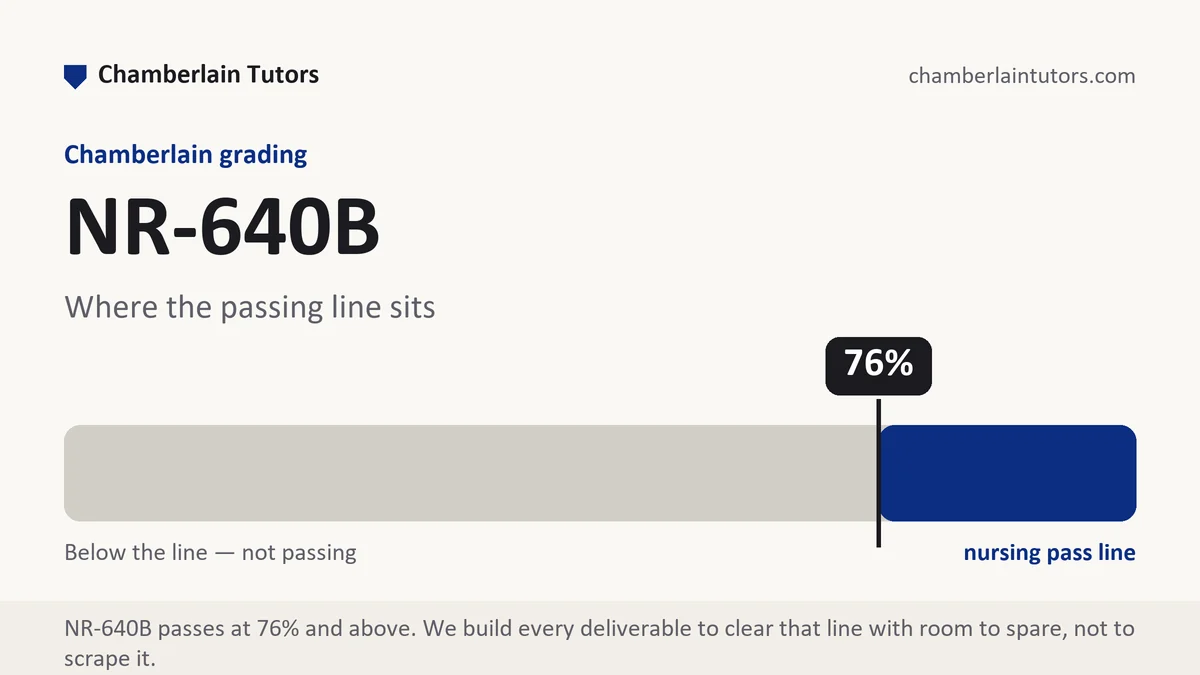
Core nursing courses pass at 76 percent, and the specialty scale with no C band applies to nurse practitioner specialty courses rather than to this track. Either way the grade is a weighted average that supplementary work cannot rescue, so protect the early deliverables instead of hoping the final artifact carries the course.
Two eight week sessions inside a sixteen week semester, as many as six starts a year, and a deliverable nearly every week. The particular hazard in informatics is the queue. Change control boards, security review, an analyst's sprint schedule and a training calendar all run on cycles that ignore your session. Ask in week one what the approval path is and how long it usually takes, then design a project whose critical path fits inside the answer. Discussion boards are uneditable once posted at Chamberlain, so anything containing a system detail should be checked in a document before it goes up permanently.
Turn the criterion rows into a section plan
Copy the rows into a blank file in their printed order and reduce each to its verb: define, analyze, plan, justify, evaluate. Those verbs become headings in the guide's own sequence, which keeps a grader from hunting.
Then convert weights into words. Suppose the deliverable is capped at 1,400 words with appendices allowed, and four rows carry 35, 25, 25 and 15 percent. The budget is 490 words, 350, 350 and 210. Informatics students hit a specific trap here: the charter, the work breakdown and the risk register are naturally tabular, so the tables go into appendices and the prose rows end up thin. Tables in an appendix are evidence, not argument. Each one still needs its paragraph in the body explaining why the scope stops where it stops, why that risk ranks first, why the sequence cannot be reordered. Check whether appendices count toward the cap before you plan, since informatics deliverables carry more attachments than most.
The shape of a charter and project plan
Most graded writing here is a project artifact set, whether it appears as a charter, a project plan, a workflow analysis or a board post defending your scope. Each part below is one a grader hunts for.
| Part | What it has to establish | What the weak version does |
|---|---|---|
| Problem in workflow terms | Who does what today, where it breaks, how often, and what it costs downstream. | Names a system or a screen as the problem. |
| Objective and success measure | One sentence, with the number that will show it worked and where that number lives. | Improve efficiency and enhance satisfaction. |
| Scope, in and out | Both lists written down, including the tempting additions you are refusing. | A scope paragraph with no exclusions. |
| Stakeholders and decision rights | Who is consulted, who approves, who can halt the build, named by role. | A list of departments with no authority attached. |
| Work breakdown | Tasks small enough to assign, each with an owner and an estimate. | Four phases with no visible work inside them. |
| Timeline and dependencies | What cannot start until something else finishes, and where the slack is. | A calendar of even blocks that assumes nothing waits. |
| Risk register | Each risk with likelihood, impact, owner and the trigger that says it is happening. | Generic risks such as staff resistance, unowned. |
| Training and communication | Who is told what, in which format, and how you know it landed. | An email will be sent before go live. |
| Support and ownership | Who maintains the build, fields questions and owns it after the course ends. | Nothing, which is how student builds get retired. |
Write the out of scope list early and show it to your mentor. Scope creep in a 72 hour practicum is not an inconvenience, it is the reason projects arrive at the second course unfinished.
Evidence craft in informatics writing
- Standards get a version and a year. Terminologies, interoperability specifications and regulatory guidance are revised on schedules. Name the edition you are working from and confirm it is current before you build requirements on it.
- Vendor material is a claim, not evidence. A white paper describes what a product is designed to do. Peer reviewed evaluation describes what happened when people used it. Cite both if you like, but label which is which.
- Design and sample before the finding. Write that a single site time and motion study of 24 nurses observed across 96 hours reported a change, then report it. Informatics evaluation is small and local far more often than its abstracts suggest.
- Verbs the design can pay for. Was associated with, accompanied and followed suit observational and before and after work. Reduced and eliminated require a controlled comparison.
- Denominator and window on every rate. Alerts fire per thousand orders, errors occur per hundred admissions, and both need a time period. A percentage with no base is the fastest way to lose the evidence row.
- Screenshots carry risk. Test data only, no patient identifiers, no employee names, and check whether your organization or the vendor restricts publishing screens at all before one goes into an appendix.
What separates a passing plan from a strong one
A passing plan describes a sensible project in reasonable order and closes with a paragraph about evaluation. It is tidy, and it could be handed to a project manager who would immediately ask three questions it cannot answer: who approves this, what happens if the analyst is reassigned, and what are we deliberately not doing.
Strong plans answer those questions before they are asked. They tie every deliverable back to the workflow problem, so the reader can see why each task exists. They make the constraints visible instead of hiding them, including the ones that shrank the project. And they treat the informatics role as an argument rather than a job description, explaining what the specialist changed by being in the room. The 76 percent floor leaves room to be merely tidy, but this plan is what you have to execute in the next course, and vagueness now becomes rework later.
Six mistakes that cost points here
- Naming the solution in the problem statement. A charter that opens with the tool you already chose has skipped the analysis the rubric is scoring.
- No out of scope list. Without it every reviewer adds a request, and the plan cannot say no in writing.
- Risks with no owner or trigger. A risk nobody watches is a paragraph, not a control.
- Treating governance as paperwork. Change control, security review and downtime procedures shape your timeline, and a plan that ignores them fails the feasibility row.
- Identifiable data anywhere. Patient details, employee names or internal report extracts need permission and de-identification before they appear.
- A role section made of duties. Lists of what informatics nurses generally do are not the immersion analysis. Use real decisions.
Questions NR-640B students ask
My IT department will not give me access to the test environment. Can I still run a project?
How detailed should the work breakdown be?
How do I describe our workflow without breaching confidentiality?
Where NR-640B sits in Chamberlain's programs
Open the exact program map for sequence, credit, and option context. The current student schedule and syllabus remain authoritative after transfer evaluation, electives, state rules, and approved plan changes.
The weeks, one by one
Week 1
An informatics practicum opens with two documents that have to agree with each other: what you intend to learn inside the role, and what project you intend to manage while learning it. Read the full Week 1 manual.
Week 2
Nothing in informatics can be improved until the current state is written down accurately, and writing it down accurately is harder than it sounds because the documented process and the real one are almost never the same. Read the full Week 2 manual.
Week 3
A charter is the document that makes a project a project rather than an intention, and in a course that pairs role immersion with formal project management it is the artifact everything else hangs from. Read the full Week 3 manual.
Week 4
The work breakdown is the artifact that turns a charter into something a team can execute, and it is where project management technique becomes visible or fails to. Read the full Week 4 manual.
Week 5
The informatics nurse specialist spends most of the working day translating between people who describe outcomes and people who need specifications, and the middle of NR-640B is usually where that translation becomes the written subject. Read the full Week 5 manual.
Week 6
A risk register is the project document with the highest ratio of value to length, and the one students most often write as a formality. Read the full Week 6 manual.
Week 7
Late in an informatics practicum the writing turns to two questions that decide whether anything you built will survive: how will this be measured, and who is allowed to say what the measure means. Read the full Week 7 manual.
Week 8
The closing stage of a first practicum is not a summary of everything you did. Read the full Week 8 manual.