NR-632 is the capstone half of the nurse executive concluding graduate experience: 1.5 theory credits, 1.5 practicum credits and 72 hours spent executing and evaluating the change you planned in NR-631. The writing shifts genre here. NR-631 asked you to argue for something. NR-632 asks you to report what happened and then request a decision, and reports that stop before the decision leave the heaviest row half answered.
What NR-632 actually grades
First, the distance between plan and delivery. Nothing runs the way it was written, and the rubric is not scoring obedience to your own proposal. It is scoring whether you can say precisely what was implemented, on which units, from which date, with which parts dropped or altered and why. A report that repeats the NR-631 plan in the past tense is the single most recognizable weak submission in this course.
Second, the number, handled honestly. That means the post period compared against the same kind of baseline period, counts printed before percentages, and a paragraph naming everything else that changed in the same weeks. Executives are trained to ask what else was happening, and a report that has not asked it first gets asked in front of an audience.
Third, the recommendation. This is the row that separates graduate executive writing from a project summary: sustain, expand, modify or stop, said in one sentence, with the resources that decision needs and the person who will own the process after you finish the course. A close-out with no owner is a pilot that quietly ends the week you graduate, and graders read it that way.
How we help in this course
The limit first. Your practicum hours, your mentor, your site and any log or form the school requires all stay with you. We do not complete hours, speak to anyone at your organization, or sign anything. We write.
What comes back inside 24 to 48 hours is a premium original draft built to your scoring guide: results written with their denominators, competing explanations named rather than hidden, a recommendation stated in one sentence and defended, and an executive summary that survives being read alone. Two quality passes and the floor check run before it reaches you, and revision stays free until it lands.
Writing this course's deliverables from the rubric
Chamberlain publishes no syllabus for NR-632, and each scoring guide appears with its assignment in Canvas, so there is no honest week by week grid to publish. The method transfers anyway: how a close-out report is proportioned, how results get reported without overclaiming, and how a recommendation is written so somebody could act on it. Keep your own guide beside this page.
Closing out your NR-632 project?
Send the scoring guide and your results, however messy. First premium sample free, back in 24 to 48 hours.
The passing line, and a project that outlives the session
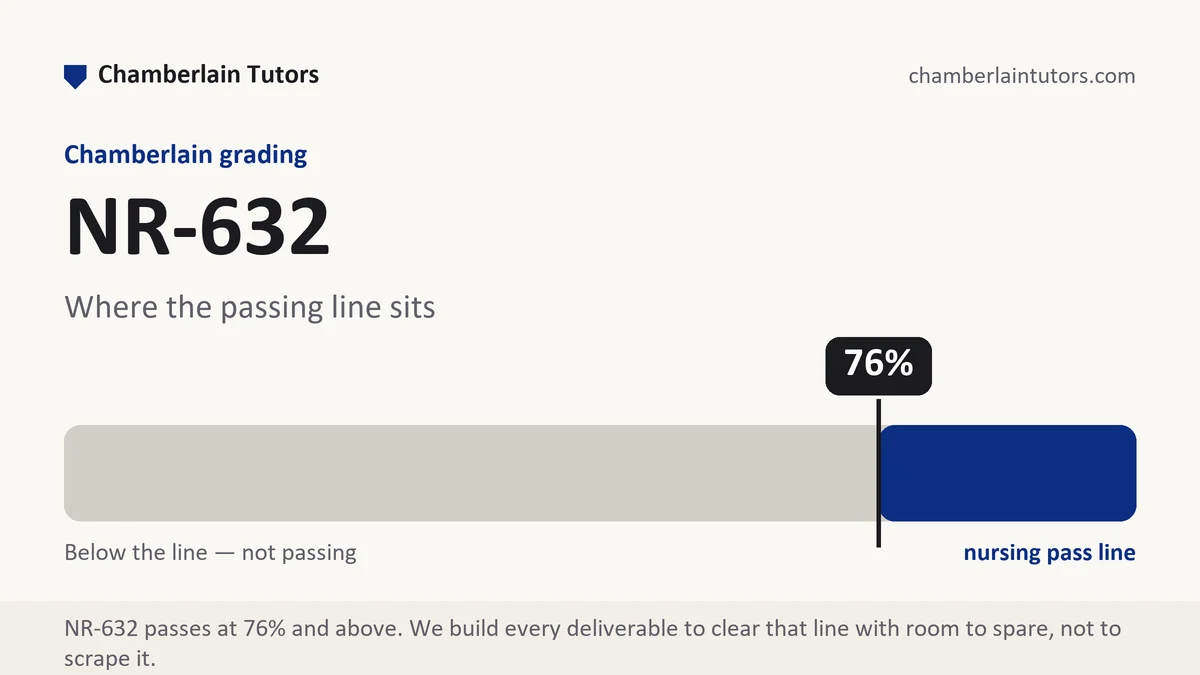
Core nursing courses pass at 76 percent, and the no C specialty scale belongs to nurse practitioner specialty courses rather than to this track. The grade is a weighted average that supplementary work cannot repair, so the safe strategy in a finishing course is to keep the mid session deliverables clean rather than banking everything on the final report.
Eight week sessions inside sixteen week semesters, up to six starts a year, something due most weeks. The specific squeeze here is that implementation time is shorter than it looks: approvals eat the first weeks, training eats more, and the measurement window that remains is often four to six weeks. Plan the report around the window you will actually have, and say in the paper what a longer one would have told you. Remember too that a discussion post cannot be edited after submission at Chamberlain, so draft any post carrying results in a document first.
Turn the criterion rows into a section plan
Copy the rows in printed order, strip each to its verb, and use those verbs as headings so the grader finds every row where they expect it. Then convert weights into a word budget, since weight is a depth instruction wearing a number.
Say the report is capped at 2,800 words with four rows weighted 40, 30, 20 and 10 percent. That is 1,120 words, 840, 560 and 280. Two things usually go wrong with that arithmetic. Students give the results row most of the paper when it is often worth 20, and they treat the executive summary as free space outside the count. Write the summary last, hold it near 350 words inside the cap, and let it carry the four sentences a busy reader needs: what was done, what changed, what it cost, what you are asking for.
The shape of a close-out report an executive can act on
Most graded writing in NR-632 is a final report in one costume or another, whether it appears as a project summary, a results paper or a board post defending your conclusion. These parts recur.
| Part | What it has to establish | What the weak version does |
|---|---|---|
| Executive summary | Purpose, action, result, cost and request, in a passage that stands alone. | An abstract about the importance of the topic. |
| What was implemented | The change as it actually ran, with dates, units and any part dropped. | The proposal rewritten in the past tense. |
| Adoption | Who used it, on which shifts, how consistently, measured rather than assumed. | Staff were engaged with the initiative. |
| The measure against baseline | Counts and denominators for matched periods, with the definition unchanged from NR-631. | A percentage improvement with no base period. |
| Cost and hours | What it took to run, set beside what you projected, in the same units. | Silence about resources once the money was spent. |
| What resisted | The specific obstacle, who raised it, and what was done about it. | Change is difficult, with a citation. |
| Recommendation | Sustain, expand, modify or stop, with the resources that choice requires. | Further study is warranted. |
| Control plan and owner | Who watches the metric, at what interval, and what triggers a response. | A hope that the unit will continue. |
Write the recommendation before you write the discussion. If you cannot say what you are asking for, the results section has not finished doing its job.
Evidence craft when the numbers are your own
- Counts before percentages. Nine of 47 is a finding. Nineteen percent, alone, hides that the whole result rests on nine events.
- Match the windows. Six post weeks against a twelve month baseline is not a comparison. Say both windows in the same sentence, and mention season, census or staffing if they differed.
- Name what else changed. A new orientation cohort, an ended agency contract, a system upgrade in the same month are competing explanations. Listing them is appraisal, and leaving them out reads as advocacy.
- Verbs your design can pay for. Uncontrolled before and after work earns followed, coincided with and was associated with. Caused and reduced require a control you almost certainly did not have.
- Report the projection against the actual. If NR-631 estimated eleven charge nurse hours a week and the pilot consumed nineteen, that gap is a finding, not an embarrassment, and it is often the most useful sentence in the report.
- External comparisons stay current and matched. Any published benchmark you cite needs a recent date and a setting close enough to yours to mean something.
What separates a passing report from a strong one
A passing report describes a project, prints a number and concludes that the change was beneficial. It reads like a summary written for the person who assigned it, which is exactly the audience an executive report is not written for.
Strong reports do three things. They separate what was delivered from what was planned, in plain sentences, so the reader can judge the result against what actually happened. They interpret the number with its limits attached, which paradoxically makes the finding more persuasive rather than less. And they end with a decision request and a named owner, because the point of the genre is to move a resource, not to close a course. Precision here is also self interested: this is the piece of writing you will be asked about in an interview, and it is the one you can show.
Six mistakes that cost points here
- Describing intentions where delivery belongs. If the paper would read the same had nothing been implemented, the implementation row is unanswered.
- Redefining the measure late. A metric quietly changed between the two courses invalidates the comparison and graders notice the mismatch immediately.
- Causal claims from an uncontrolled pilot. One unit, one season, no comparison group. Write what the design can support.
- Percentages on single digit counts. Two events out of five is not 40 percent worth reporting. Print the counts.
- No owner after graduation. A sustainment plan naming nobody is a sustainment plan that will not happen.
- Identifying the organization or its patients. A general descriptor is enough, and internal reports need permission before they are quoted.
Questions NR-632 students ask
My sponsor left the organization mid project. How do I write that?
What belongs in the executive summary and what belongs in the body?
The pilot only ran on one shift. Is that enough for the capstone?
Where NR-632 sits in Chamberlain's programs
Open the exact program map for sequence, credit, and option context. The current student schedule and syllabus remain authoritative after transfer evaluation, electives, state rules, and approved plan changes.
The weeks, one by one
Week 1
NR-632 opens with a genre change that catches experienced nurses off guard. Read the full Week 1 manual.
Week 2
A capstone report is only ever as good as the number it started from, and the early stages of NR-632 are where that number gets defined in writing. Read the full Week 2 manual.
Week 3
Once a capstone project is live, the work stops being about the plan and starts being about people, and the writing has to follow. Read the full Week 3 manual.
Week 4
Halfway through an implementation, the interesting question stops being whether the project is working and becomes whether it is running as written. Read the full Week 4 manual.
Week 5
The results stage of NR-632 is where most capstone credibility is won or lost. Read the full Week 5 manual.
Week 6
A capstone that proves a change works and cannot say what it costs has done half a nurse executive's job. Read the full Week 6 manual.
Week 7
Every capstone report has to end somewhere, and in an executive course it ends in a decision. Read the full Week 7 manual.
Week 8
The last stage of a concluding graduate experience is a compression problem. Read the full Week 8 manual.