Once a capstone project is live, the work stops being about the plan and starts being about people, and the writing has to follow. This stage of NR-632 usually turns on engagement: who has to change what they do, what each of them stands to lose, how the change was introduced, and what the resistance actually taught you. The trap is writing it as a communication summary. What earns graduate marks is an analysis of influence, written by someone who was in the room and can say why a particular sentence at a particular huddle moved a skeptical charge nurse. Your section may print this as NR 632 or NR632; it is the same course. Chamberlain publishes no syllabi outside Canvas. The placement here is our teaching judgment from the course's catalog arc; your section's rubric decides what your week actually asks.
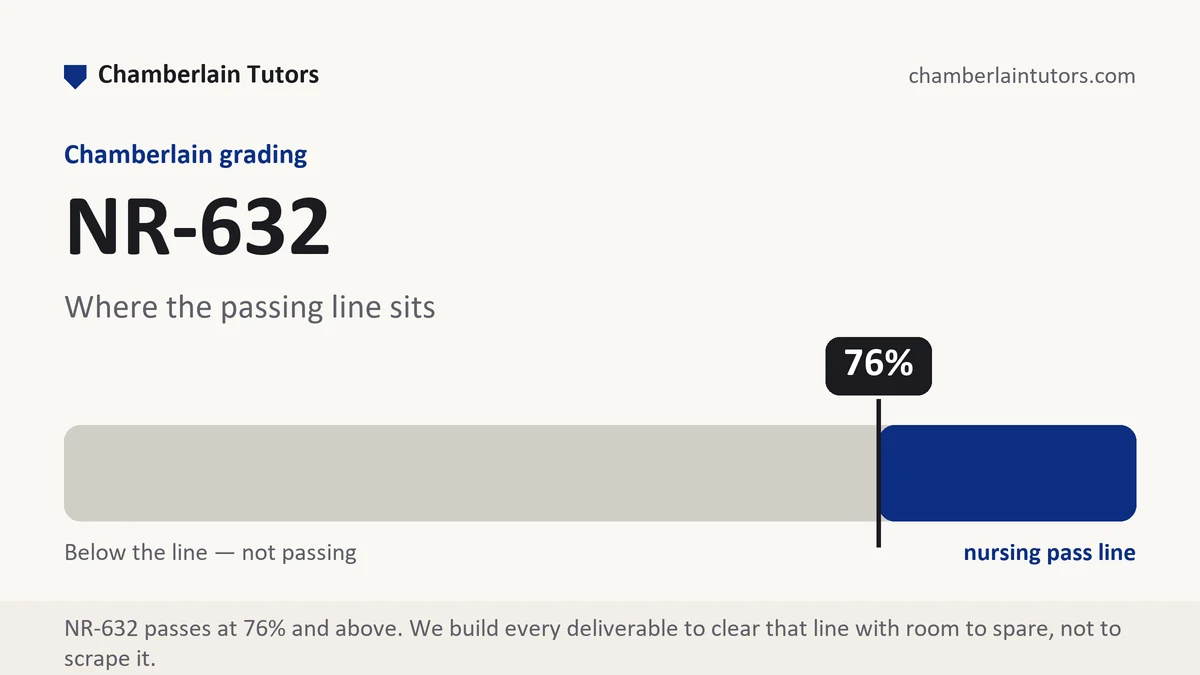
What NR-632 Week 3 asks for
Where does a well-planned project actually die? Almost never in the plan. It dies at the moment a medical assistant at a busy community clinic realizes that the new screening step adds ninety seconds to every rooming, that the schedule was built without those ninety seconds in it, and that nobody asked her before the workflow was announced. A stage on engagement exists because nurse executives are graded on their ability to see that moment coming and to write about it in terms an organization can act on.
So the deliverable at this point in a concluding graduate experience is usually analytic rather than descriptive. You may be asked to map stakeholders, to write up how the change was introduced and received, or to reflect on your own leadership in the rollout. Whatever the form, the scoring depth is the same: a page that lists who was involved sits at the bottom of the band, a page that classifies stakeholders by interest and influence sits in the middle, and a page that explains why one group's resistance was rational and what you changed in response sits at the top.
Resistance is the concept most often mishandled here. Graduate writing that treats staff objection as an obstacle to be overcome reads as junior, because objection is usually information. The medical assistant is telling you something true about cycle time. The evening charge nurse who will not run the new huddle prompt may be protecting a handover that already runs eleven minutes long. Executive analysis names the legitimate content inside the resistance, separates it from the part that is habit or fatigue, and says which parts of the plan changed as a result.
The other thing this stage tends to ask for is a record of your own conduct as a leader. Not a self-congratulatory paragraph, but a specific account of a decision you made under pressure: what you were told, what you weighed, what you chose, and what it cost. In an eight-week capstone this is the material that distinguishes candidates who have been leading from those who have been observing, and it can only come from hours you personally worked.
Where our help stops and your practicum begins
The 72 practicum hours behind this stage are yours. We do not attend meetings, speak with your mentor, your staff or anyone at your organization, complete hours, or produce site documentation of any kind. Your hour log, your activity records, your mentor and preceptor evaluations and any signed or verified form are your own record, never drafted, reconstructed or estimated with our help. Engagement is precisely the kind of work that cannot be represented by someone who was not there, and we would not attempt it.
What we work on is the written layer that sits on top of the conversations you actually had. How to structure a stakeholder analysis so the categories do analytic work instead of decorating the page. How to write up a difficult meeting as evidence rather than as a story. How to convert a reflection from narration into analysis, which is the single largest scoring gap on pages of this kind. How to source the leadership and change literature so your interpretation is supported rather than asserted.
Everything from the site arrives on the page de-identified. Staff appear as roles, never as names or nicknames, and clients never appear in identifiable form at all. Be especially careful with the vivid detail that makes engagement writing readable: the nurse who returned from leave, the assistant who was covering two rooms because of a specific absence. In a small clinic those details identify a person to anyone who works there, and faculty expect you to have thought about it before submitting.
The NR-632 Week 3 method, step by step
Six moves that turn a rollout you lived through into an analysis of influence.
-
List stakeholders by what the change costs them, not by title
Start from the workload, the autonomy or the visibility each group loses. A list organized by cost predicts behavior; a list organized by org chart predicts nothing and reads as filler.
-
Place each group on interest and influence, then say what the placement implies
High influence and low interest is a briefing problem. High interest and low influence is a group whose complaints will surface elsewhere. The placement is worth nothing until the sentence after it names the tactic it dictates.
-
Reconstruct one specific engagement moment in evidence form
Setting, who was present by role, what was proposed, what was said back, what you decided in the moment. Keep it to a paragraph and keep the adjectives out, because the analysis that follows is where the marks are.
-
Separate the legitimate content of resistance from the rest
Write two short lists: what the objection got right about the work, and what it reflected about fatigue, history or unclear authority. Both are real, and only the first should change your plan.
-
Name what you changed and what you held
An executive who concedes everything has no project and one who concedes nothing has no staff. State one adaptation you made in response to feedback and one element you protected, each with the reasoning that decided it.
-
Anchor the interpretation in named change literature
Say which model or body of evidence you are reading the situation through and use its vocabulary consistently. A named framework applied to a real scene is graduate analysis; the same scene narrated without one is a story.
A layout and word budget for an engagement analysis
Our frame for an engagement or leadership analysis of roughly 1,100 to 1,400 words. It is our own outline rather than anything the university publishes, and your scoring guide outranks it wherever the two disagree.
| Section | What belongs in it | Word target |
|---|---|---|
| The change, from the floor's point of view | What the project asks each frontline role to do differently, in minutes and steps rather than in principles. | 150 to 190 |
| Stakeholder map | Groups classified by interest and influence, each line closing with the engagement tactic the placement dictates. | 220 to 270 |
| One engagement scene | A single documented moment written as evidence: setting, roles present, proposal, response, decision. | 170 to 210 |
| Analysis of resistance | What the objection got right, what it reflected, and how you tested the difference. | 230 to 280 |
| Adaptation and hold | The element you changed, the element you protected, and the reasoning behind each. | 180 to 220 |
| Leadership judgment | What this episode revealed about your own practice as an executive and what you will do differently. | 140 to 180 |
Evidence craft for engagement writing
Use one change framework and use it all the way through. Mixing the vocabulary of three models in six paragraphs signals that none of them is doing analytic work. Pick the one that actually fits your situation, cite it with a year, and let its categories organize the section.
Quote sparingly and paraphrase precisely. A short remembered line from a meeting can carry a paragraph, but it has to be attributed to a role and framed as your recollection rather than as a transcript. Manufactured dialogue is easy to spot and expensive when spotted.
Distinguish what you observed from what you inferred. Attendance dropping at the second in-service is an observation. Staff losing confidence in the project is an inference. Write both, keep them in separate sentences, and mark the join.
Report engagement effort with its base. Nine of the fourteen day-shift staff attended the briefing and four of the eleven evening staff did is evidence about a shift imbalance. Most staff attended is a sentence that quietly hides the finding.
Five mistakes that cost points in this week's territory
- Narration where analysis was asked for. A chronology of meetings answers a question the scoring rows did not ask, however accurate it is.
- Resistance framed as a character flaw. Describing staff as difficult or resistant to change without examining the workload behind it reads as a failure of executive perception.
- A stakeholder table nobody uses. A grid pasted in and never referenced again is decoration; every row should produce a tactic somewhere in the prose.
- Naming individuals. Even a first name or a distinguishing detail in a small clinic breaches confidentiality and is noticed.
- Leadership reflection with no cost in it. An account in which every decision you made was correct tells the grader nothing and is rarely believed.
Before you submit
- Stakeholders are grouped by what the change costs them
- Each map entry ends in the tactic it implies
- One engagement moment is written concretely, with roles rather than names
- The legitimate content of resistance is separated from the rest, explicitly
- One adaptation and one protected element are both named with reasoning
- A single change framework is cited and used consistently throughout
Writing up the rollout you are living through?
Send the scoring guide and your own notes from the week, de-identified. A premium original draft comes back in 24 to 48 hours with resistance analyzed rather than complained about, and revisions run until the grade lands.