NR-631 is the first half of the nurse executive concluding graduate experience: 1.5 theory credits, 1.5 practicum credits and 72 hours spent inside an executive's week while you plan one organizational practice change. The hours put you in the room. The grade comes from the plan you write, and the row that quietly decides it asks what the current problem costs the organization, because a proposal that cannot price the present has nothing to measure its solution against.
What NR-631 actually grades
The first thing scored is whether you can convert a complaint into an operating number. Executives receive problems as frustration: discharge is chaotic, the float pool is a mess, nobody answers the transfer line. The rubric wants that translated into how often, in which unit, over what period, out of how many opportunities. Of 412 medical surgical discharges last quarter, 118 left after 4 p.m. and 31 of those waited more than two hours for transport. A baseline written that way proves the problem exists, fixes the measure you will report against later, and defines the population the project belongs to.
The second thing scored is the executive frame. A staff nurse describes the fix. An executive describes the trade: who funds it, whose hours change, what work stops so this work can start, which accreditation or regulatory obligation it touches, and what the organization keeps paying if nothing changes. A proposal that never says what the change displaces reads as a wish list no matter how good the idea is.
The third strand is the role immersion. The writing asks what you watched an executive actually do, and it wants specifics: how a decision travelled from a meeting into a budget line, what your mentor traded to get an approval through, which stakeholder held a veto the organization chart does not show. Reports summarizing the duties of a chief nurse sit mid band. Reports that take three real decisions apart move above it.
How we help in this course
Start with the boundary, because it is absolute. Practicum hours are yours. We do not complete them, contact your mentor or your organization, sign anything a site requires, or fill in an hour log. None of that is writing, and writing is the part we take.
Send the prompt and the scoring guide out of Canvas and a premium original draft returns in 24 to 48 hours: the baseline written as a statement a finance office would recognize, the change argued from evidence a grader can verify, the resource case in the units your organization actually counts. Two quality passes and the floor check run before delivery, and revision stays free until the piece lands.
Writing this course's deliverables from the rubric
Chamberlain publishes no syllabus for NR-631, and your scoring guide arrives attached to each assignment inside Canvas rather than ahead of the session, so nobody can honestly hand you a week by week grid. What transfers is method: how an executive proposal gets scoped, budgeted in words, evidenced and checked before submission. Keep your own guide open beside this page.
Planning your NR-631 project?
Send the prompt and the scoring guide. First premium sample free, floor-checked, back in 24 to 48 hours.
The passing line, and a calendar you do not own
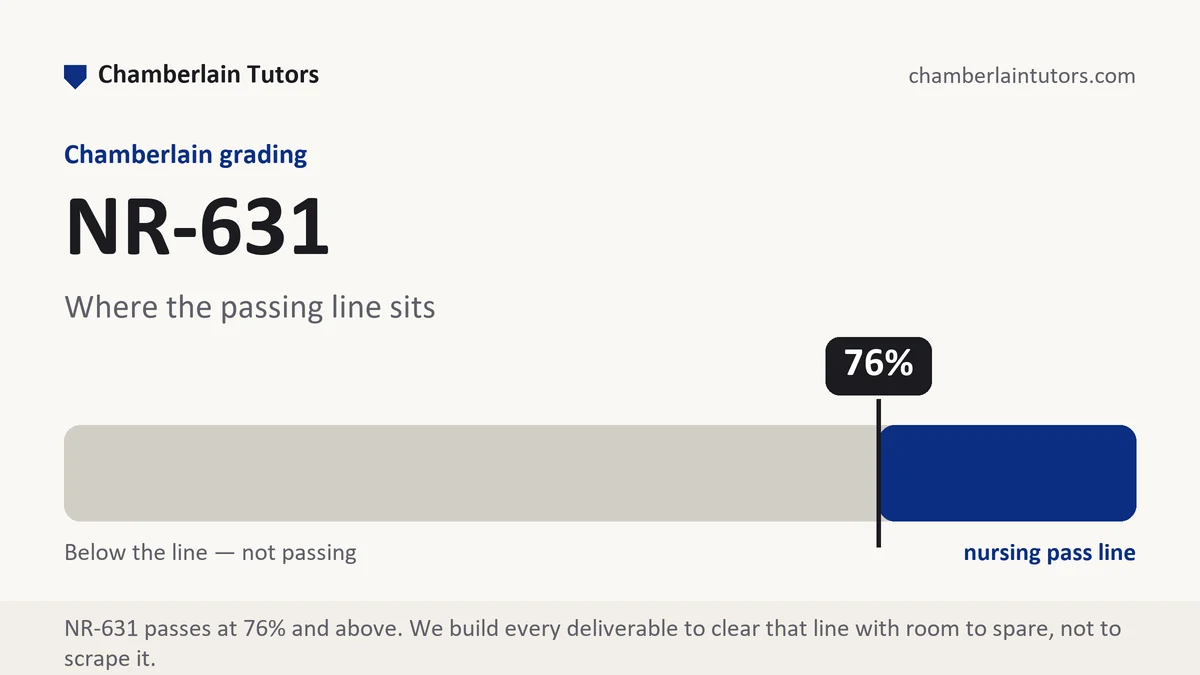
Core nursing courses pass at 76 percent. The specialty scale with no C band belongs to nurse practitioner specialty courses rather than to this track, so 76 is the number you are defending here, and it is a weighted average that supplementary work cannot repair after the fact. Confirm the scale published inside your own course, then keep every graded piece clear of the line rather than gambling on a strong finish.
Sixteen week semesters split into two eight week sessions, with up to six starts a year and something due most weeks. The pressure in this course is not writing speed. It is permission. Access to a finance report, a seat in a committee, a data pull from quality, a conversation with a director who travels: each of those moves on the organization's calendar, not the session's. Ask in week one, in writing, and draft the sections that need nobody's approval while you wait for the ones that do.
One structural detail is worth planning around. Discussion posts cannot be edited once submitted at Chamberlain, and this is a course where students post baseline numbers for peer feedback. Build the post in a document, check the figure against its source, then paste once.
Turn the criterion rows into a section plan
Copy the rows out of Canvas in printed order and reduce each to its verb: identify, analyze, justify, project, evaluate. Those verbs become your headings, kept in the guide's sequence, so a grader working down the rows meets each section where they expected it.
Then convert the weights into words, because a weight is a depth instruction wearing a number. Executive guides are often written in points rather than percentages, so work from the total. Say the guide totals 200 points across five rows worth 60, 50, 40, 30 and 20, and the paper is capped at 2,400 words. Divide the cap by the total and each point is worth 12 words, which gives 720 words to the first row, 600 to the second, 480, 360 and 240 to the rest. The arithmetic is where the surprise usually lives: the 720 word row is normally the problem and its baseline, and that is the section students write in two paragraphs so they can hurry on to the solution they had in mind before the course started.
Write each target beside its heading and clear it as the section reaches size. Any row finishing at half its budget is telling you that the evidence is not there yet, or that the analysis is still in your head rather than on the page, and graders cannot score what stayed in your head.
The shape of an executive practice change proposal
Most graded writing in NR-631 is a proposal for an organizational change, whether it shows up as a problem analysis, a project plan, a business case or a board post defending your scope. These parts recur, and a grader looks for each one.
| Part | What it has to establish | What the weak version does |
|---|---|---|
| The problem, in operating terms | What is happening, to whom, how often, measured over a named period. | Opens with a national statistic and never reaches the local unit. |
| Baseline and its source | The current number, where it came from, and how it is defined well enough for someone else to reproduce. | A percentage with no denominator and no date range. |
| Why it happens | Contributing causes traced through the actual workflow, separating the process fault from the staffing fault. | A list of causes that could apply to any hospital in the country. |
| The proposed change | What will be different on a Tuesday morning, described concretely enough that a manager could brief it. | Names a framework and calls it an intervention. |
| Evidence behind the choice | Published work supporting this change in a comparable setting, and the alternative you rejected. | Sources proving the problem is real but silent on the fix. |
| Resource case | Hours, roles, equipment, training time and the recurring cost, with the source of every figure. | An assurance that the change is cost effective. |
| Sponsorship and authority | Who can approve this, who must be consulted, and who can stop it quietly. | A sentence saying leadership is supportive. |
| Measurement plan | The metric, its denominator, the collection interval and who owns the pull after you graduate. | A promise to monitor outcomes and adjust as needed. |
| Risk and mitigation | The two or three things most likely to derail this, and the response to each. | Resistance to change, listed once, with education as the answer. |
Draft the measurement plan directly after the baseline rather than at the end. If the baseline cannot be pulled again in three months by the same method, the project has no evaluation, and you will find that out next session when there is no time to fix it.
Evidence craft when the argument is operational
Executive writing leans on two kinds of evidence, published research and organizational data, and the rows scoring you expect both handled with the same discipline.
- Design and sample before the finding. Write that a two site pre and post study of 1,140 discharges over eight months reported a change, then say what changed. Naming the design first is appraisal rather than apology.
- Verbs your design can pay for. Was followed by, coincided with and was associated with are honest for uncontrolled before and after work. Reduced, produced and caused belong to controlled designs, and borrowing them invites a grader to test the claim.
- Denominator and window on every rate. Fourteen falls in one quarter across 3,900 patient days is a rate. A 22 percent improvement with no base, no period and no unit is decoration, and it is the commonest way a good proposal loses points.
- Cost figures carry a year and a unit. An amount published six years ago is not this year's amount, and a per case figure is not a per day figure. Benchmarks need the same care, since a different bed size or payer mix is a different hospital.
- Currency depends on what you cite. Prevalence, staffing and cost data go stale in a few years, while a structural account of how organizations absorb change survives longer. Where your guide sets no rule, anything older than five years needs its justification in the sentence.
What separates a passing proposal from a strong one
A passing NR-631 proposal names a real problem, offers something plausible and finishes with an evaluation paragraph. It is competent and interchangeable, and read closely it could belong to any hospital, which is what keeps it mid band.
Strong proposals do three things visibly. They quantify the present before proposing a future, so a reader can see the size of the prize instead of being told it is significant. They name the trade honestly, including what the change costs in hours and what it displaces, because a plan that pretends to be free reads as a plan nobody costed. And they write for the person whose approval actually matters rather than for a generic audience. The 76 percent floor leaves room to be merely correct, but the plan you file here is the project you have to execute next session, so precision now buys you a finishable capstone later.
Six mistakes that cost points here
- Writing a clinical paper in an executive course. A thorough account of best practice with no resource case, no sponsor and no measurement plan answers a different rubric.
- Scope that outgrows 72 hours. Enterprise wide redesign cannot be planned, approved and evaluated by one student in one session. One process, one unit, one measure finishes.
- Naming your employer and its numbers casually. Use a general descriptor such as a 240 bed community hospital, keep identifiable data out, and ask before quoting any internal report.
- A baseline you cannot pull twice. A number produced by a one time favor from an analyst is not a measure. It is an anecdote with a decimal point.
- Confusing the mentor with the sponsor. The mentor guides your role learning, the sponsor authorizes resources, and blurring them leaves the authority row unanswered.
- Leaving the reference list to the last hour. Every citation appears in the list and every entry appears in text. Graders check that mechanically.
Questions NR-631 students ask
My organization will not release financial data. Can I still write the business case?
How large should the project be for 72 practicum hours?
How do I write the role immersion part without it turning into a diary?
Where NR-631 sits in Chamberlain's programs
Open the exact program map for sequence, credit, and option context. The current student schedule and syllabus remain authoritative after transfer evaluation, electives, state rules, and approved plan changes.
The weeks, one by one
Week 1
A charge nurse from a 38-bed medical surgical floor spends her first immersion morning in a capacity meeting and leaves with three pages of notes about a bed flow problem she has complained about for four years without ever seeing how it is decided. Read the full Week 1 manual.
Week 2
Executives receive problems as complaints and can only act on them as numbers, and the conversion between the two is the most heavily weighted piece of writing in the first half of a nurse executive concluding experience. Read the full Week 2 manual.
Week 3
Every practice change that fails in a hospital fails somewhere other than the idea. Read the full Week 3 manual.
Week 4
An executive reading a proposal wants to know one thing about the evidence section: has this been made to work somewhere resembling here. Read the full Week 4 manual.
Week 5
The sentence that separates a nurse executive's proposal from a good idea is the one naming what the change displaces. Read the full Week 5 manual.
Week 6
Practice changes fail quietly more often than they fail loudly. Read the full Week 6 manual.
Week 7
A change plan is judged on whether someone other than its author could execute it. Read the full Week 7 manual.
Week 8
The closing stage of a planning practicum is assembly, not composition. Read the full Week 8 manual.