A charge nurse from a 38-bed medical surgical floor spends her first immersion morning in a capacity meeting and leaves with three pages of notes about a bed flow problem she has complained about for four years without ever seeing how it is decided. That shift in vantage point is what a nurse executive concluding experience is built to produce, and the opening written work asks you to define it deliberately: what you are there to learn, which problem you are circling, and how a 72-hour immersion will be used rather than merely attended. Your section may print this as NR 631 or NR631; it is the same course. Chamberlain publishes no syllabi outside Canvas. The placement here is our teaching judgment from the course's catalog arc; your section's rubric decides what your week actually asks.
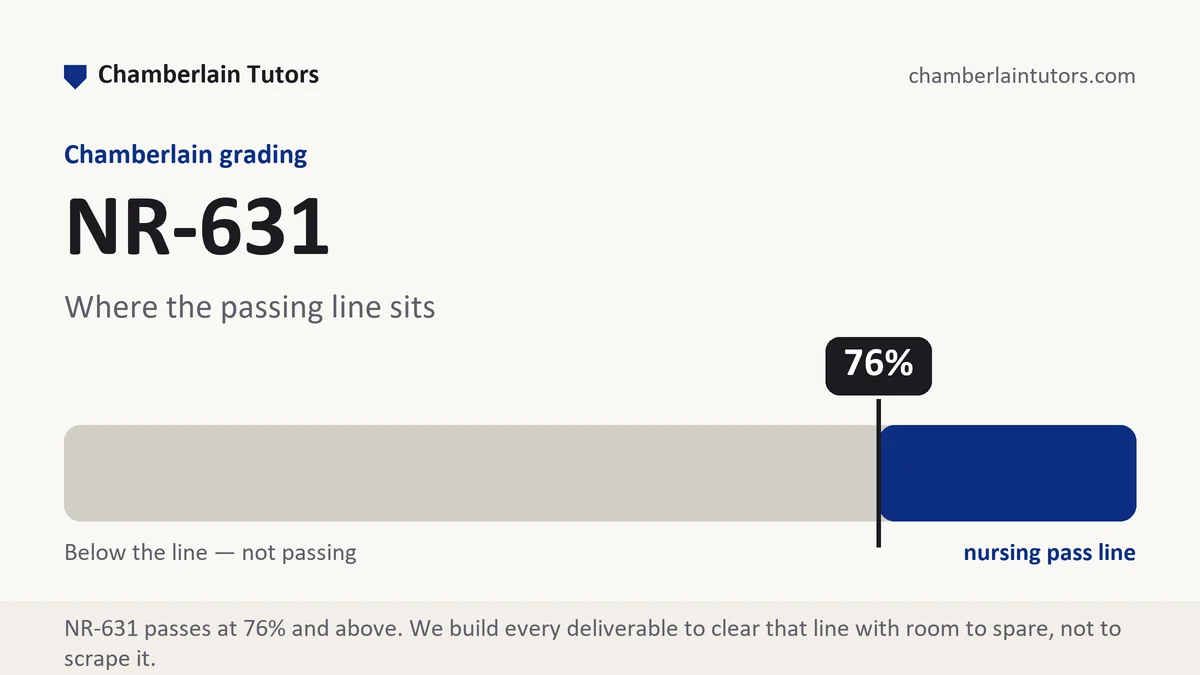
What NR-631 Week 1 asks for
The first half of an executive concluding experience opens with scoping. You have a mentored placement inside a leadership role and a requirement to plan an organizational practice change, and the written work at this stage usually asks you to define both: what the immersion will consist of, and what territory the project will live in. Neither is a formality. A vague immersion produces a report of meetings attended, and a vague project territory produces a proposal that wanders for seven weeks and never earns a baseline.
The executive frame has to be visible from the first page. A staff nurse writes about what should happen on a unit. An executive writes about what an organization will fund, who owns it, what it displaces and what the alternative costs. Even at the scoping stage that distinction shows: an opening piece describing an ambition to improve discharge communication reads as a unit-level wish, while one describing a discharge process in a specific service line, with an owner, a governance route and an existing measure, reads as executive work. The rest of the session is much easier from the second starting point.
The stage also asks for a learning plan tied to competencies rather than to activities. Executive competency frameworks are published, and mapping your immersion onto them converts a list of shadowing opportunities into an argued development plan. Communication and relationship management, knowledge of the health care environment, leadership, professionalism and business skills are the kinds of domains such frameworks describe, and each gives you a place to say what you specifically intend to observe and why you need it.
Expect a short structural deliverable here: a scoping or planning document, a learning agreement in narrative form, sometimes a posted introduction of the practice problem. Treat posts as final copy. Posts do not reopen after submission in Canvas, and an opening description of your problem that later turns out to be wrong about the numbers is an inconsistency a grader can quote back at you in week seven.
Where our help stops in a practicum course
The 72 practicum hours are the immersion, and they are yours in every sense. Hours, hour logs, attendance records, mentor evaluations, site paperwork and signatures are the student's own record and are never drafted, reconstructed, or estimated with help. We do not contact a mentor or an organization, sit in a meeting on your behalf, produce site documentation, or write anything a preceptor or a school verifies. The experience of watching decisions get made cannot be shortcut, and it is not the part that needs support.
What can be supported is the written layer around it: scoping a problem so it can carry a baseline, structuring a learning plan against published competencies, framing observations as analysis rather than as attendance, and writing in the register an executive audience expects. Where your writing draws on real meetings, real staff or real patient flow, de-identify completely. No names, no titles specific enough to identify one person, no description of an incident detailed enough to be traced to a particular patient or a particular shift.
The NR-631 Week 1 method, in six analytic moves
Six moves that turn an assigned placement into a scoped, writable project.
-
Locate the problem inside a service line, not a unit
Executives operate on service lines, cost centers and processes that cross units. Naming the problem at that level from the first week determines whether your later baseline can be built from data the organization already keeps, which is the difference between a measurable project and an anecdotal one.
-
Test the problem against an available measure before committing
Ask early whether any existing report touches your problem: throughput, readmission, incident, staffing, satisfaction, turnover. A problem with no accessible measure will force you to invent one under time pressure, and inventing measurement in week four is how proposals lose their baseline row.
-
Map the decision path the change would have to travel
Who approves, who funds, which committee reviews, what evidence each expects. Writing this in week one tells you what your proposal will eventually have to contain, and it gives your immersion a purpose beyond observation.
-
Write learning aims against a named competency framework
For each domain, one aim stating what you intend to understand and how the immersion would show it. Aims written as activities, attend budget meetings, produce nothing; aims written as understandings can be assessed.
-
Set an observation discipline you will actually keep
Decide now what you record after each immersion block: the decision observed, the information it rested on, who held influence, what was traded. Executive detail is unrecoverable a week later, and the reflective sections at the end of the session are built entirely from these notes.
-
State the scope boundary and what you are excluding
One paragraph saying what the project will not attempt and why. Executive proposals are judged partly on whether their author understood constraint, and a stated exclusion demonstrates that far better than an ambitious scope does.
A layout and word budget for an immersion scoping document
Our frame for the opening written piece of an executive concluding experience, sized for roughly 1,000 to 1,300 words. It is our own outline rather than anything the university issues, and your week's rubric outranks it wherever the two disagree.
| Section | What belongs in it | Word target |
|---|---|---|
| Setting described operationally | Organization type, service line, scale in beds or volume, and the leadership structure you are placed within. | 150 to 190 |
| The practice problem | The problem stated at service-line level, with the population it affects and the first indication that it is real. | 200 to 250 |
| Measurability check | What data the organization already holds that touches this problem, and what access you would need. | 170 to 210 |
| Decision path | The approval and funding route a change of this kind would have to travel, named by function rather than by person. | 180 to 220 |
| Learning aims | One aim per competency domain, each stating an understanding to be reached rather than an activity to attend. | 200 to 250 |
| Scope and exclusions | What the project will and will not attempt within the session, with the reason for each boundary. | 130 to 170 |
Evidence craft for an executive scoping piece
Name the competency framework and date it. Executive competency models are published by professional organizations and revised on their own schedules. Naming yours with its edition inside the sentence turns a personal development list into a claim anchored to a standard a grader can check.
Describe the setting in operating units. Bed count, average daily census, annual volume, number of direct reports in the structure you are joining. Those numbers let a reader judge the scale of everything that follows, and they cost you one sentence.
Cite one or two sources establishing the problem matters beyond your organization. A single well chosen study or professional report showing the problem is recognized in the field prevents the proposal from reading as a local complaint. Name the setting each source studied.
Keep every organizational detail non-identifying. Refer to a mid-sized community hospital rather than naming it, describe roles by function, and avoid any combination of details that would let a reader identify the organization or a person within it. Executive writing routinely handles sensitive material and is expected to be careful with it.
Five mistakes that cost points in this week's territory
- A problem defined at bedside scale. Nurses on my unit feel rushed at discharge cannot be measured, funded or owned, and every later section inherits the vagueness.
- Learning aims written as attendance. Shadow the chief nursing officer states a plan for your calendar, not an understanding a grader can assess.
- No check that data exists. Committing to a problem the organization does not measure guarantees a weak baseline in the stage where the baseline carries the most weight.
- An unbounded scope. Proposing to redesign an entire service in eight weeks signals inexperience more clearly than any writing fault could.
- Identifiable people. The nurse manager who has run the float pool since 2019 identifies a specific person as effectively as a name does.
Before you submit
- The problem is stated at service-line or process level, not unit level
- The setting is described in operating units a reader can weigh
- At least one existing organizational measure is identified as a possible baseline source
- The approval and funding route is mapped by function
- Every learning aim names an understanding rather than an activity
- Scope exclusions are stated with reasons
- No person or organization is identifiable from the text
Scoping your NR-631 project this week?
Send the scoring guide and what you know about your placement. A premium original draft comes back in 24 to 48 hours with the problem framed at executive scale, learning aims mapped to competencies, and revisions run until the grade lands.