NR-611 is the first half of the population health concluding graduate experience: a mentored immersion carrying 1.5 theory credits, 1.5 practicum credits and 72 practicum hours, in which you start an evidence-based practice project rather than finish one. Almost none of the grade comes from the hours. It comes from the written case you build for a project that has not happened yet, and the row that decides that case is the one asking you to define a population, attach a number to it, and state an aim someone could later hold you to.
What NR-611 actually grades
The immersion is the setting, not the assignment. What reaches a grader is a written project plan built in stages, and each stage is graded on whether it narrows the work rather than restates it. A submission saying the community faces high rates of chronic disease has said nothing a reader can act on. One that names an aggregate, gives its size, and reports the measure that made the aggregate worth choosing has begun.
The second graded strand is fit between problem and evidence. The intervention you propose has to sit at the level the problem lives at. A screening gap in a clinic of 2,000 patients is not repaired by counseling one patient better, and the rubric rows notice when a proposed change is aimed at individuals while the problem was described as an aggregate.
The third strand is measurability. Every plan has to say what number will move, from what baseline, by when, and where the number comes from. Graders read the aim statement first and the rest of the paper through it, so a vague aim makes every later section look vague.
How we help in this course
Boundary first, because this course has practicum hours attached. We do not complete practicum hours, contact a mentor, a preceptor or a site, sign placement paperwork or enter anything into an hour log. What we work on is the writing: the proposal, the aggregate assessment, the evidence synthesis, the board posts and whatever else the scoring guide attaches points to.
Send the prompt and the guide from Canvas and a premium original draft returns in 24 to 48 hours, built against the criterion rows in printed order, with population data cited to the agency that published it rather than to a news article about it. Both quality passes and the floor check run before delivery, and revision stays free until it lands.
Writing this course's deliverables from the rubric
Chamberlain publishes no syllabus for this course, and there is no public grid of week by week deliverables, because the scoring guide travels attached to each assignment inside Canvas and is reweighted from section to section. What transfers is the method below: how a population health project proposal is scoped, budgeted, evidenced and checked. Keep your own guide beside it, and draft first any row your guide names that this page does not.
In NR-611 right now?
Send the week and the rubric from Canvas. First premium sample free, floor-checked, back in 24 to 48 hours.
The passing line, and a clock that belongs to someone else
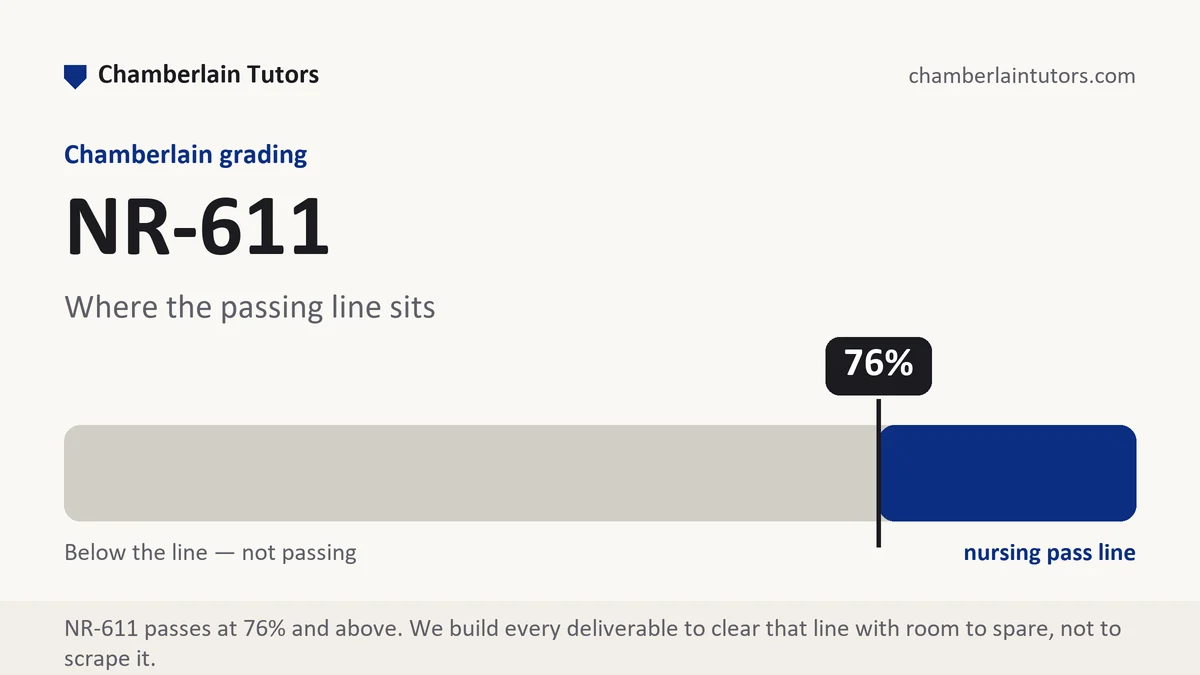
Core nursing courses pass at 76 percent. The specialty scale with no C band governs nurse practitioner specialty courses, not this one, so the number you are protecting here is 76. That is a lower bar than the NP ladder and a more deceptive one, because the grade is still a weighted average and supplementary work cannot repair it. A soft first submission in a course where the early pieces set up every later piece costs more than its own weight.
The scheduling problem is specific to a project course. Sixteen week semesters split into two eight week sessions with up to six starts a year, and something is due most weeks, but the things your project needs from other people run on their own calendar: site permission, a mentor's availability, a data request approved by someone who does not know your session ends in week eight. Write the sections that depend on nobody else first, in week one, and put the requests out the same day.
One structural warning: discussion posts at Chamberlain cannot be edited once submitted, and the boards are often where you first describe your population. That description then follows you into the graded paper. Draft the post in a document, read it once, then paste it.
Turn the criterion rows into a section plan
A scoring guide is the assignment written twice, loosely as a prompt and precisely as rows, and the precise version is the one that pays. Copy the rows into a blank file in printed order, strip each to its verb, and let the verbs become headings: identify, analyze, synthesize, propose, evaluate. A grader working down the rows should never have to hunt.
Then price the rows. A weight is a depth instruction wearing a percentage sign. Say your proposal is capped at 2,500 words and the guide carries five rows weighted 35, 25, 20, 12 and 8 percent. Multiply straight through and the budget is 875 words, 625, 500, 300 and 200. In this course the 875 word row is usually the problem and population analysis, which is exactly the section students compress so they can reach the intervention they already decided on before the course started. Writing 300 words of population analysis and 900 words of intervention detail inverts the guide and scores in the middle band no matter how good the intervention is.
Keep the budget beside each heading and clear each number as the section reaches it. Title page and reference list sit outside the count unless your guide says otherwise, and where a table of population data is allowed as an appendix, put it there rather than spending prose on rows a reader can see.
The shape of a population health project proposal
Most graded writing in NR-611 is a proposal in one costume or another: a problem statement, an aggregate assessment, an evidence synthesis, a planning paper. These parts recur, and each one is something a grader hunts for.
| Part | What it has to establish | How the thin version reads |
|---|---|---|
| The aggregate, defined | Who is in the group and who is not, with the size of the group stated as a number. | An entire community, a whole clinic, or the underserved. |
| The problem, measured | A rate or count for that group, from a named source, with the comparison that makes it a problem. | An assertion that rates are rising, cited to a general web page. |
| Contributing factors | The determinants operating on this group, split into what your project can touch and what it cannot. | National risk factors that would fit any population. |
| The evidence synthesis | What has been tried for a comparable group, what it achieved, and why you selected this approach over the one you rejected. | Article summaries in a row, each with its own paragraph and no comparison. |
| The aim statement | One sentence: which measure, in which group, from which baseline, to which target, by when. | A goal to improve outcomes and raise awareness. |
| The evaluation plan | The data source, who pulls it, the collection window, and the process measure that tells you whether the plan happened at all. | A promise to evaluate effectiveness at the end. |
| Stakeholders and feasibility | Who must agree, what the project costs their time, and the constraint most likely to stop it. | A list of titles with nothing said about what each approves. |
Draft the aim statement first even though it appears late, because the aim exposes whether your population and your measure agree. If it cannot be written without hedging, the problem section is not finished.
Evidence craft when the unit of analysis is a group
Population data behaves differently from clinical data, and the rows that score evidence in this course are checking whether you know that.
- Cite the agency, not the article about the agency. Surveillance figures, vital statistics and county health data are published by the bodies that collect them. A secondary summary drops the case definition, which is what makes two numbers comparable.
- Currency is short for prevalence, long for method. Where your guide sets no rule, a prevalence figure older than five years needs its justification written into the sentence. A paper explaining how a rate is calculated ages far better than the rate itself.
- Design and sample before the finding. Nine words of provenance turn an assertion into evidence. Write that a cross sectional survey of 1,940 adults in one county reported the gap, then report it. The sentence that skips the setup stays an opinion with a citation attached.
- Verbs the design can pay for. Almost everything at population level is observational. Was more common among, tracked with, and predicted are honest. Caused and prevented belong to controlled designs, and borrowing them is the appraisal error graders mark most often here.
- Denominator and window on every rate. An age-adjusted rate of 42.6 per 100,000 across a county of 318,000 residents over three years is a finding. Forty-two percent higher is a headline. Say which population, over what period, and whether the rate is crude or adjusted, because a crude rate compared against an adjusted one is not a comparison.
- Small numerators deserve a sentence. When a rate rests on eleven events, say so. A percentage built from single digits swings wildly year to year, and naming that instability reads as appraisal.
What separates a passing proposal from a strong one
A passing NR-611 proposal identifies a real problem, cites real sources and proposes something reasonable. Nothing in it is wrong. Nothing in it is decided either, and it could describe forty projects at forty sites. That interchangeability is what holds it in the middle band.
Strong proposals differ in three visible ways. They shrink. A project aimed at 180 patients on one panel with one measure is more defensible than one aimed at a county, and the shrinking is what makes the aim statement writable. They argue for the chosen approach against a named alternative, so the evidence section reads as a decision rather than a reading list. And they say in advance what would count as failure, which is the sentence that convinces a grader the evaluation plan is real rather than decorative. The 76 percent floor gives you room, but a proposal that survives into NR-612 without being rebuilt is worth more than the points.
Six mistakes that cost points here
- A population that is everyone. If the group cannot be counted, the baseline cannot be measured and the aim cannot be written. Narrow until you can state a number.
- Choosing the intervention before the assessment. Arriving with education sessions already decided forces the problem section to argue backwards, and graders can see the reverse engineering.
- Mismatched levels. An aggregate problem answered with an individual intervention loses the fit rows even when the intervention is good.
- An aim with no number and no date. Improve and increase are not targets. From 46 percent to 65 percent by the end of the session is.
- Naming your employer and its data casually. Describe the setting generically and confirm what your site permits before quoting internal figures.
- Treating the reference list as a formality. Agency reports and data portals are the entries students format worst, and a list that does not match the in-text citations is checked mechanically.
Questions NR-611 students ask
How small should my population be before it counts as a population?
My site will not release the data I planned the project around. What now?
My mentor and my instructor seem to want different scopes. Whose version do I write?
Where NR-611 sits in Chamberlain's programs
Open the exact program map for sequence, credit, and option context. The current student schedule and syllabus remain authoritative after transfer evaluation, electives, state rules, and approved plan changes.
The weeks, one by one
Week 1
NR-611 is a mentored immersion carrying 72 practicum hours in which you begin an evidence-based practice project rather than finish one, and the opening written work almost always turns on defining the aggregate you intend to serve. Read the full Week 1 manual.
Week 2
Once a population is bounded, the written work turns to describing it with numbers somebody else published, and describing it well enough that the problem you are about to name looks inevitable rather than chosen. Read the full Week 2 manual.
Week 3
The middle of NR-611 usually asks you to turn an assessed population into a stated problem and a searchable question, and this is the stage where most projects are silently decided. Read the full Week 3 manual.
Week 4
An evidence-based project stands or falls on whether its evidence was gathered systematically or collected until it agreed with the plan. Read the full Week 4 manual.
Week 5
Synthesis is the stage where a pile of appraised sources becomes an argument for one specific change, and the difference between a synthesis and a summary is organization. Read the full Week 5 manual.
Week 6
Graders read the aim statement first and then read the rest of the proposal through it, which makes this the highest-leverage paragraph in the whole project. Read the full Week 6 manual.
Week 7
Late in NR-611 the written work usually turns from what the evidence supports to whether the change can actually be delivered, and by whom. Read the full Week 7 manual.
Week 8
The closing stage of the first half of a concluding experience usually asks you to assemble everything written so far into one document that someone could act on, and to write an analytic account of the immersion alongside it. Read the full Week 8 manual.