NR-588 carries four theory credits and no practicum. Its subject is the nursing leader acting as an advocate across complex systems, proposing evidence-based solutions that assure quality and reduce risk. The word that changes everything is across. The problems here sit between organizations, and the person writing the proposal cannot order anybody on the other side of the boundary to do anything.
What NR-588 actually grades
A complex system is not simply a large organization. It is several bodies with their own budgets, incentives and regulators, whose work has to interlock for a patient to be safe. A discharge that depends on a pharmacy, a transport provider, a skilled facility and a family member is a complex system, and it fails in the gaps rather than inside any one participant.
The rubric rows therefore reward boundary thinking. Where does responsibility end and what happens in the space after it. Whose incentives point the wrong way. What information stops moving when it crosses an organizational line. Proposals that assume a single chain of command lose the rows about systems no matter how well argued they are internally.
Risk is the second strand and it has to be characterized rather than asserted. A risk has a likelihood and a consequence, and a proposal that treats every hazard as equally urgent has done no prioritizing. Rows that mention mitigation are usually looking for a specific control placed at a specific point, plus an honest note about the residual risk that remains after it.
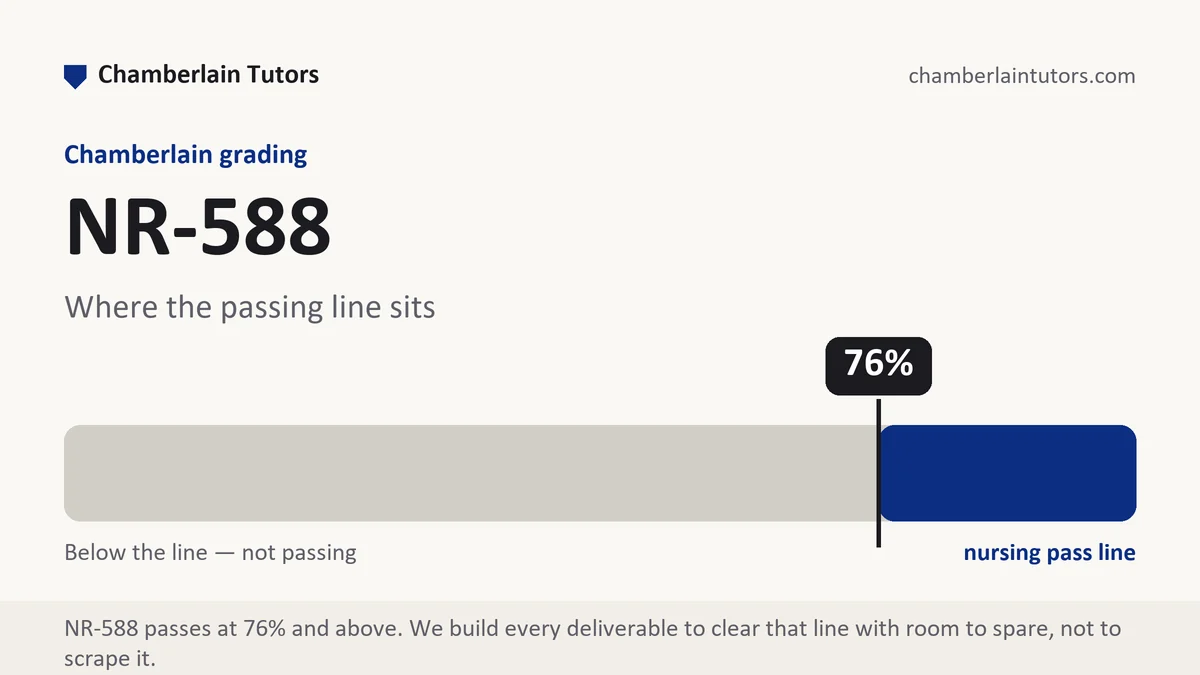
At four credits inside an eight-week session this course rewards early scoping. Chamberlain's floor in core nursing courses is 76, deliverables land weekly, and supplementary work cannot rescue a weak weighted average.
How we help in this course
Send the prompt and the rubric from Canvas plus the boundary you want to write about: a transfer, a referral, a shared record, a supply chain, a contracted service. We build the proposal with a named risk, an evidence-based control and an escalation path, and we keep the analysis honest about which parties you can direct and which you can only persuade.
Where a rubric asks for a governance or committee route, we specify it structurally rather than by naming any real organization, which is what these rows actually reward and what keeps your paper safe to submit.
Working across a boundary?
Send the rubric and the handoff that keeps failing. We will scope the proposal today.
Read the rubric before the prompt
Copy the rows into a blank document and mark which ones require you to write about somebody your organization does not employ. Those are the rows that separate this course from the one before it, and they are where most drafts quietly stay inside their own walls. If none of your sections currently crosses a boundary, the paper is answering the wrong question regardless of quality.
Then convert the weights into words. A four-credit deliverable capped at 2,800 words with rows weighted 30, 30, 25 and 15 percent gives 840, 840, 700 and 420 words. Two sections of 840 words is a substantial commitment, and in this course they usually belong to the systems analysis and to the proposed solution. Background and definitions have to fit inside the 420, which is one tight page and not the four most students plan.
Where the rubric mentions risk, budget space for the residual risk sentence. It costs forty words, it is nearly always missing, and it is the kind of specific admission that graders read as experience.
The layers of a cross-system proposal
The dominant deliverable is a proposal that has to work between parties rather than inside one.
| Layer | What it must establish | The single-organization version |
|---|---|---|
| The failure, located | Where in the path between parties the work breaks, described as a specific transfer that goes wrong. | A general problem said to affect the whole system. |
| The parties | Each organization involved, what it is paid for, and what it is measured on. | A list of departments, all inside one employer. |
| Risk characterized | How likely the failure is, how bad it is when it happens, and how often it currently occurs. | A hazard described as serious with no likelihood attached. |
| Misaligned incentives | Where doing the right thing costs one party and benefits another, which is usually the real cause. | An assumption that everyone shares the same goal. |
| The evidence-based control | A specific intervention placed at a specific point, with the evidence that it works and where that evidence came from. | A recommendation for improved communication across the system. |
| Unintended consequences | What the control makes worse, and for whom, including workload pushed onto a party with no say. | Silence, as though controls are free. |
| Governance and escalation | Which forum agrees this, how disputes are settled, and what happens when one party does not comply. | An appeal to collaboration and shared commitment. |
| Cross-boundary measurement | One measure both sides accept, with a shared definition, a source and an interval. | Two organizations counting different things and disagreeing. |
Evidence craft across organizations
System-level evidence is thinner than clinical evidence and travels worse, so it has to be handled with more care rather than less.
Say where the intervention was studied. A care transition programme evaluated in an integrated system with shared records may not transfer to unaffiliated partners. Name the structural difference rather than hoping the reader does not notice it.
Quantify risk in two dimensions. Likelihood and consequence, both stated. "Roughly 40 of the 900 transfers last year arrived without a current medication list, and in 3 the omission reached the patient" is a risk statement. "Medication reconciliation is a serious concern" is a heading.
Verbs the design can support. Most cross-system evidence is observational or quasi-experimental, so "was associated with", "was followed by" and "predicted" are the honest choices. Reserve "reduced" for controlled evidence, and note the design in the sentence where you use the finding.
Rates need the same denominator on both sides. If one party counts transfers and the other counts admissions, the two figures cannot be compared. Say which denominator you are using each time, and where the two organizations differ, say that too, because reconciling definitions is often the actual first step of the proposal.
Passing and strong in a systems course
A passing proposal is competent and internal. It identifies a genuine problem, proposes an evidence-based response, and quietly assumes that everyone involved reports to the same executive. It reads as a good departmental plan, and the rows about complex systems have almost nothing to reward.
A useful check before submitting is to count how many sentences describe somebody outside your own organization doing something. If the answer is none, the paper has an internal plan wearing the vocabulary of systems thinking, and no amount of extra citation will fix that. Adding the partner's perspective usually means cutting background, which is a trade every rubric in this course rewards.
A strong proposal crosses the line and stays there. It says what the other party is paid for and why the current behaviour is rational from where they sit. It puts the control at the point of transfer rather than inside the writer's own building. It names what the change costs the partner and what would make the trade acceptable to them. And it states the residual risk, because a proposal that claims to eliminate a system risk has misunderstood systems.
Six habits that cost marks in NR-588
- Staying inside one organization. If nobody in the paper works for a different employer, the systems rows cannot be awarded.
- Risk without likelihood. A hazard described only by its severity has not been prioritized against anything else.
- Controls that need authority you lack. A mandate you cannot issue is not a plan. Persuasion, contract terms and shared measures are.
- No unintended consequence. Every control moves work or cost. Naming where is the mark of an author who has implemented something.
- Identifying real partner organizations. Describe them by type, size and relationship, which earns full marks and keeps the paper safe.
- Pasting a discussion post before it is finished. Posts do not reopen once submitted at Chamberlain, so the first version is the graded one.
Questions NR-588 students ask
What actually counts as a complex system for this assignment?
How do I propose something for an organization I have no authority over?
How is this different from the leadership course before it?
Where NR-588 sits in Chamberlain's programs
Open the exact program map for sequence, credit, and option context. The current student schedule and syllabus remain authoritative after transfer evaluation, electives, state rules, and approved plan changes.
The weeks, one by one
Week 1
A resident leaves a skilled nursing facility at four in the afternoon with a transfer packet, arrives at an emergency department that cannot open the packet, and is admitted at ten that night on a medication list assembled from a family member's memory. Read the full Week 1 manual.
Week 2
The provider who covers a nursing facility rounds on Tuesdays. Read the full Week 2 manual.
Week 3
An anticoagulated resident in a long-term care facility has blood drawn by a mobile laboratory service, the result returns to a covering provider group by fax, the dose change is phoned back to a nurse on a different shift, and the medication administration record is updated by a third person. Read the full Week 3 manual.
Week 4
You find a study showing that a structured transfer protocol cut avoidable hospitalizations from long-term care by a meaningful margin. Read the full Week 4 manual.
Week 5
A skilled nursing facility reports that eight percent of its residents return to the hospital within thirty days. Read the full Week 5 manual.
Week 6
A resident is discharged to an assisted living community at three on a Friday afternoon with an order for continuous oxygen. Read the full Week 6 manual.
Week 7
The new transfer process worked beautifully on one hall for five weeks. Read the full Week 7 manual.
Week 8
A performance improvement committee in a long-term care facility meets monthly, works through a standing agenda, and gives a new proposal about eleven minutes before the next item. Read the full Week 8 manual.