The new transfer process worked beautifully on one hall for five weeks. Then the nurse who championed it took two weeks of leave, three of the six evening shifts that month were covered by agency staff who had never seen the form, and by the following month the process existed only in the binder where it was written. Nothing about the design failed. Adoption failed. NR-588 Week 7 is where the proposal acquires a change and communication plan: who is told, who is trained, who owns it when the champion is away, and what makes the new behavior the easiest available option rather than the most virtuous one. Your section may print this as NR 588 or NR588; it is the same course. Chamberlain publishes no syllabi outside Canvas. The placement here is our teaching judgment from the course's catalog arc; your section's rubric decides what your week actually asks.
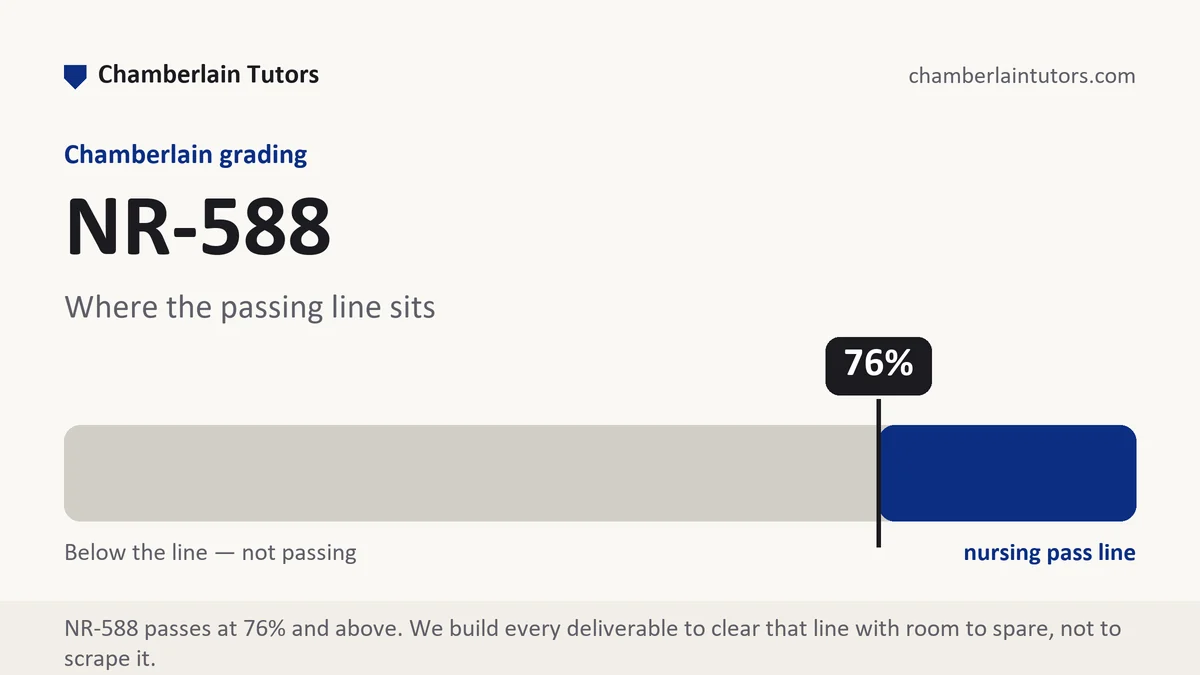
What NR-588 Week 7 asks for
Implementation is a separate discipline from design, and the stage that follows a proposal usually asks you to prove you know that. The rows in this territory ask about change theory, stakeholder engagement, communication and sustainment. The failure mode is a paper that names a change model in its first paragraph, describes the model's phases in the abstract, and never applies a single phase to the actual boundary the writer has been studying for six weeks.
Applied change theory looks different. If you use a model built around unfreezing, moving and refreezing, the graded content is what specifically has to loosen at this boundary and what specifically will hold the new state in place. If you use a model organized around readiness or diffusion, the graded content is which parties are early adopters, which are late, and what characteristic of your intervention makes it easy or hard to try. The model is a lens, and lenses are judged by what they let you see.
Cross-organization adoption has a distinctive problem: you cannot mandate the other side, and the people on your own side who touch the process most are often the least permanent. In post-acute and long-term care settings, agency coverage, weekend staffing and high turnover mean that any process depending on institutional memory decays fast. Writing to that reality, rather than around it, is one of the strongest available moves in this stage.
Communication is graded as a design, not as a gesture. A communication plan says who needs to know what, in what form, at what moment, and how you will know the message landed. Telling a reader that you will educate staff and inform partners is a sentence with no content. A plan that specifies a message to the covering provider group at the point of contract review, a two-minute item at every shift huddle for three weeks, a laminated single page at the fax station and a confirmation question at the next survey readiness meeting is a design somebody could execute.
Expect a written implementation or change plan as the deliverable, sometimes as the penultimate component of the larger proposal, and often accompanied by a discussion in which you address resistance. If your section runs that post, resist the temptation to treat resistance as an attitude problem; most resistance in cross-boundary work is a rational response to a cost the proposal did not account for. Posts do not reopen after submission in Canvas.
The NR-588 Week 7 method, step by step
Six moves for writing an adoption plan that survives turnover and a boundary.
-
Read the rubric for whether the model is required or optional
Some rows name a change framework explicitly and some simply ask for a theoretically grounded approach. Where a model is required, use one and use it throughout; where it is optional, a single well-applied model still outperforms unframed common sense, because it gives the grader a structure to score against.
-
Apply the model to your boundary in its own vocabulary
Take each phase or construct and write one paragraph saying what it means here. Not what unfreezing means in general, but what specifically has to loosen: an assumption that the receiving site will call if something is missing, a habit of faxing at the end of the shift, a belief that the packet is somebody else's problem.
-
Separate the people you can direct from the people you must convince
Two lists, and two different plans. For your own staff the questions are training, scheduling and accountability. For the partner organization the questions are forum, incentive and reciprocity, and the honest answer often includes what you are offering in return for their cooperation.
-
Design for the worst staffing week, not the launch week
Assume the champion is absent, the shift is covered by someone unfamiliar with the process, and the volume is high. Then say what still works: a field that cannot be skipped, a form that lives with the chart rather than in a binder, an instruction printed where the task happens. Anything that survives that week is real; anything that does not is a pilot.
-
Write the communication plan as a table of messages
Audience, message, channel, timing, and the signal that tells you it was received. Include the partner organization, the families or responsible parties where the change is visible to them, and the governance body that will hear the measures later. A plan without a feedback signal is broadcasting.
-
Name the owner after implementation ends
Sustainment is a role, not an intention. Say which position holds the process once the project is over, what appears in that role's regular review, and what happens when the measures drift. If the answer is that you personally will keep an eye on it, the process has a single point of failure and the sustainment row will find it.
A layout and word budget for an adoption and communication plan
Our frame for an implementation plan spanning two organizations, sized for roughly 1,300 to 1,600 words plus a communication table. It is our own outline rather than anything the university issues, and your week's rubric outranks it wherever the two disagree.
| Section | What belongs in it | Word target |
|---|---|---|
| The change model, applied | The framework named and attributed, then each construct written in the vocabulary of your actual boundary. | 250 to 300 |
| Readiness and current state | What already supports the change here, what works against it, and which of those you can move. | 200 to 250 |
| Directing versus convincing | Two plans: accountability and training on your side, forum and reciprocity across the boundary. | 230 to 280 |
| Resistance, taken seriously | The two strongest objections stated as rational costs, with what you will change in response to each. | 200 to 250 |
| Communication design | Audience, message, channel, timing and receipt signal for each group, including the partner and any governance route. | 200 to 250 |
| Sustainment | The owning role, the standing review the measures enter, and what happens on drift after the project ends. | 170 to 210 |
Evidence craft for implementation writing
Attribute the change model and use its actual terms. Change and implementation frameworks are published, dated and often revised, and naming yours with its source lets a grader check whether you applied it correctly. Borrowing half the vocabulary of one model and half of another is a common and visible error in this stage.
Support claims about adoption with implementation literature, not clinical literature. The evidence that a structured process reduces omissions is one body of work. The evidence about what makes a process stick in a high-turnover setting is another, and the second is the one this stage rests on. Searching for it separately is worth the twenty minutes it costs.
Treat resistance as information and cite it that way. Published work on implementation consistently finds that objections track real costs in time, autonomy and workload. Framing resistance as a signal about your design, with support behind the framing, is stronger writing than framing it as a barrier to be overcome.
Price training the same way you priced the control. Minutes per person, multiplied by staff count, plus the re-training rate implied by turnover in your setting. In post-acute environments the turnover multiplier is the number that determines whether an education-dependent plan is viable, and stating it is more persuasive than any assurance about staff commitment.
Keep organizations, roles and residents de-identified, and mark what is proposed. A contracted staffing agency, a covering provider group, a receiving acute care partner. Present tense for what happens now, explicit conditional language for what you are recommending, throughout.
Five mistakes that cost points in this week's territory
- A change model described but not applied. Three paragraphs explaining a framework, followed by a plan that would be identical without it, scores as a summary of somebody else's theory.
- Resistance treated as attitude. Staff buy-in as a diagnosis explains nothing and prescribes nothing. The cost that produced the objection is the analytic object.
- Plans built for the launch week. A process that requires the champion present and the unit fully staffed has not been designed for the conditions it will actually live in.
- Communication with no receipt. Messages sent with no way of knowing whether they landed are not a plan, particularly across a boundary where you cannot see the other side's inbox.
- No named owner after the project. Sustainment that depends on the writer's continued personal attention is the single most common reason improvements disappear.
Before you submit
- The change model is named, attributed and applied construct by construct to your boundary
- People you can direct and people you must convince have separate plans
- Each objection is written as a rational cost with a design response attached
- The communication table carries audience, message, channel, timing and a receipt signal
- Training is priced including a re-training rate that reflects turnover
- A named role owns the process after implementation, inside a standing review
Writing the implementation plan for NR-588?
Send the rubric and the proposal you are trying to land. A premium original draft comes back in 24 to 48 hours with the change model applied to your boundary, resistance treated as cost, and sustainment owned by a role, and revisions run until the grade lands.