A performance improvement committee in a long-term care facility meets monthly, works through a standing agenda, and gives a new proposal about eleven minutes before the next item. Whatever you wrote across seven weeks has to survive that room in the form of two pages and a table, read by people who were not in your course and who will decide on feasibility rather than on scholarship. NR-588 Week 8 usually asks for both halves of that: the final synthesis in academic form and the translated version a decision-making body could act on, plus an honest account of how anyone would know later whether the change worked. Your section may print this as NR 588 or NR588; it is the same course. Chamberlain publishes no syllabi outside Canvas. The placement here is our teaching judgment from the course's catalog arc; your section's rubric decides what your week actually asks.
What NR-588 Week 8 asks for
Closing stages in an eight-week graduate session tend to carry the heaviest single deliverable, and in a systems leadership course it is usually a synthesis: the boundary, the risk, the evidence, the intervention, the measures and the implementation assembled into one document that argues rather than reports. The most common failure is not weak content but weak assembly. Seven competent sections stapled together read as seven assignments, and rubrics at this stage frequently contain a row about coherence or integration that punishes exactly that.
Synthesis means the parts explain each other. The risk analysis has to be the reason the intervention takes the form it does. The evidence has to be the reason you expect the effect you claim. The measures have to be able to detect the control you designed. If a reader could remove your evidence section without changing your proposal, the two were never connected, and saying the connection out loud in one sentence per junction is most of the work.
Dissemination is the second half of the stage and it is a translation problem. Academic prose and decision documents optimize for different things. A paper earns credit for showing the reasoning; a committee brief earns action by leading with the ask, the cost and the risk of doing nothing, then keeping the reasoning available underneath for anyone who wants it. Writing both, and knowing why they differ, is what the dissemination rows are looking for.
Evaluation returns here in a different register than in the measurement stage. There the question was what to count. Here it is how anyone would know whether the change caused what they observe, given that no organization is going to randomize its residents and that everything else in a facility keeps changing at the same time. An honest paragraph about attribution, confounding and the limits of a before-and-after comparison is worth more than a confident claim of effectiveness.
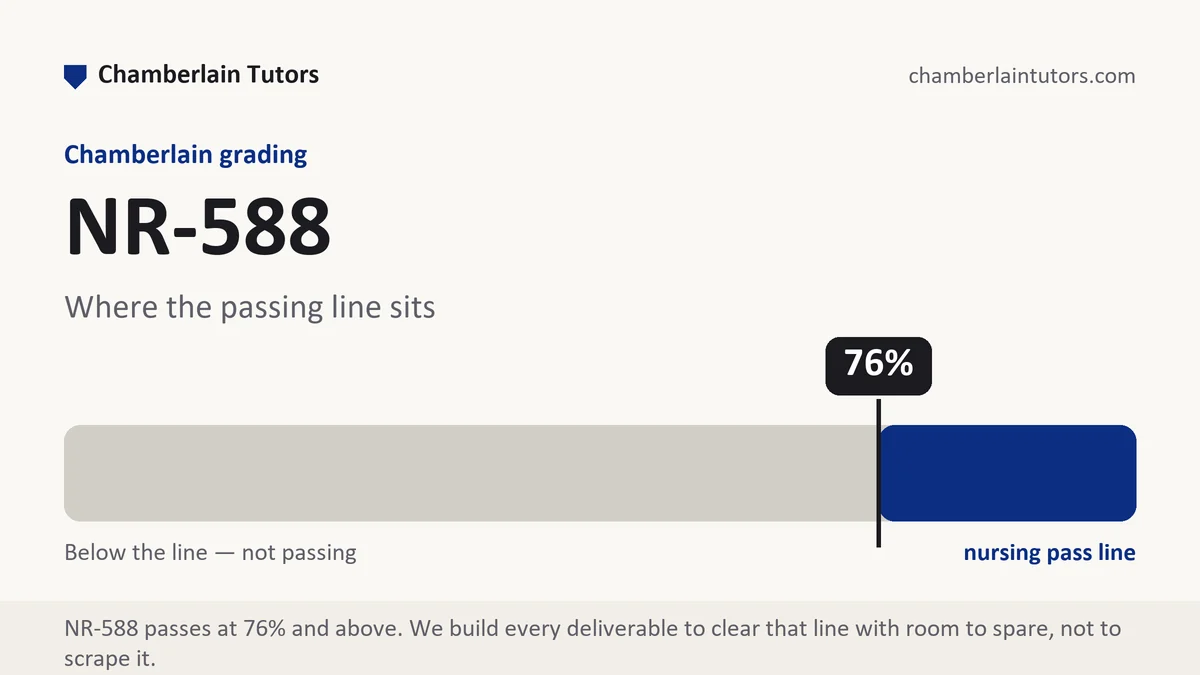
Two practical notes about closing stages. First, this is where the word budget is most often blown, because everything from earlier weeks wants to be included; the fix is a hard cut against your rubric's weights rather than an even trim. Second, this is the last score in the session, so the 76 percent floor arithmetic is fully visible by now: check what you actually need from this submission before deciding how much time it deserves relative to the rest of your term.
The NR-588 Week 8 method, step by step
Six moves for assembling and translating a systems proposal.
-
Price the sections against the rubric weights before you assemble anything
Convert each row's weight into words against your cap. A 3,000-word limit with rows at 35, 25, 25 and 15 percent gives 1,050, 750, 750 and 450. If your draft gives the largest share to background, the document is built upside down and no amount of polishing at the sentence level will fix it.
-
Write the joins, one sentence at each seam
At every transition, state why the next section follows from the last: because the highest-ranked risk sits at the moment of departure, the control is placed there; because the evidence for effect comes from settings with shared records, the measures include a fidelity check. Six sentences of this kind change how the whole document reads.
-
Cut background hard and keep analysis
Everything a reader needs to follow the argument stays; everything that proves you did the reading goes. In closing syntheses the material to sacrifice is almost always the general literature about why the problem matters, which by this stage the reader has accepted twice over.
-
Write the evaluation limits before the conclusions
Say what a before-and-after comparison in one facility can and cannot establish, name at least one plausible rival explanation for an improvement, and state the period over which you would want to see the measures hold. Doing this before the conclusion keeps the conclusion honest rather than requiring you to walk it back.
-
Translate into the decision document
Lead with the ask, the cost, the risk of doing nothing and the date you want a decision by. Put the evidence and the risk analysis into a short appendix or a table. Keep it inside two pages, because the room you are writing for is monthly, crowded and short of time.
-
Run the mechanical pass last and separately
Citations matched both directions, headings consistent, tables labeled, every proposed element still marked as proposed, every organization and resident still de-identified. This pass finds points that content revision never touches, and in a closing submission those points are the last ones available.
A layout and word budget for a closing synthesis
Our frame for a final systems proposal, sized for roughly 2,500 to 3,000 words with a separate two-page brief. It is our own outline rather than anything the university issues, and your week's rubric outranks it wherever the two disagree.
| Section | What belongs in it | Word target |
|---|---|---|
| Problem at the boundary | The system, the parties and the failure, compressed to what the argument needs and nothing more. | 300 to 380 |
| Risk, ranked | The prioritized hazards with the basis for the ranking, carried forward rather than re-derived. | 350 to 430 |
| Evidence and its limits | What the literature supports, in absolute units, with the context gaps between the studies and your setting. | 450 to 550 |
| The intervention | The control, its position, its trigger, its cost and who must agree, written as an observable event. | 500 to 600 |
| Measurement and evaluation | The indicator set, the evaluation design, and an honest paragraph on attribution and rival explanations. | 400 to 500 |
| Implementation and sustainment | Phases, approvals, the owning role afterward, and what happens when the measures drift. | 350 to 430 |
| Decision brief, separately | Ask, cost, risk of inaction, decision date, with evidence in a table underneath. | 500 to 700 |
Evidence craft for a closing synthesis
Every claim in the conclusion must already exist in the body. Closing sections attract new assertions because the writer has thought of something in the last hour. Anything that appears for the first time in a conclusion is unsupported by construction, and graders in this territory look there first.
Keep effects in absolute units to the last line. A change of three transfers per hundred discharges stays that all the way through. Relative reductions that grow more impressive as the document proceeds are the most common quiet exaggeration in student proposals, and the arithmetic is checkable.
State the evaluation design's weakness in the paper rather than waiting for the grader. An uncontrolled before-and-after comparison at one facility cannot separate your intervention from seasonal variation, a staffing change or the attention the project itself generated. Naming a specific rival explanation, and saying what you would look at to rule it out, is a stronger close than any confident claim.
Cite standards and guidance with issuing body and year at every appearance. Documents that anchor a proposal are revised, and a synthesis assembled from seven weeks of drafting can easily carry a version reference that changed since week two. Check them in the mechanical pass.
Mark the boundary between what exists and what you recommend one final time. This is the document most likely to be read by someone outside your course, and it is the document where the distinction matters most. Present tense for current state, explicit conditional language for the proposal, no exceptions, and every organization and resident de-identified.
Five mistakes that cost points in this week's territory
- Assembly without synthesis. Seven sections in sequence with no joins is the failure mode this stage exists to test, and integration rows detect it immediately.
- Background eating the word budget. Six hundred words re-establishing that transitions are risky come directly out of the sections carrying the most weight.
- Conclusions the evidence never supported. Claiming an effect larger than your sources reported converts a good proposal into an evidence failure at the last moment.
- No evaluation limits. A proposal that treats a single-site before-and-after comparison as proof of causation has not written the paragraph that distinguishes graduate work here.
- A brief that is just a shorter paper. Decision documents lead with the ask and the cost; a condensed academic argument does not translate and will not be acted on.
Before you submit
- Each section is sized against its rubric weight rather than by how much you enjoyed writing it
- A join sentence connects every section to the one before it
- No claim appears for the first time in the conclusion
- Effects are stated in absolute units consistently from the evidence section to the close
- At least one rival explanation for improvement is named and addressed
- The decision brief leads with ask, cost, risk of inaction and a decision date
- Citations match both directions and every proposed element is still marked as proposed
Assembling the final NR-588 proposal?
Send the rubric, the cap and whatever you have from earlier weeks. A premium original draft comes back in 24 to 48 hours sized to the rubric weights, joined at the seams and paired with a decision brief, and revisions run until the grade lands.