NR-587AI is the artificial intelligence concentration version of Chamberlain's advanced nursing leadership course, four theory credits and no practicum, set in environments where algorithmic tools already sit inside clinical work. The graded writing is oversight writing: what a tool predicts, for whom it was built, where it enters the workflow, who can overrule it, and who answers when it is wrong.
What NR-587AI actually grades
The failure mode in this course is generality. Papers about the promise and peril of artificial intelligence in healthcare are easy to write, indistinguishable from one another, and score in the middle no matter how current the references are. The rubric rows want a specific tool, at a specific decision point, evaluated for a specific population.
What that evaluation requires is unfamiliar to most nurses, so it is worth naming plainly. A predictive tool has a population it was built on, a set of performance figures that depend on how common the condition is, a place in the workflow where its output appears, and a set of people who now have to decide whether to believe it. Leadership questions attach to each of those, and none of them require you to understand how the model works internally.
The ethics content is graded as design rather than as commentary. Saying that algorithmic bias is a concern earns very little. Specifying that performance be reported separately by subgroup, that an override path exist and be documented, and that someone be accountable for reviewing overrides earns the row, because those are things an organization can actually implement.
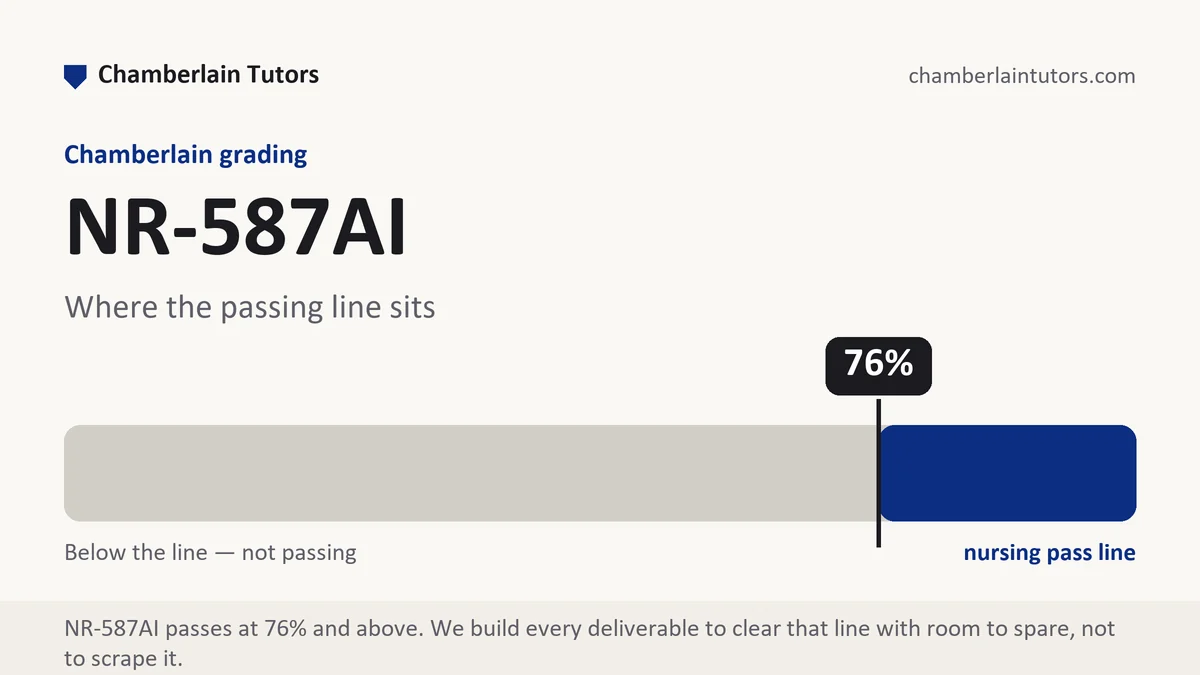
At four credits inside an eight-week session the reading is heavy. Chamberlain's floor in core nursing courses is 76, and supplementary work cannot rescue a weak weighted average, so the early weeks are worth protecting.
How we help in this course
Send the prompt and the rubric from Canvas plus the tool or the decision you want to write about. It can be a deterioration score, a sepsis alert, a documentation assistant, a scheduling or acuity model, a triage aid or a chatbot used before a visit. We build the draft around one decision point, keep the performance discussion honest about prevalence, and write the oversight sections so they could be adopted rather than admired.
If your section allows you to write about a tool you have only read about, that often produces a cleaner paper, because published evaluations give you the numbers that internal experience rarely provides.
Appraising a tool this week?
Send the rubric and the tool or decision point. We will scope the oversight case today.
Read the rubric before the prompt
Pull the criterion rows into a blank document and mark every row that could be answered without naming a specific tool. Those are the rows where general writing will cost you, because a grader comparing two papers will always award the one that could not have been written about anything else. Then decide your tool before you plan anything, since the tool determines which sources exist.
Now the word budget. Assume a 2,000-word cap with four rows weighted 40, 30, 20 and 10 percent, giving 800, 600, 400 and 200 words. Eight hundred words is a substantial section, and in this course it usually belongs to appraisal or to implications rather than to description. If your draft plan puts 800 words into explaining what artificial intelligence is, the paper has already lost the row it was best paid to answer.
Reserve about 150 words for the override and accountability material even if no row names it explicitly. Rows about ethics, safety and governance all draw on it, and it is the fastest content to write once the workflow is clear.
The checkpoints of an oversight case
The dominant deliverable is an appraisal of one algorithmic tool as it would operate in one setting.
| Checkpoint | What it must settle | The generic version |
|---|---|---|
| The prediction | Exactly what the tool outputs, for which patients, and how far ahead. | A claim that the system uses artificial intelligence to improve care. |
| Training population | Who the tool was built on, in what setting and what years, and how that differs from your patients. | Silence about where the model came from. |
| Performance in context | How often it is right when it fires, given how common the condition actually is where you work. | A headline accuracy figure with no prevalence attached. |
| Workflow placement | Where the output appears, who sees it, what they were doing at that moment, and what it interrupts. | A statement that the alert appears in the record. |
| Override design | How a clinician disagrees, what that takes, whether it is recorded, and who reads those records. | An assurance that clinical judgment remains paramount. |
| Subgroup performance | Whether accuracy holds across age, sex, language and other groups in your population, and what to do if it is not reported. | A paragraph noting that bias is an important issue. |
| Accountability | Who is answerable for a harm that follows the tool's output, and what documentation supports the decision either way. | An observation that responsibility is shared. |
| Drift and exit | What would be monitored over time and the condition under which the tool would be switched off. | No plan for the tool getting worse, as though models are static. |
Evidence craft when the evidence is a model
Performance numbers are where these papers are won and lost, and the discipline is the same one you already use for diagnostic tests.
Accuracy alone means almost nothing. A tool that flags a condition occurring in 2 percent of admissions can be right 98 percent of the time by never flagging anyone. Report how often it catches what it should and how often a positive alert turns out to be real, and say what the underlying frequency is in your setting.
External validation is not internal validation. Performance measured on the same data the model was developed from is optimistic by construction. Where a tool has been tested in a different system, that is the number worth quoting, and if it has not been, that absence is a finding you should report.
Vendor material states claims, not results. Cite it for what a product asserts. For whether it works, use peer-reviewed evaluation or independent implementation reports, and say when neither exists.
Design decides the verb, and rates need their base. Retrospective evaluations support "was associated with" and "identified"; prospective controlled studies support "reduced". A usable sentence looks like this: "the alert fired on 1,420 of 18,300 admissions over nine months, and 1 in 7 of those alerts preceded the outcome within 24 hours".
Passing and strong in an oversight course
A passing paper is well-read and abstract. It cites recent work, uses the right vocabulary, and concludes that these tools require careful governance. It has not appraised anything, because nothing in it is specific enough to appraise, and the rows about evaluation and application have little to hold.
A strong paper takes one tool and one moment. It says what the nurse was doing when the alert appeared and what it asked them to stop doing. It puts a number on how often that interruption is worth it. It names the subgroup for whom the tool is likely to perform worse and what would be done about that. And it specifies the exit condition, which is the most adult sentence in this literature and the one almost no student writes.
Six habits that cost marks in NR-587AI
- Writing about the field instead of a tool. A paper that could be published unchanged next year is a paper with no appraisal in it.
- Quoting accuracy without prevalence. Performance figures are meaningless until the frequency of the condition is stated.
- Assuming validation transfers. A model built elsewhere on a different population is an untested tool in your setting until shown otherwise.
- No override path. If disagreement has no route and no record, oversight is a word rather than a design.
- Leaving accountability vague. Someone answers for the outcome. A paper that will not say who has skipped the leadership question entirely, and the governance row has nothing to award.
- Posting an unfinished discussion response. Posts do not reopen once submitted at Chamberlain, so compose in a document and paste once.
Questions NR-587AI students ask
Do I need a technical background to write these papers?
My organization does not use any of these tools. What do I write about?
How do I handle the ethics section without repeating what everyone says?
Where NR-587AI sits in Chamberlain's programs
Open the exact program map for sequence, credit, and option context. The current student schedule and syllabus remain authoritative after transfer evaluation, electives, state rules, and approved plan changes.
The weeks, one by one
Week 1
At 0412 a deterioration score turns amber on a medical-surgical patient who is asleep, afebrile and looks entirely well. Read the full Week 1 manual.
Week 2
Two nurses in a simulation debrief are asked the same question about the same scenario: the score was low, the patient looked wrong to you, and you did not escalate. Read the full Week 2 manual.
Week 3
Take a tool that catches four out of five cases of a condition and is right about the absence of it ninety-five percent of the time. Read the full Week 3 manual.
Week 4
A pain-related flag on a surgical unit is built from documented pain scores, and documented pain scores are produced by people asking, believing and recording. Read the full Week 4 manual.
Week 5
Every vital sign a nurse enters on a critical care flowsheet is doing two jobs at once. Read the full Week 5 manual.
Week 6
A well-validated alert fires on a surgical floor at 1930, during handover, to a nurse who has just taken report on five patients and has not yet met any of them. Read the full Week 6 manual.
Week 7
An intensive care unit runs a deterioration model for eighteen months without incident, then the hospital opens a short-stay observation area and starts admitting a different kind of patient through the same beds. Read the full Week 7 manual.
Week 8
Write the closing deliverable as though a committee has to vote on it. Read the full Week 8 manual.