At 0412 a deterioration score turns amber on a medical-surgical patient who is asleep, afebrile and looks entirely well. The nurse has four other patients, one of whom is genuinely unstable. What happens in the next ninety seconds is the whole subject of this course, and this opening stage is where you learn to write it precisely: which tool, what it outputs, at what moment it appears, to whom, and what that person is expected to do about it. Generic writing about the promise of artificial intelligence in healthcare scores in the middle no matter how current the sources are. A named tool at a named decision point scores. Your section may print this as NR 587AI or NR587AI; it is the same course. Chamberlain publishes no syllabi outside Canvas. The placement here is our teaching judgment from the course's catalog arc; your section's rubric decides what your week actually asks.
What NR-587AI Week 1 asks for
The opening stage of an artificial intelligence concentration is a scoping stage, and it exists to prevent the paper everyone writes on their first attempt. That paper defines artificial intelligence, distinguishes machine learning from rule-based logic, surveys applications across radiology, triage and documentation, and closes with a paragraph about the importance of the human touch. It is not wrong. It is interchangeable, and interchangeable is the one thing a graduate rubric cannot reward.
The alternative is to fix a scope in the first paragraph and hold it for the whole session. One tool, one setting, one decision point. A deterioration or early warning score computed from vital signs and laboratory values. A sepsis alert that fires in the record. An acuity or staffing model that proposes an assignment. A documentation assistant that drafts a note for a clinician to sign. A scheduling model that predicts no-shows. A chatbot that triages symptoms before a visit. Any of these gives you a real object with a real output, and the entire remaining seven stages of the course have something concrete to attach to.
Notice what you are not being asked to do. Nothing in this course requires you to understand how a model is trained internally, and papers that spend six hundred words explaining gradient descent are spending the budget on the cheapest content available. The leadership questions attach to the outside of the system: what it predicts, for whom it was built, where its output lands in a workflow, who is permitted to disagree with it, and who answers when the recommendation is wrong. Those questions are answerable by a nurse leader without any machine learning background at all, and they are what the rubric rows are made of.
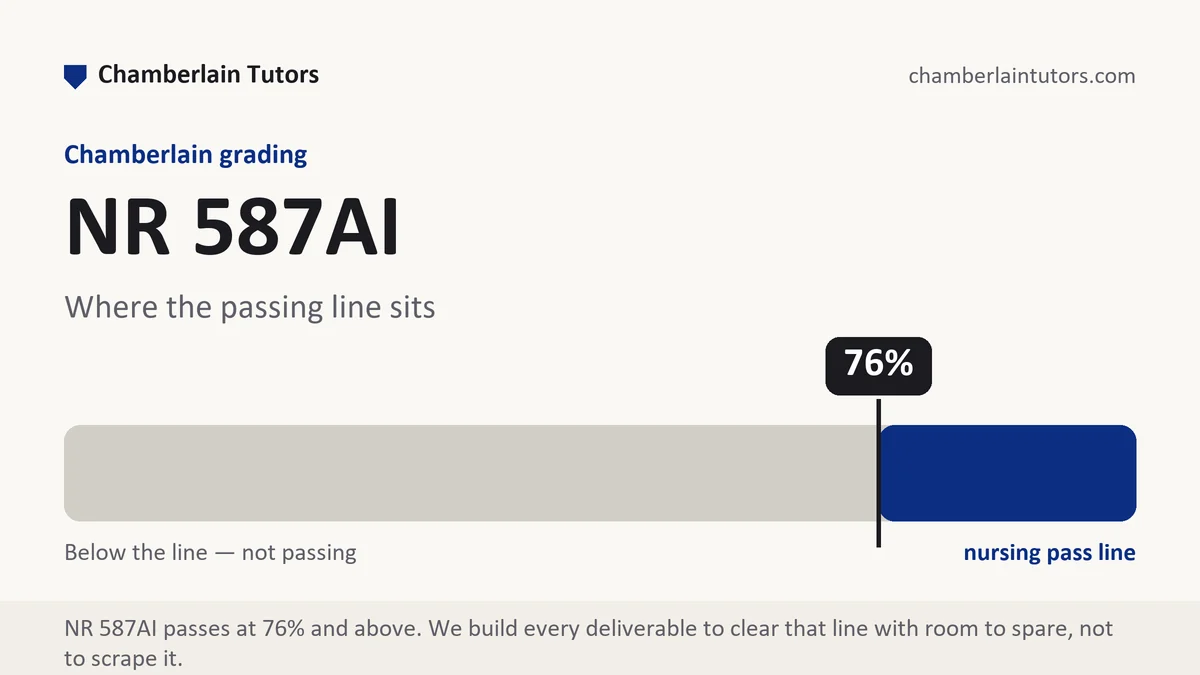
One boundary belongs on the page from the first stage and is worth stating in your own writing where it fits. These tools produce recommendations; accountability for the clinical decision stays with the licensed clinician and with the organization that deployed the system. That is not a rhetorical flourish. It is the principle that makes override design, monitoring and governance necessary rather than optional, and it is the spine every later stage in this course hangs from. Also note the arithmetic: this is a four-credit course in an eight-week session, core nursing courses pass at 76, and supplemental work cannot lift a weak weighted average.
The NR-587AI Week 1 method, step by step
Six moves for scoping an algorithmic tool into a writable case.
-
Choose the tool before you choose the topic
The tool determines which literature exists. Pick one with published evaluations behind it, because a tool nobody has studied leaves you writing opinion for eight weeks. Availability of evidence is a legitimate selection criterion and worth one sentence in your paper.
-
Write the output as a sentence with a subject and a horizon
This tool estimates the probability that this class of patient will experience this event within this many hours. If you cannot fill every slot, you do not yet know what the tool does, and the rest of the paper will be vague in ways a grader can feel.
-
Locate the moment the output appears
Not the system, the moment. An interruptive box at chart opening, a colored flag on a census board, a page to a response team, a line in a report reviewed at 0700 huddle. Placement changes everything about how the tool behaves in practice.
-
Name the human who receives it and what they were doing
Bedside nurse mid-medication pass, charge nurse assembling an assignment, hospitalist rounding, response team already at another bedside. The recipient's situation at that instant determines whether the output is used, deferred or dismissed.
-
State the decision the output is supposed to change
Assess sooner, escalate, order a laboratory test, move the patient, reassign staffing, call the family. If no decision changes, the tool is generating work rather than value, and saying that plainly is a strong finding for an opening paper.
-
Fix your scope boundary in writing
One paragraph saying what this paper covers and what it deliberately excludes. It protects you from the drift into general commentary that costs more marks in this course than any other single habit.
A layout and word budget for a scoping paper
Our frame for an opening submission in this course, sized for roughly 1,200 to 1,500 words. It is our own outline rather than anything the university issues, and your week's rubric outranks it wherever the two disagree.
| Section | What belongs in it | Word target |
|---|---|---|
| The tool and its output | What it predicts, for which patients, over what horizon, expressed as a score, a flag or a draft. | 170 to 210 |
| The clinical setting | Unit type, population, volume, and what happens on that unit without the tool present. | 170 to 210 |
| Workflow placement | Where the output appears, in what form, how interruptive it is, and what it competes with for attention. | 230 to 280 |
| The receiving clinician | Role, workload at that moment, authority to act, and what they must do before they can respond. | 200 to 250 |
| The decision at stake | The specific action the output should change, and the consequence of getting it wrong in each direction. | 230 to 280 |
| Scope and accountability | What this paper covers, what it excludes, and where clinical accountability sits regardless of the output. | 150 to 190 |
Evidence craft for writing about clinical algorithms
Use primary evaluations, not vendor material. Marketing documents describe intended performance under favorable conditions. Peer-reviewed validation and implementation studies describe what happened. Where you cite a vendor claim, label it as a vendor claim in the sentence, which is itself an act of appraisal a grader can score.
Give every performance figure its population and its date. A model's accuracy is a property of a model tested on a particular population at a particular time, not a permanent attribute. Name the setting, the years and the sample in the sentence where the number appears.
Keep terminology exact. A score is not a diagnosis. An alert is not a recommendation. A prediction is not a cause. Precision of language is graded heavily in this course because sloppy terms hide exactly the distinctions that governance depends on.
Be careful with the word bias. It carries a statistical meaning and an equity meaning and they are related but not identical. Say which one you mean at first use. That single clarification prevents most of the confusion that appears in later sections of student papers.
De-identify any encounter you draw on. If a real alert on a real patient prompted your interest, write it without a diagnosis-date-unit combination that could identify anyone. The analysis needs the shape of the event, not its particulars.
Five mistakes that cost points in this week's territory
- The survey paper. Six applications described at equal shallow depth demonstrates reading, not analysis, and could have been written about any healthcare setting.
- Technical explanation as filler. Paragraphs on how neural networks learn answer no leadership row and consume the budget the appraisal needed.
- An output with no horizon. Predicts deterioration is incomplete. Within six hours, twelve hours or the admission changes everything about how the alert should be handled.
- The tool with no recipient. If the paper never says who sees the output and what they were doing, the workflow rows have nothing to grade.
- Optimism or alarm in place of appraisal. Both the enthusiastic and the fearful versions of this paper skip the specific evidence that a graduate rubric is asking for.
Before you submit
- One tool, one setting and one decision point are named in the first paragraph
- The output is stated with a subject, a form and a time horizon
- The exact moment and format of the output's appearance are described
- The receiving clinician's role and workload at that moment are named
- Every performance figure carries its population and its year
- A scope paragraph states what the paper excludes and where accountability sits
Starting NR-587AI this week?
Send the instructions and the rubric out of Canvas with the tool or decision point you want to build on. A premium original draft comes back in 24 to 48 hours scoped to one tool at one decision point, and revisions run until the grade lands.