Write the closing deliverable as though a committee has to vote on it. Somebody at that table cares about patient safety, somebody about money, somebody about the medical staff's tolerance for another alert, and somebody about what happens if this ends up in a public report. Your document has to give all of them a reason and give one of them a decision. That is what a governance case is: a recommendation about a specific tool at a specific decision point, with the evidence, the equity analysis, the workflow design, the cost and the monitoring plan assembled into a single argument that ends in an approval, a conditional approval or a refusal. Your section may print this as NR 587AI or NR587AI; it is the same course. Chamberlain publishes no syllabi outside Canvas. The placement here is our teaching judgment from the course's catalog arc; your section's rubric decides what your week actually asks.
What NR-587AI Week 8 asks for
Closing stages in an eight-week session are synthesis, and this concentration synthesizes into governance because that is the form the content naturally takes. Everything the term has covered is a component of one decision: whether to deploy, expand, restrict or withdraw an algorithmic tool in a defined setting, and under what conditions. The graded skill is integration, and the fastest way to fail it is to submit an anthology of earlier work with transitions added.
The structural rule from leadership writing applies here with force. The recommendation goes first, and the rest of the document defends it. A committee reader wants to know what is being asked of them, what it costs, what could go wrong and how you would know, before they will read your validation section. Papers that build slowly toward a conclusion on the final page lose the reader and often lose the row asking for a clear recommendation, because a grader has to go looking for it.
Conditional approval is the most sophisticated available answer and it is underused by students. Real governance bodies rarely say yes or no outright. They say yes on one unit, for six months, with subgroup reporting monthly, with these thresholds, with this override review, and with an automatic review if any of the following occurs. A conditional recommendation demonstrates that you can hold benefit and risk at the same time, and it gives you a natural place to put every safeguard the course has taught. It is also honest, which matters when the evidence base for most of these tools remains thinner than the enthusiasm around them.
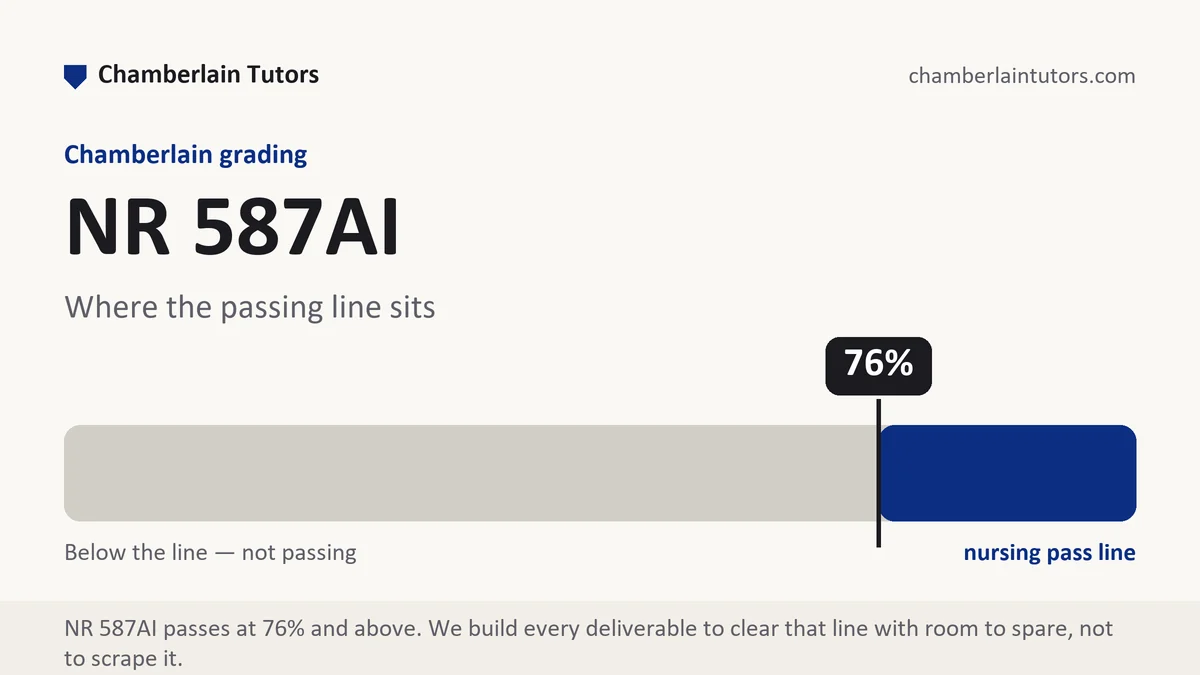
If your section closes with a reflective component, write it as changed reasoning rather than as appreciation. What you assumed about these tools in the first stage and no longer assume, and the specific thing that changed your mind. And keep the arithmetic in view: this is a four-credit course, the closing deliverable often carries the heaviest weight in the gradebook, core nursing courses pass at 76, and there is nothing after this stage to repair a weak submission.
The NR-587AI Week 8 method, step by step
Six moves for assembling a governance case.
-
Write the recommendation and its conditions in one block
Approve, approve with conditions, defer pending named evidence, or decline. Then the conditions as a short list. Put it at the top, before any background, and make it survivable as the only thing a busy reader sees.
-
Give the reader the four-line brief
What it costs in the first year, what it is expected to change, the most serious risk, and what happens if the organization does nothing. Four lines under the recommendation do most of the persuasive work.
-
Rebuild the evidence chain toward the recommendation
Validation, base rate and alert burden, subgroup performance, workflow design, cost, monitoring. Condense hard and cut anything that does not bear on the decision, however much work it took to produce.
-
State the residual risk you are accepting
Every approval accepts something. Name it plainly: incomplete subgroup evidence, a base rate that will produce a known level of false alerts, a dependence on an overnight role that is thinly staffed. Naming it is what makes the rest credible.
-
Attach the human accountability statement
Where clinical accountability sits, who may override and at what cost, who reviews overrides, and who holds authority to suspend. One tight section, not a sentence of reassurance in the conclusion.
-
Run the mechanical pass separately from the writing
Citations reconciled both directions, figures identical in table and prose, headings in your rubric's format, terminology consistent from the first page to the last. These are the cheapest points in the term and the most often lost at midnight.
A layout and word budget for a governance case
Our frame for a closing deliverable, sized for roughly 2,000 to 2,500 words, which is the range a four-credit course tends to run at the end of a session. It is our own outline rather than anything the university issues, and your week's rubric outranks it wherever they disagree.
| Section | What belongs in it | Word target |
|---|---|---|
| Recommendation and conditions | The decision requested, the conditions attached, and the four-line brief beneath it. | 200 to 250 |
| Tool, setting and decision point | What it predicts, where it lands, who acts on it, condensed from your opening work. | 280 to 340 |
| Evidence and expected burden | Validation quality, base rate, alert volume per shift, and subgroup performance or its absence. | 380 to 450 |
| Design and safeguards | Threshold, routing, modality, override path, and the accountability map in one place. | 350 to 420 |
| Cost and monitoring | Total cost of ownership, the measures across three layers, baselines, owners and triggers. | 350 to 420 |
| Residual risk and review | What is being accepted, what would force reconsideration, and when the decision returns to the table. | 280 to 340 |
Evidence craft for a governance document
Rewrite rather than paste from earlier stages. Sections written for a different question show their joins in tense and register, and self-reuse policies vary between institutions. Check your program's rule, then compress each earlier analysis into the version that serves this decision.
Calibrate your confidence explicitly. Say where the evidence is strong, where it rests on a single-site evaluation, and where you are reasoning from mechanism because no study exists for your exact configuration. Graders reward honest calibration and can spot an overclaimed evidence base quickly.
Prune the reference list to what carries the decision. Validation evidence, subgroup evidence, implementation evidence and any standard you are applying. Sources that appear once in a background sentence can usually go.
Keep every figure consistent across the document. The alert burden in your recommendation block must be the same number that appears in your evidence section and in your table. Mismatches read as carelessness in exactly the document where care is the subject.
Write the tool as a tool throughout. It produces outputs that inform decisions made by accountable clinicians. Language that gives a system agency, that says it decides or it knows, weakens the accountability argument the entire document rests on.
Five mistakes that cost points in this week's territory
- The recommendation withheld. A committee reader should know what is being asked of them within the first thirty seconds of reading.
- Binary thinking. Approve or reject, with no conditional option, throws away the most sophisticated answer available.
- No residual risk stated. A case where nothing is being accepted has not been thought through, and experienced readers stop trusting it.
- Monitoring reduced to a promise. Two sentences pledging to track outcomes leaves the row asking how you would know it worked essentially blank.
- Mechanics abandoned at the end. A strong argument delivered with drifting citations and inconsistent figures loses points that cost nothing to keep.
Before you submit
- The recommendation and its conditions sit in the first block of the document
- Cost, expected change, principal risk and the consequence of inaction appear beneath it
- Every retained section bears directly on the decision being requested
- Residual risk is named explicitly rather than implied
- Accountability, override and suspension authority appear in one clear section
- Figures, citations, headings and terminology have had a dedicated final pass
Assembling the governance case?
Send the rubric out of Canvas with whatever you have built across the session. A premium original draft comes back in 24 to 48 hours with the recommendation leading, the conditions specified and the monitoring plan attached, and revisions run until the grade lands.