NR-587 carries four theory credits and no practicum. It is about leading inside a working environment: making decisions with incomplete information, managing resources you do not have enough of, coordinating care across people who do not report to you, and doing all of it in a way that fits the patients actually in front of you. The written work is decision writing, and decision writing is graded on constraints.
What NR-587 actually grades
The distinguishing feature of this course is that recommendations have to live inside limits. Anyone can improve care with more staff and more time. What is being examined is whether you can improve something with the staff and time that exist, say what it costs elsewhere, and defend the trade you made.
Care coordination is the second heavy strand, and it is harder to write than it looks because it happens between roles rather than inside one. The graded content is the handoff: what information moves, when, to whom, and what happens when it does not arrive. Papers that describe coordination as a value rather than as a sequence of transfers score in the middle.
Culturally congruent care runs through the whole course and is graded strictly. A paragraph of generalizations about a cultural group is worse than saying nothing, because it demonstrates the opposite of the skill. What earns marks is a mechanism: how the service finds out what matters to a particular patient or population, and what it changes as a result.
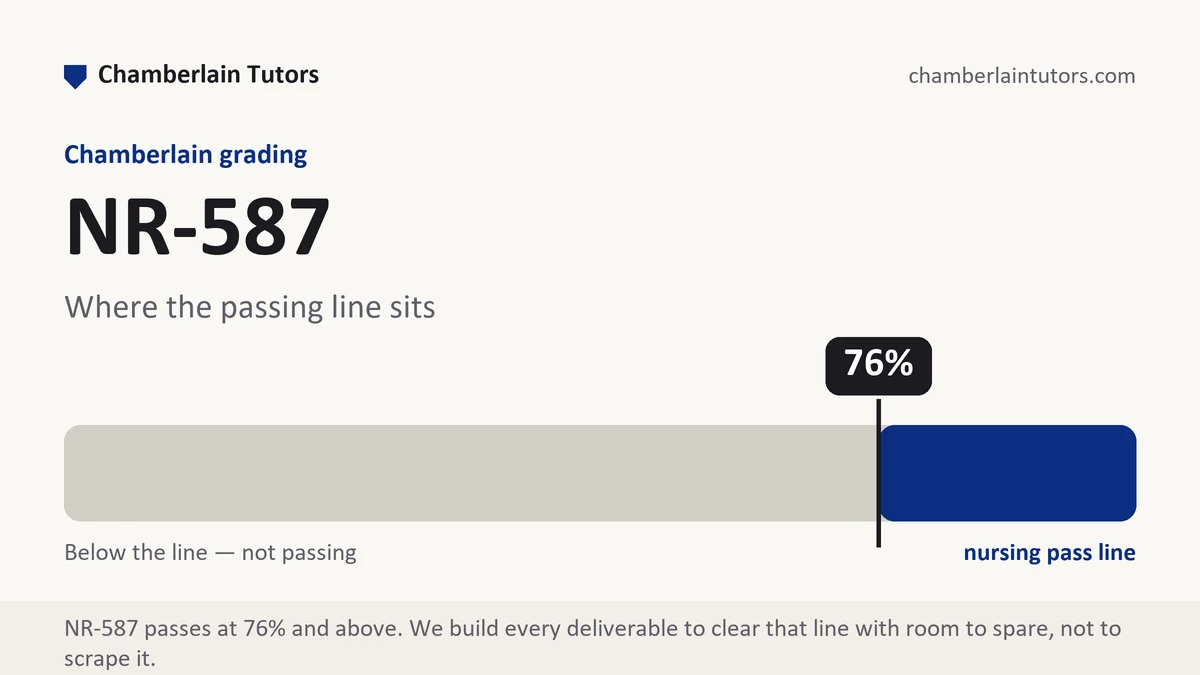
At four credits, the reading and the deliverable weight are heavier than in the three-credit courses around it, which matters inside an eight-week session. Core nursing courses pass at 76, and because supplementary work cannot lift a weak weighted average, the heavier credit load has to be planned for rather than absorbed.
How we help in this course
Send the prompt and rubric from Canvas with the decision you are being asked to make and the constraint that makes it hard: a fixed budget, a vacancy, a shared resource, a coordination failure that keeps recurring. We build the case with real options, honest costs and a defended choice, and we keep the cultural congruence content mechanical rather than descriptive.
Where your section asks for a financial component, we keep the arithmetic simple and transparent so you can defend every line of it, since a spreadsheet you cannot explain is worse than a rough estimate you can.
Building the decision case?
Send the rubric and the constraint you are working inside. We will lay out the options today.
Read the rubric before the prompt
Decision rubrics usually contain one row that quietly controls the grade: the row asking you to justify the choice among alternatives. Find it first. Everything else in the paper exists to make that row answerable, and drafts that treat it as a concluding paragraph lose more than that row alone.
Then convert the weights into a word budget. A four-credit course often carries longer deliverables, so assume a 2,500-word cap with rows weighted 30, 25, 25 and 20 percent. That yields 750, 625, 625 and 500 words. Seven hundred and fifty words is roughly seven paragraphs, which is enough to compare three options properly, and it is far more than the two paragraphs most drafts give to the comparison.
Where a rubric row mentions culturally congruent care, budget for it explicitly rather than letting it be absorbed into other sections. A distributed treatment of that content is nearly impossible for a grader to award, and a short dedicated section with a mechanism in it is easy to score.
The components of a resource decision case
The dominant deliverable is a case for a decision somebody has to make with what they have.
| Component | What it must establish | The version that cannot be acted on |
|---|---|---|
| The decision | What is being decided, by whom, and by when, in the opening two sentences. | A problem described with no decision point identified. |
| Demand | The workload in countable terms: volume, acuity, timing, and how it varies across the week. | A statement that the unit is busy. |
| Capacity now | What exists in hours, skill mix, rooms or equipment, against that demand. | A complaint about short staffing with no baseline. |
| Options, costed | Two or three real alternatives, including doing nothing, each with what it consumes and who provides it. | One preferred option and two obvious losers built to lose. |
| Coordination effect | How each option changes the handoffs between roles, and where information would fall through. | Silence about anyone outside the unit. |
| Cultural congruence | The mechanism for learning what matters to the patients affected, and what it would change in practice. | Generalizations about a group, offered as understanding. |
| The decision, defended | Your choice, the trade you accepted, and what you would tell the group that loses by it. | A recommendation phrased so that nobody loses anything. |
| Monitoring | What you would watch, with a denominator and an interval, and what would trigger a reversal. | An intention to evaluate effectiveness. |
Evidence craft in decision writing
Decision documents are argued with numbers, and the numbers have to behave.
Show the arithmetic that matters. If your option costs 0.4 of a full-time position, say what that is in hours per week and where the hours come from. A cost with no working shown cannot be challenged, which sounds convenient until a rubric row asks for justification.
Staffing evidence is mostly observational. The literature linking nurse staffing to outcomes is largely cross-sectional and cohort work, which supports "was associated with" and "predicted". Only controlled designs support "reduced". This is the most frequently overreached body of evidence in leadership writing.
Rates need their base and period. "Falls ran 3.1 per 1,000 patient days across the last two quarters" can be compared to something. "Falls are up" cannot. The same applies to overtime, vacancy and cancellation figures, which are meaningless without their denominators.
Demand is a shape, not a total. A weekly volume figure hides the two hours on a Monday when everything arrives at once, and resource decisions are made about those two hours. Where you can, give the distribution rather than the average, since a case built on a mean will be dismantled by the first manager who works the floor.
Cultural evidence describes populations, not people. When you cite research about a group, use it to raise a question you would ask, never to predict what an individual patient will want. Writing that treats population-level findings as individual expectations is scored as a failure of the skill it was meant to demonstrate.
Passing and strong in a leadership decision course
A passing paper identifies a real problem and recommends more of something: more staff, more education, more meetings. It is sincere and it is unusable, because the constraint that made the problem hard was never engaged. Graders see this shape constantly and it settles in the middle band.
One habit converts most of these drafts. Before writing the recommendation, write the sentence that begins "the cost of this is". If the sentence will not finish, the option is not real, because every decision made in a working environment takes something from a budget, a rota or somebody's afternoon. Papers that can finish that sentence tend to satisfy the justification row without any additional research at all.
A strong paper works inside the limit. It reallocates rather than requests, or it requests with a number and a return attached. It states what gets worse as a result and who absorbs that, which is the sentence that reads as leadership. It treats coordination as a sequence with named handoffs. And it puts a monitoring trigger in place, so the decision can be reversed on evidence rather than defended out of pride.
Six habits that cost marks in NR-587
- Answering with more resources. If the recommendation requires money that does not exist, the decision row has not been answered.
- Options built to lose. A comparison is only credible when each alternative is stated at its strongest, including the option of leaving things exactly as they are.
- Coordination as a sentiment. Name the handoff, the information and the failure point, or the section scores as filler.
- Cultural generalizations. Population findings raise questions to ask; they never predict an individual's preferences.
- No monitoring trigger. A decision with no reversal condition tells the reader you have not considered being wrong.
- Submitting a board response you are still thinking about. Chamberlain posts cannot be edited after they go up, so the thinking has to finish before the paste does.
Questions NR-587 students ask
What if the honest answer really is that the unit needs more nurses?
How do I write about culturally congruent care without generalizing?
This is a four-credit course. Is the written work longer?
Where NR-587 sits in Chamberlain's programs
Open the exact program map for sequence, credit, and option context. The current student schedule and syllabus remain authoritative after transfer evaluation, electives, state rules, and approved plan changes.
The weeks, one by one
Week 1
A charge nurse on a twenty-eight bed progressive care unit walks in at 0645 and finds two admissions holding in the emergency department, one nurse called out, and a telemetry box that has been missing since Friday. Read the full Week 1 manual.
Week 2
Run a mock code in a simulation lab twice with the same team and two different leads and you will see the whole content of this stage in twelve minutes. Read the full Week 2 manual.
Week 3
Two intensive care units can both run at four to one on paper and be nothing alike. Read the full Week 3 manual.
Week 4
A step-down unit has one bladder scanner for thirty-two beds and it lives, most nights, wherever the last person left it. Read the full Week 4 manual.
Week 5
A patient leaves the intensive care unit at 1830 with a new tracheostomy, a swallow evaluation pending and a family that has not yet been told about the discharge plan. Read the full Week 5 manual.
Week 6
An interpreter is available on a rolling cart on the fourth floor. Read the full Week 6 manual.
Week 7
A surgical unit adopts a new two-nurse verification step for high-alert infusions. Read the full Week 7 manual.
Week 8
Assume you have eight minutes at the end of an operations meeting and a director who has already read the first page. Read the full Week 8 manual.